
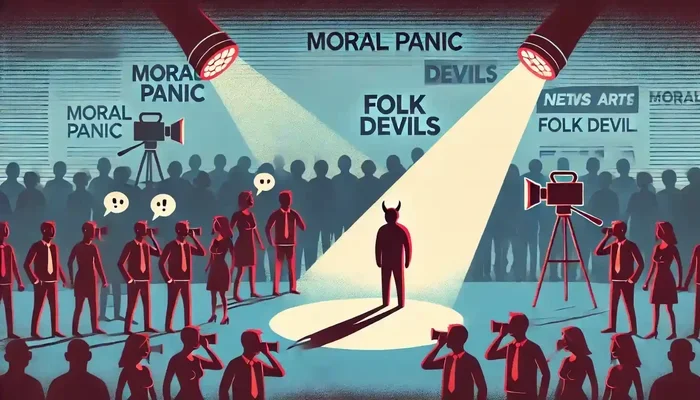
Folk Devils And Moral Panics Cohen 1972 is a groundbreaking sociological theory by Stanley Cohen that explains how society identifies and demonizes certain groups as threats. This moral panic framework reveals how mass media, labeling, and social reaction work together to create fear and reshape public policy. Understanding this theory helps us recognize manipulation and protect ourselves from scapegoating.
Key Takeaways
- Folk Devils Are Created, Not Born: Society labels certain groups as deviant through a social process, not because they are inherently dangerous.
- Media Fuels Moral Panics: Mass media plays a central role in amplifying fear and shaping how the public perceives so-called threats.
- The Theory Explains Real-World Patterns: From Mods and Rockers to modern stereotypes, Cohen’s framework applies to many historical and contemporary events.
- Labeling Has Serious Consequences: Being tagged as a folk devil can ruin lives, trigger discrimination, and harm mental health.
- The Theory Remains Highly Relevant: Modern media and social platforms make moral panics faster and more powerful than ever before.
📑 Table of Contents
- Folk Devils And Moral Panics Cohen 1972: A Complete Guide
- What Is Folk Devils And Moral Panics Cohen 1972 All About?
- How Moral Panics Work In Society
- Key Concepts In Cohen’s Theory
- Real-World Examples Of Moral Panics
- Why Folk Devils And Moral Panics Cohen 1972 Still Matters Today
- Common Misunderstandings About The Theory
- How To Apply Cohen’s Theory In Everyday Life
- Conclusion
Folk Devils And Moral Panics Cohen 1972: A Complete Guide
Have you ever noticed how society suddenly panics over a certain group? One day they are just regular people. The next day, the media paints them as dangerous criminals. Folk Devils And Moral Panics Cohen 1972 explains exactly why this happens. Stanley Cohen published this landmark work in 1972, and it changed how we understand deviance forever.
This theory breaks down how societies create “folk devils” and then flood them with blame. It shows the powerful role of mass media, public fear, and social reaction. Whether you are a student, a curious reader, or someone who questions social narratives, this guide will break it all down for you in plain language.
What Is Folk Devils And Moral Panics Cohen 1972 All About?
The Background Behind The Theory
Stanley Cohen was a British sociologist who studied how society responds to deviance. He noticed a recurring pattern. Society would identify a group, label them as evil, and then treat them as the root of all problems. He called these groups folk devils.
Cohen published his work Folk Devils and Moral Panics in 1972. The book studied youth subcultures in the United Kingdom during the 1960s. He focused heavily on the conflicts between Mods and Rockers in seaside towns. Through careful research, he showed that the public reaction was far bigger than the actual problem. The real issue was not the youth themselves. It was how society chose to respond to them.
Who Are Folk Devils?
A folk devil is a person or group that society blames for social problems. They are not necessarily criminals. In many cases, they are simply young people expressing themselves differently. Society labels them as threats, and suddenly they become the face of moral decay.
Think of it this way. A teenager listening to loud music is just a teenager. But when the media calls them a “danger to society,” something shifts. The public starts fearing them. Politicians start demanding action. The teenager has become a folk devil. This transformation is at the heart of moral panic theory.
Being labeled this way can cause serious harm. If you have ever felt targeted by unfair social judgment, you are not alone. Many people struggle with the emotional toll of being misunderstood. It is worth exploring resources on how societal pressures can affect your mental health and well-being, especially when outside forces paint you in a negative light. Understanding these dynamics is a key step toward staying strong and positive through personal challenges.
How Moral Panics Work In Society
The Role Of Mass Media
Mass media is the engine of every moral panic. Cohen showed that newspapers, television, and radio do not just report on deviance. They actively shape how the public thinks about it. Media outlets choose which stories to highlight and how to present them.
They use dramatic headlines. They show scary images. They interview “experts” who reinforce public fear. This creates a feedback loop. The public feels afraid, demands action, and the media responds with more coverage. It becomes a cycle that feeds on itself. For example, understanding how media can distort perceptions of people is also crucial in recognizing bias, such as how society sometimes confuses attraction with sexual objectification when portraying certain groups.
The Cycle Of A Moral Panic
Cohen identified a clear pattern. Every moral panic follows a cycle. Here are the stages:
- Emergence: A group is identified as different or unusual.
- Amplification: Media picks up the story and blows it out of proportion.
- Peak: Public fear reaches its highest point. Politicians and authorities react.
- Decline: Public interest fades. The group is forgotten or replaced by a new folk devil.
- Institutionalization: The reaction leads to new laws, policies, or social norms.
This cycle repeats over and over. Every generation gets its own folk devils. Today, it might be a music subculture. Tomorrow, it could be a different group entirely. The pattern stays the same.
Key Concepts In Cohen’s Theory
Symbolic Racism And Social Reaction
Cohen introduced the idea of symbolic racism. This concept describes how society uses symbolic threats to justify hostility. It is not always about real danger. It is about what people believe to be dangerous. These beliefs are shaped by culture, media, and social norms.
Social reaction is another important term. Cohen argued that deviance is not a quality of the act a person commits. It is a quality of the response by others. In other words, society decides who is “deviant.” The behavior itself does not automatically make someone a criminal. It is the social reaction that creates that label.
The Sentiment Of The Crowd
Cohen borrowed the phrase “sentiment of the crowd” from classic sociology. He used it to describe the collective emotional response during a moral panic. When panic takes hold, rational thinking disappears. People act on emotion, not evidence.
This is why moral panics often target the wrong people. Fear drives the narrative. Facts take a back seat. The crowd feels a strong need to identify someone to blame. That someone becomes the folk devil. This emotional reaction is powerful. It can lead to discrimination, harassment, and even violence against innocent people. If you have ever experienced the stress of being unfairly judged, you know how overwhelming that can be. Learning healthy coping strategies can help you stay healthy and positive even when facing unfair social pressure.
Real-World Examples Of Moral Panics
Mods And Rockers
Cohen studied the Mods and Rockers conflict in the 1960s. Mods rode scooters and preferred pop music. Rockers rode motorcycles and preferred rock and roll. These were two youth subcultures that occasionally clashed in seaside towns like Brighton.
The actual violence was minor. A few fights, some broken windows. But the media treated it like a war. Newspapers ran alarming front pages. Police increased arrests. The public believed Britain was facing a youth crime crisis. Cohen showed that the reaction was wildly out of proportion to the actual events. The media created the panic. The police reinforced it. And Mods and Rockers became the folk devils of the day.
Modern Day Moral Panics
The pattern Cohen identified still plays out today. Think about the moral panics over video games, social media, and certain music genres. Each time, a group is blamed for social problems. Each time, the media amplifies the fear. Each time, the reaction exceeds the actual threat.
Today, social media speeds up the cycle. A moral panic can now develop in hours instead of weeks. Viral posts spread fear rapidly. Algorithms promote sensational content. The cycle of amplification is faster and more intense than anything Cohen could have imagined.
Why Folk Devils And Moral Panics Cohen 1972 Still Matters Today
Impact On Criminal Justice
Cohen’s theory has had a huge impact on criminal justice. It shows how policy can be driven by fear rather than evidence. When moral panics take hold, governments often pass harsh laws. These laws target the groups being demonized at that moment.
But these policies rarely solve the underlying problems. They just punish the folk devils. Understanding this helps us think critically about criminal justice reform. We need to ask: Is this policy based on evidence? Or is it a reaction to media-fueled fear?
Influence On Media Studies
Media studies owes a lot to Cohen’s work. His theory gave researchers a framework for analyzing how media shapes public perception. Today, media scholars use his ideas to study everything from news coverage to entertainment. They examine how stories get framed. They study how stereotypes get reinforced. They explore how representation affects real-world attitudes.
Common Misunderstandings About The Theory
Criticisms Of Cohen’s Work
No theory is perfect. Cohen’s work has faced criticism over the years. Some critics say he focused too much on media and not enough on real crime. Others argue that he romanticized the folk devils. They say he ignored the actual harm that some groups might cause.
These are fair points. But Cohen never claimed that all deviance is harmless. He simply showed that society’s reaction is often bigger than the problem. He wanted people to think more carefully about how they respond to difference. His goal was not to excuse deviance. It was to promote a more rational and fair response to it.
What Critics Get Wrong
Many critics misunderstand the core message. They think Cohen is saying deviance does not exist. That is not true. He is saying that deviance is socially constructed. Some behaviors are labeled as deviant. Others are not. It depends on who is doing the labeling.
This is a subtle but important distinction. Cohen was not denying reality. He was showing how society interprets reality. This insight remains powerful. It encourages us to question narratives. It pushes us to look beyond surface-level judgments.
How To Apply Cohen’s Theory In Everyday Life
Thinking Critically About News
One practical application is critical media consumption. When you see a scary headline, pause. Ask yourself: Is this story amplifying fear? Who benefits from this panic? What is being left out?
These questions help you see through the cycle of moral panic. You become a more informed reader. You stop being a passive consumer of fear. Instead, you become an active thinker who questions narratives.
Recognizing Labeling In Your Own Life
Labeling happens everywhere. Not just in the news. It happens in schools, workplaces, and social groups. People get labeled as “troublemakers,” “lazy,” or “difficult.” These labels shape how others treat them. They can also shape how people treat themselves.
Recognizing this pattern is the first step. Once you see it, you can push back. You can choose not to participate in labeling. You can treat people as individuals, not as categories. This shift makes a real difference in how communities function.
Conclusion
Folk Devils And Moral Panics Cohen 1972 remains one of the most important works in sociology. Stanley Cohen showed us how society creates fear, assigns blame, and responds to difference. His theory explains the role of media, the power of labeling, and the cycle of moral panic. It applies to past events and present ones. It helps us understand criminal justice, media studies, and everyday social dynamics.
The key takeaway is simple. Deviance is not fixed. It is created by social reaction. When we understand this, we can think more critically. We can resist fear-driven narratives. We can treat people fairly. That is the lasting power of Cohen’s work. It challenges us to be better thinkers and more compassionate humans.
The next time you see a moral panic in the news, remember what Cohen taught us. Ask questions. Look deeper. The folk devil is not always the real story. The real story is how society chooses to respond.
Frequently Asked Questions
What does Folk Devils And Moral Panics Cohen 1972 mean?
It refers to Stanley Cohen’s 1972 book that explains how society identifies groups as “folk devils” and creates moral panics around them. The theory shows how media, public fear, and social reaction work together to demonize certain groups beyond what is actually warranted.
Who is Stanley Cohen?
Stanley Cohen was a British sociologist who became famous for his research on deviance and social reactions. He published “Folk Devils and Moral Panics” in 1972 and later developed the concept of “moral panic” in 1973. His work remains foundational in sociology and criminology.
What is a moral panic example today?
Modern examples include moral panics over social media addiction, video game violence, and certain music genres. In each case, media amplifies fear about a specific group or behavior, and public reaction often exceeds the actual evidence of harm. The cycle of amplification and blame follows Cohen’s original pattern.
How does media create moral panics?Media creates moral panics by choosing dramatic headlines, showing alarming images, and interviewing experts who reinforce public fear. This coverage amplifies concern beyond the actual level of threat. The public then demands action, which leads to more coverage. It becomes a self-reinforcing cycle of fear.
What is the difference between deviance and a moral panic?
Deviance is any behavior that breaks social norms. A moral panic is the exaggerated public reaction to perceived deviance. Not all deviance leads to a moral panic. A moral panic happens when media and society amplify fear to an extreme level, often targeting specific groups as folk devils.
Why is Cohen’s theory still relevant?
Cohen’s theory is still relevant because moral panics continue to happen. Social media has only made them faster and more intense. His framework helps us understand how fear is manufactured, how labeling works, and why society sometimes overreacts to difference. It encourages critical thinking about media and public narratives.
