
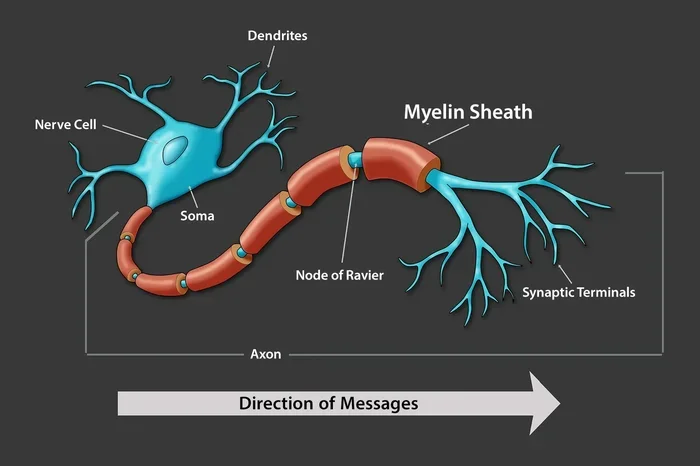
Have you ever wondered what is myelin sheath made from? This incredible protective coating is primarily built from lipids (fats) and proteins, forming a fatty insulation around your nerves. Understanding the myelin sheath composition reveals how your brain sends lightning-fast signals every single day.
If you have ever marveled at how quickly you can move your hand away from a hot stove, you have your nervous system to thank. But even more specifically, you have your myelin sheath to thank. This vital structure wraps around your nerve fibers like the rubber coating around an electrical wire. But have you ever stopped to wonder exactly what is myelin sheath made from?
Understanding the myelin sheath composition is fascinating. It is not just a simple blob of fat. Instead, it is a highly organized, complex biological structure made of specific lipids, proteins, and cholesterol. This precise makeup allows it to protect your nerves and ensure your brain communicates with the rest of your body at lightning speed.
In this comprehensive guide, we will break down the exact building blocks of the myelin sheath. We will explore the cellular builders, the crucial role of fats and proteins, and why this composition is so vital for your overall health. Let’s dive into the microscopic world of your nervous system.
Key Takeaways
- Fatty Foundation: The myelin sheath is roughly 60-75% lipids (fats), making it one of the fattiest structures in the human body.
- Protein Support: About 25-40% of the sheath is made of structural proteins that hold the fatty layers tightly together.
- Cellular Builders: Specialized glial cells, called oligodendrocytes and Schwann cells, are responsible for producing and maintaining the myelin sheath.
- Cholesterol is Crucial: Unlike the negative reputation cholesterol has, it is an absolutely vital building block for the myelin sheath structure.
- Electrical Insulation: The high fat content acts as a powerful electrical insulator, allowing nerve impulses to travel at incredible speeds.
- Vulnerable to Damage: When the myelin sheath breaks down, it leads to serious neurological conditions like multiple sclerosis (MS).
- Repairable: The body can repair myelin through a process called remyelination, especially with proper nutrition and lifestyle support.
📑 Table of Contents
- The Basic Composition: What Is Myelin Sheath Made From?
- The Cellular Builders: Who Creates the Myelin Sheath?
- Lipids: The Fatty Foundation of the Myelin Sheath
- Proteins: The Structural Support System
- The Crucial Role of Cholesterol in Myelin
- The Architecture of Nerve Transmission: Nodes of Ranvier
- Why the Myelin Sheath Composition Matters for Your Health
- What Happens When Myelin Breaks Down?
- How to Support Your Myelin Sheath Naturally
The Basic Composition: What Is Myelin Sheath Made From?
When scientists first isolated the myelin sheath, they were surprised by its makeup. Unlike most cells in the body, which are primarily made of protein, the myelin sheath is overwhelmingly made of lipids. In fact, about 60% to 75% of the sheath is composed of fats. The remaining 25% to 40% consists of proteins.
This high lipid content is the secret to its function. Lipids are hydrophobic, meaning they repel water. Because nerve impulses are essentially electrical signals, you need a material that will not conduct electricity to insulate them. Water and salts conduct electricity very well, which is exactly why the myelin sheath is made of fat. It blocks the electrical current from leaking out of the nerve cell, forcing it to travel efficiently down the axon.
The Unique Ratio of Fats to Proteins
The ratio of lipids to proteins in the myelin sheath is unique compared to other cell membranes in the body. Most cell membranes have a roughly 50:50 ratio of lipids to proteins. However, the myelin sheath flips this ratio on its head.
This skewed ratio is what makes the sheath such an excellent insulator. The proteins present are not there to build structures like they are in other cells. Instead, their primary job is to hold the massive amounts of fat together in tight, neat layers. Without these specific proteins, the fatty layers would fall apart, and the insulation would fail.
The Cellular Builders: Who Creates the Myelin Sheath?
Visual guide about myelin sheath neuron
Image source: c8.alamy.com
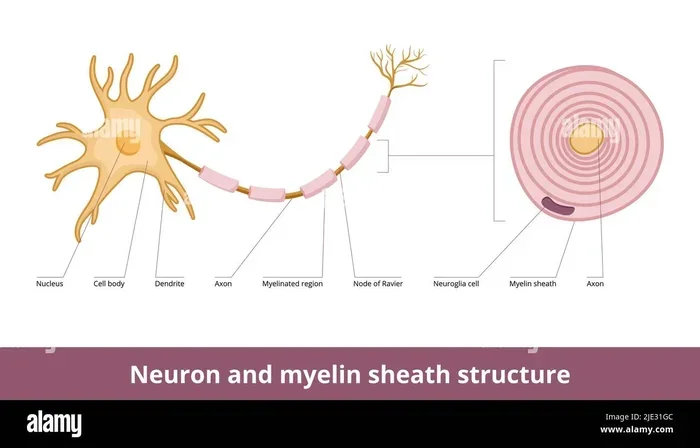
Now that we know the basic chemical makeup, we need to look at the factory workers. The myelin sheath is not just a blob that appears out of nowhere. It is meticulously created by specialized cells called glial cells. Depending on where you are in the body, different glial cells take on the job.
Oligodendrocytes: The Central Nervous System Builders
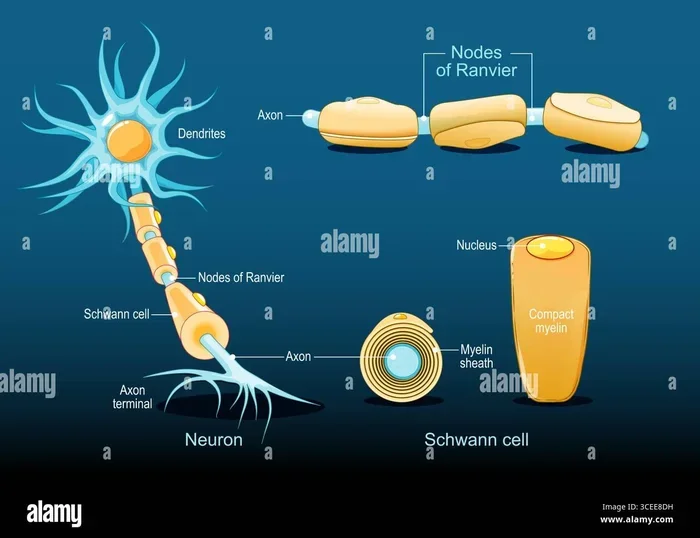
In your brain and spinal cord, the myelin sheath is produced by cells called oligodendrocytes. These incredible cells have long arms, or processes, that reach out and wrap around the axons of neurons. One single oligodendrocyte can extend its processes to up to 50 different nerve fibers, insulating them all at once.
When an oligodendrocyte wraps its arm around an axon, it squeezes its own cytoplasm out of the way, leaving behind layer upon layer of its cell membrane. Because cell membranes are made of lipids, this wrapping process creates the fatty myelin sheath.
Schwann Cells: The Peripheral Nervous System Builders
Outside of the brain and spinal cord, in the peripheral nervous system, Schwann cells take over the job. Unlike oligodendrocytes, which can insulate multiple nerve fibers, a Schwann cell insulates only one single axon.
Schwann cells also play a massive role in nerve repair. If a nerve fiber is cut in your finger, the Schwann cells survive and form a guiding tube. This tube helps the nerve grow back correctly. Once the nerve reaches its destination, the Schwann cells wrap around it again to rebuild the myelin sheath.
Lipids: The Fatty Foundation of the Myelin Sheath
Visual guide about myelin sheath neuron
Image source: c8.alamy.com
Since lipids make up the vast majority of the myelin sheath structure, it is worth taking a closer look at exactly which fats are involved. The lipids in the myelin sheath are not random. They are highly specialized to create a dense, stable, and impermeable barrier.
Phospholipids: The Building Blocks
Phospholipids are the primary structural lipids found in all cell membranes, including the myelin sheath. They have a unique shape: a water-loving head and two fat-loving tails. When placed in water, they automatically arrange themselves into a double-layered sheet, with the heads facing the water and the tails hiding inside.
This double-layered arrangement is the fundamental architecture of the myelin sheath. However, phospholipids alone are too fluid. The myelin sheath needs to be incredibly dense and stable to do its job. That is where the other lipids come in.
Glycolipids: The Signature Fat of the Brain
If phospholipids are the bricks, glycolipids are the mortar. Glycolipids are a type of fat with a sugar molecule attached to them. The most famous glycolipid in the myelin sheath is called cerebroside.
Cerebroside makes up a huge portion of the myelin lipids. The sugar molecules on the outside of the cerebroside act like Velcro. They bind tightly to the sugar molecules on the cerebroside of the opposing membrane layer. This strong bonding is what holds the many layers of the myelin sheath tightly together, preventing them from sliding apart.
The Lipid Comparison Table
| Lipid Type | Role in Myelin Sheath |
|---|---|
| Phospholipids | Provides the basic double-layered membrane structure. |
| Cerebrosides (Glycolipids) | Acts as biological Velcro, holding membrane layers together. |
| Sphingomyelin | Adds structural rigidity and stability to the sheath. |
| Cholesterol | Fills gaps between lipids, making the membrane impermeable. |
Proteins: The Structural Support System
Visual guide about myelin sheath neuron
Image source: thumbs.dreamstime.com
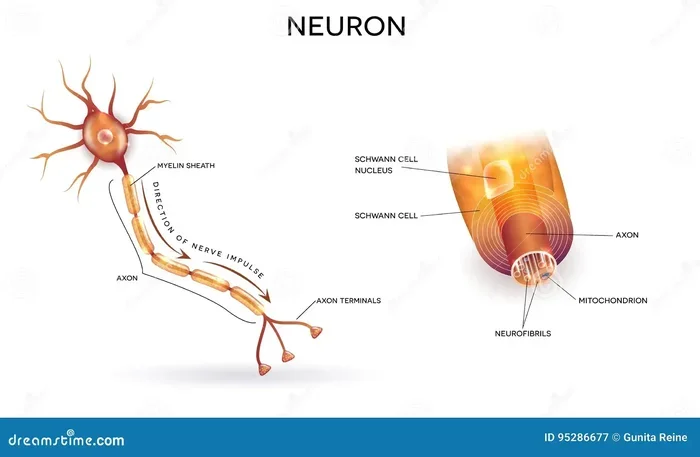
While lipids provide the insulation, proteins provide the structure. The proteins found in the myelin sheath are highly specialized. They exist solely to hold the fatty layers in place and maintain the integrity of the sheath.
Myelin Basic Protein (MBP)
Myelin Basic Protein is the second most abundant protein in the central nervous system myelin. MBP sits on the inside of the cell membrane layers. Its job is to act like a staple, fusing the two opposing layers of the membrane together.
Without MBP, the layers of the myelin sheath would separate, creating gaps in the insulation. This leads to severe neurological problems. MBP is so important that scientists study it extensively to understand diseases like multiple sclerosis.
Proteolipid Protein (PLP)
Proteolipid Protein is the most abundant protein in the central nervous system myelin. PLP spans across the entire membrane of the myelin sheath. It acts as a structural scaffold, ensuring the layers are packed incredibly tightly together.
Because PLP spans the membrane, it also helps transport molecules in and out of the myelin sheath, keeping the structure healthy and functional. Mutations in the gene that creates PLP can lead to severe developmental disorders, proving just how critical this protein is.
Peripheral Myelin Protein 22 (PMP22)
While PLP and MBP are the stars of the central nervous system, PMP22 is the key protein in the peripheral nervous system. It is produced by the Schwann cells and helps regulate the growth and structure of the myelin sheath in your extremities.
If there is a genetic error that causes too much PMP22 to be produced, the myelin sheath becomes too thick and unstable. Conversely, too little PMP22 causes the sheath to fall apart. Both scenarios lead to peripheral neuropathies, which cause weakness and numbness in the hands and feet.
The Crucial Role of Cholesterol in Myelin
When most people hear the word cholesterol, they think of heart disease. However, cholesterol is an absolutely essential building block of the human body, especially the brain. The brain holds about 25% of the body’s total cholesterol, and a massive amount of it is used to build the myelin sheath composition.
Why Cholesterol is Essential
Cholesterol is a waxy, fat-like substance that is rigid and sturdy. In the myelin sheath, cholesterol inserts itself between the phospholipid molecules. Because phospholipids are naturally fluid and flexible, they need something to stabilize them.
Cholesterol fills the gaps between the phospholipid tails, making the membrane much denser and less permeable. Without cholesterol, the myelin sheath would be too leaky, and electrical signals would escape before reaching their destination.
The Brain’s Private Cholesterol Factory
Here is a fascinating fact: the cholesterol in your brain does not come from your diet. The blood-brain barrier prevents cholesterol in your bloodstream from entering the brain. Therefore, the brain has to manufacture all of its own cholesterol locally.
Oligodendrocytes are cholesterol-producing machines. They synthesize cholesterol constantly to maintain and repair the myelin sheath. If the brain cannot produce enough cholesterol, the myelin sheath begins to degrade, leading to cognitive decline and motor issues.
The Architecture of Nerve Transmission: Nodes of Ranvier
To truly appreciate what is myelin sheath made from, you have to understand how its structure facilitates nerve transmission. The myelin sheath does not wrap around the axon as one continuous tube. Instead, it is segmented.
Between each segment of myelin, there is a tiny gap. These gaps are called the Nodes of Ranvier. The myelin sheath acts as an insulator, while the nodes act as amplification stations.
When a nerve signal travels down an axon, it cannot pass through the insulated myelin. Instead, the electrical signal jumps from one Node of Ranvier to the next. This jumping mechanism is called saltatory conduction. Because the signal is jumping rather than traveling continuously down the entire length of the axon, it moves incredibly fast.
This jumping mechanism saves an incredible amount of energy. To learn more about how energy levels impact your overall well-being, read about what does energy have to do with mental health. The brain is an energy-hungry organ, and the myelin sheath is one of its best tools for conserving power.
Why the Myelin Sheath Composition Matters for Your Health
The specific makeup of the myelin sheath is not just a biological trivia fact. It is central to your overall health. Because the sheath is made of delicate fats and specialized proteins, it is vulnerable to damage from various sources.
Autoimmune Attacks on Myelin
In diseases like Multiple Sclerosis (MS), the immune system mistakenly attacks the myelin sheath. Because the sheath is made of specific proteins like MBP and PLP, the immune system targets these proteins. When the immune system destroys the myelin, the electrical signals in the brain slow down or stop completely. This leads to symptoms like muscle weakness, fatigue, and coordination problems.
The Impact of Stress and Anxiety on the Nervous System
When the nervous system is compromised due to myelin damage, the resulting neurological issues can create immense stress. Chronic illness and the unpredictability of symptoms can take a heavy toll on a person’s mental health. This stress can ripple out into personal relationships, much like why being married to someone with anxiety is exhausting, as loved ones try to navigate the emotional and physical challenges of a neurological condition.
Myelin and Memory Formation
Every time you learn something new, your brain builds more myelin. The process of learning a new skill, like playing an instrument or riding a bike, involves the oligodendrocytes wrapping more layers of myelin around the specific neural pathways you are using. This thickens the insulation, making the signal faster and stronger. This is known as muscle memory. To understand how this affects your daily recall, check out this guide on how an explicit memory is different from an implicit memory.
What Happens When Myelin Breaks Down?
Demyelination is the term used when the myelin sheath is damaged or destroyed. Because the sheath is made of specific fats and proteins, anything that disrupts lipid metabolism or triggers an autoimmune response against those proteins can cause demyelination.
Common Symptoms of Demyelination
When the insulation around your nerves fails, the electrical signals short-circuit. This leads to a wide variety of symptoms, including:
- Numbness or tingling in the extremities
- Muscle weakness and spasms
- Blurred or double vision
- Difficulty with coordination and balance
- Cognitive fog and memory issues
- Chronic fatigue
Sleep and Dreams
Because myelin impacts how brain signals travel, it also influences your sleep cycles. The brain’s physical wiring, including the myelin sheath, plays a role in memory consolidation during sleep. If you are curious about your night-time thoughts, you might wonder what does it mean when you dream about someone. The health of your neural pathways directly impacts how your brain processes emotions and memories while you rest.
How to Support Your Myelin Sheath Naturally
Now that you understand what is myelin sheath made from, you can take steps to protect it. Because the sheath is primarily made of fats and cholesterol, your diet plays a massive role in its maintenance and repair.
Eat Healthy Fats
Since 70% of your myelin sheath is made of fat, you need to eat plenty of healthy fats to provide your body with the raw materials it needs. Focus on foods rich in Omega-3 fatty acids, such as salmon, walnuts, and flaxseeds. These fats are highly anti-inflammatory and help protect the myelin from damage.
Get Enough B Vitamins
Vitamin B12 is absolutely essential for the maintenance of the myelin sheath. A deficiency in B12 can lead to demyelination, causing symptoms similar to multiple sclerosis. You can find B12 in animal products like meat, eggs, and dairy. Folate (Vitamin B9) is also crucial for repairing the DNA in the cells that produce myelin.
Cholesterol is Your Friend
Do not fear dietary cholesterol. Your brain needs it to produce and repair myelin. Eggs, grass-fed butter, and olive oil are excellent sources of healthy cholesterol that support brain function.
Quick Tips for Myelin Health
- Exercise Regularly: Exercise stimulates the production of proteins that support myelin growth.
- Limit Sugar: High blood sugar can cause inflammation that damages the delicate myelin sheath.
- Stay Hydrated: Water is essential for the chemical reactions that build and maintain myelin.
- Manage Stress: Chronic stress releases cortisol, which can damage the brain’s glial cells over time.
Common Mistakes to Avoid
- Avoiding all fats: Low-fat diets starve the brain of the lipids it needs to maintain the myelin sheath.
- Ignoring B12: Vegetarians and vegans must supplement B12, as a deficiency can permanently damage myelin.
- Over-exercising: While moderate exercise is good, extreme overtraining can increase oxidative stress and damage myelin.
Expert Insights
Neurologists emphasize that the myelin sheath is a dynamic structure. It is not just built during childhood and then left alone. Throughout your life, your oligodendrocytes are constantly surveying the nerves, repairing small tears, and adjusting the thickness of the sheath based on how often you use certain neural pathways. This means that every day, you have the power to either support or damage your myelin through your lifestyle choices.
Frequently Asked Questions
What percentage of the myelin sheath is fat?
The myelin sheath is roughly 60% to 75% fat (lipids). This incredibly high fat content makes it one of the fattiest structures in the human body, which is exactly what allows it to act as an electrical insulator for your nerve cells.
Can the myelin sheath be repaired?
Yes, the body can repair the myelin sheath through a process called remyelination. Specialized cells in the brain can wrap new layers of myelin around damaged nerves, although this new sheath is often thinner and less effective than the original.
What vitamins support myelin sheath health?
Vitamin B12 is the most critical vitamin for myelin health, as it is essential for the maintenance of the fatty sheath. Additionally, Vitamin D, Omega-3 fatty acids, and folate (Vitamin B9) play significant roles in supporting the cells that produce myelin.
What diseases destroy the myelin sheath?
Multiple Sclerosis (MS) is the most well-known disease that destroys the myelin sheath in the central nervous system. In the peripheral nervous system, Guillain-Barré syndrome and Charcot-Marie-Tooth disease are examples of conditions that damage the myelin.
How do Schwann cells differ from oligodendrocytes?
Schwann cells produce myelin in the peripheral nervous system (nerves outside the brain and spinal cord), while oligodendrocytes produce myelin in the central nervous system. Additionally, one oligodendrocyte can insulate up to 50 nerve fibers, whereas one Schwann cell insulates only one.
Why is the myelin sheath important for nerve impulses?
The myelin sheath acts as an electrical insulator. It prevents the electrical signal from leaking out of the nerve cell, forcing the signal to jump quickly between the Nodes of Ranvier. This process, called saltatory conduction, allows nerve signals to travel at speeds up to 100 meters per second.
=== META DESCRIPTION ===
Discover what is myelin sheath made from. Learn about the key lipids, proteins, and cells that make up this vital nerve covering and why it matters.
