
Creating lasting habits doesn’t require superhuman willpower — it requires the right system. This guide breaks down the science of habit formation into simple, actionable steps you can start today. You’ll discover why most people fail at building habits and exactly how to design routines that stick for good.
Have you ever set a goal with burning excitement, only to find yourself back at square one two weeks later? You’re not alone. Most people struggle to create habits that last because they rely on motivation instead of systems. The truth is, willpower is like a battery — it drains throughout the day. But a well-designed habit runs on autopilot.
Here’s the good news: scientists have spent decades studying how habits form. And the research shows that anyone can build lasting routines using specific, proven strategies. Whether you want to exercise daily, read more, eat healthier, or improve your relationships, the process is the same.
In this guide, you’ll learn exactly how to create a habit that sticks. No fluff. No empty motivation. Just science-backed techniques that actually work. By the end, you’ll have a clear blueprint for building any habit you want — and keeping it for life.
Key Takeaways
- Start incredibly small: The most effective habits begin with actions so tiny you can’t say no. A two-minute version of any habit builds momentum.
- Use habit stacking: Attach new behaviors to existing routines. This creates natural triggers that make habits automatic.
- Focus on identity, not outcomes: Lasting habits form when you change who you believe you are, not just what you want to achieve.
- Design your environment: Make good habits obvious and bad habits invisible. Your surroundings shape your behavior more than motivation does.
- Never miss twice: Missing one day is fine. Missing two days starts a new pattern. Get back on track immediately.
- Track your progress: What gets measured gets managed. Visual tracking creates accountability and motivation.
- Reward yourself immediately: The brain needs instant gratification to wire a habit. Celebrate small wins to reinforce the behavior.
📑 Table of Contents
- Understanding How Habits Actually Work
- Start Ridiculously Small: The Two-Minute Rule
- Use Habit Stacking to Build Automatic Routines
- Design Your Environment for Success
- Focus on Identity, Not Just Outcomes
- Track Your Progress and Celebrate Small Wins
- Overcome Setbacks: The Never Miss Twice Rule
- Advanced Strategies for Long-Term Habit Success
- Common Mistakes That Kill New Habits
- How Long Does It Really Take to Form a Habit?
- Putting It All Together: Your Habit Creation Blueprint
Understanding How Habits Actually Work
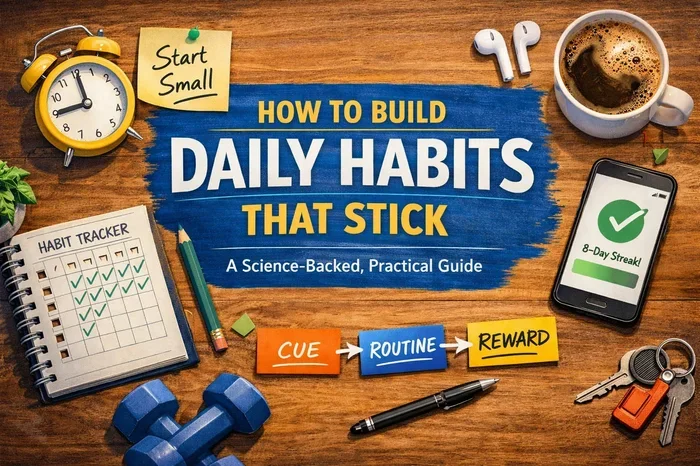
Before you can build a habit, you need to understand what’s happening inside your brain. Every habit follows a simple four-step loop: cue, craving, response, and reward. This cycle repeats thousands of times per day, often without you realizing it.
The cue is the trigger that starts the behavior. It could be a time of day, a location, an emotion, or the people around you. The craving is the motivational force — your brain’s desire for the reward. The response is the actual behavior or action. And the reward is the satisfaction your brain gets from completing the behavior.
Dr. Judson Brewer, a neuroscientist at Brown University, explains that habits become automatic when the brain stops fully participating in the decision-making process. The basal ganglia, a primitive part of your brain, takes over and runs the show. That’s why you can drive home without remembering the route or bite your nails while watching TV.
The Habit Loop in Real Life
Let’s look at a common example. You feel stressed at work (cue). You crave relief (craving). You scroll through social media (response). You feel temporarily distracted (reward). Over time, your brain wires stress directly to phone-scrolling. The habit becomes automatic.
The key insight? You can’t easily delete old habits. But you can rewire them. By understanding the loop, you can insert new behaviors into existing triggers. This is the foundation of lasting change.
Start Ridiculously Small: The Two-Minute Rule
Visual guide about building daily habits
Image source: blogger.googleusercontent.com
The number one mistake people make is starting too big. They commit to an hour at the gym, thirty minutes of meditation, or reading fifty pages a day. It feels great for a few days. Then life happens, and the habit dies.
BJ Fogg, a behavior scientist at Stanford University, discovered that tiny habits are the secret to big changes. His research shows that motivation follows action, not the other way around. You don’t need to feel ready. You just need to start small enough that resistance disappears.
How to Apply the Two-Minute Rule
The concept is simple: scale any habit down to a version that takes two minutes or less. Here’s how it looks in practice:
- Want to read more? Start with reading one page per night.
- Want to meditate daily? Start by sitting quietly for sixty seconds.
- Want to exercise regularly? Start by putting on your workout clothes.
- Want to eat healthier? Start by adding one vegetable to one meal.
- Want to journal? Start by writing one sentence.
These sound almost laughably easy. That’s the point. The goal isn’t the action itself — it’s showing up consistently. Once the behavior becomes automatic, you can expand it naturally. Resetting your life often starts with these tiny, consistent actions that compound over time.
Why Small Wins Create Big Results
Small wins do something powerful to your brain. They release dopamine, the feel-good neurotransmitter that reinforces behavior. Each tiny success tells your brain, “This feels good. Let’s do it again.” Over weeks and months, these micro-moments build into unstoppable momentum.
Think of it like pushing a boulder. The hardest part is getting it moving. Once it’s rolling, it takes far less energy to keep it going. Your first two minutes are the push that gets the boulder moving.
Use Habit Stacking to Build Automatic Routines
Visual guide about building daily habits
Image source: ascendproject.org
One of the most effective strategies for creating lasting habits is called habit stacking. The concept comes from BJ Fogg’s research and James Clear’s bestselling book “Atomic Habits.” It works by linking a new behavior to something you already do automatically.
The formula is simple: “After I [current habit], I will [new habit].” This creates a natural trigger that your brain can latch onto. Instead of relying on willpower or reminders, you use existing neural pathways to build new ones.
Examples of Effective Habit Stacks
- “After I pour my morning coffee, I will write one thing I’m grateful for.”
- “After I brush my teeth at night, I will floss one tooth.”
- “After I close my laptop for the day, I will lay out my workout clothes for tomorrow.”
- “After I sit down for lunch, I will take three deep breaths.”
- “After I get into bed, I will read one page of my book.”
The magic here is specificity. Vague intentions like “I’ll exercise more” fail because there’s no clear trigger. But “After I take off my work shoes, I will put on my running shoes” gives your brain an exact cue to act.
Finding Your Existing Anchors
To make habit stacking work, first identify the routines you already do without thinking. Make a list of everything you do automatically each day: showering, making coffee, eating meals, checking your phone, sitting at your desk, watching TV. These are your anchors. Then choose the best anchor for your new habit.
Design Your Environment for Success

Visual guide about building daily habits
Image source: mrblogger.blog
Here’s a truth that changes everything: your environment shapes your behavior far more than your motivation does. You can willpower your way through a bad environment for a while. But eventually, your surroundings will win.
This is why designing your space matters so much. When you make good habits obvious and easy, and bad habits invisible and hard, you remove the need for constant self-control.
Make Good Habits Obvious
- Want to drink more water? Place a full water bottle on your desk where you can see it.
- Want to practice guitar? Keep it on a stand in the middle of your living room, not hidden in a closet.
- Want to take vitamins? Put them next to your coffee maker so you see them every morning.
- Want to read before bed? Place a book on your pillow after you make the bed.
Every choice you make has a cue. When you design your environment so that the cues for good habits are everywhere, you naturally gravitate toward better behaviors without thinking about it.
Make Bad Habits Invisible
Just as important is hiding the cues for habits you want to break. If you want to stop checking your phone constantly, put it in another room. If you want to stop eating junk food, don’t keep it in the house. If you want to stop watching TV before bed, unplug it and hide the remote.
This isn’t about being perfect. It’s about reducing friction for good habits and increasing friction for bad ones. Even small changes to your environment can produce dramatic results over time. Much like restarting your life after a breakdown, redesigning your environment creates the foundation for lasting transformation.
Focus on Identity, Not Just Outcomes
Most people set goals based on outcomes. “I want to lose twenty pounds.” “I want to save five thousand dollars.” “I want to run a marathon.” These goals focus on what you want to achieve. But research shows that lasting change comes from a different place: your identity.
James Clear explains it perfectly: “True behavior change is identity change.” Every action you take is a vote for the type of person you believe you are. When you see yourself as “someone who exercises,” working out becomes natural. When you see yourself as “a reader,” picking up a book feels normal.
How to Build Identity-Based Habits
Start by deciding who you want to become. Then prove it to yourself with small wins. Here’s the process:
- Step 1: Decide the type of person you want to be. “I am someone who takes care of my body.”
- Step 2: Prove it with small actions. “Today I will walk for ten minutes.”
- Step 3: Each action is a cast vote for that identity. Over time, the evidence builds.
- Step 4: Your identity strengthens, and bigger actions feel natural.
This shifts your mindset from “I’m trying to exercise” to “I’m the kind of person who exercises.” The difference is subtle but powerful. One feels like a chore. The other feels like who you are.
The Power of “I Am” Statements
Your brain believes what you tell it repeatedly. Use this to your advantage by framing your habits around identity. Instead of saying “I’m trying to quit smoking,” say “I’m not a smoker.” Instead of “I want to write more,” say “I’m a writer.” These statements rewire how you see yourself, and your behavior follows.
Track Your Progress and Celebrate Small Wins
What gets measured gets managed. This old business saying applies perfectly to habit formation. When you track your progress, you create visual proof that you’re moving forward. And that proof fuels motivation.
Simple Tracking Methods That Work
- The Paper Calendar Method: Put a big calendar on your wall. Every day you complete your habit, draw a big red X. Your only job is to not break the chain.
- Habit Tracking Apps: Apps like Streaks, Habitica, or Loop let you log habits digitally and see your streaks grow.
- The Seinfeld Strategy: Comedian Jerry Seinfeld reportedly used this method. He wrote jokes every day and marked a calendar. The goal was simple: don’t break the chain.
- The Jar Method: Move a marble or paperclip from one jar to another each day you complete your habit. Watching the second jar fill up is deeply satisfying.
Why Immediate Rewards Matter
Here’s something most people miss: the brain values immediate rewards more than delayed ones. Saving money feels abstract. Buying something now feels real. This is why habits need instant gratification to stick.
After completing your tiny habit, celebrate immediately. Do a little fist pump. Say “I did it!” Give yourself a mental high-five. This might feel silly, but it works. The positive emotion wires the habit into your brain faster.
Charles Duhigg, author of “The Power of Habit,” explains that a cue triggers a routine, and a reward solidifies the loop. Without the reward, the loop never fully forms. So make sure every habit has a built-in payoff.
Overcome Setbacks: The Never Miss Twice Rule
Let’s be real: you will miss days. Life gets busy. You get sick. You travel. Motivation dips. This is normal and expected. The key isn’t being perfect — it’s bouncing back quickly.
The “never miss twice” rule is your safety net. Missing one day is an accident. Missing two days is the start of a new pattern. One missed workout doesn’t ruin your fitness routine. But two missed workouts in a row can spiral into weeks of inactivity.
How to Recover When You Slip
- Acknowledge it without judgment. Don’t beat yourself up. Guilt and shame kill motivation.
- Return to your tiny version. Can’t do your full habit? Do the two-minute version. Something is always better than nothing.
- Identify what went wrong. Was your trigger missing? Did you try to do too much? Adjust your system.
- Restart immediately. The next day, do your habit. Don’t wait until Monday or the first of the month.
Think of it like a plane flying from New York to Los Angeles. The plane is off course about 90% of the time. But it constantly makes small corrections and arrives at its destination. Your habits work the same way. Constant small corrections beat occasional perfection.
Building Resilience Through Flexibility
Rigid plans break. Flexible systems survive. Give yourself permission to adapt your habits to different circumstances. Traveling? Do a hotel room workout. Too tired for a full workout? Do five minutes of stretching. Sick? Focus on drinking water and resting.
The habit isn’t the specific action — it’s the act of showing up. When you maintain consistency even in imperfect ways, you prove to yourself that you’re committed. This builds the kind of resilience that walking away from what isn’t working requires — knowing when to adjust and when to persist.
Advanced Strategies for Long-Term Habit Success
Once you’ve mastered the basics, these advanced techniques can take your habits to the next level.
Implementation Intentions
Research by psychologist Peter Gollwitzer shows that people who specify when and where they’re going to perform a habit are significantly more likely to follow through. The formula: “I will [BEHAVIOR] at [TIME] in [LOCATION].”
Instead of “I’ll exercise more,” try “I will do ten push-ups at 7 AM in my living room.” The specificity removes decision-making from the equation. You don’t have to think about when or where. You just execute.
Temptation Bundling
This strategy pairs something you want to do with something you need to do. Only allow yourself to enjoy your favorite podcast while exercising. Only watch your favorite show while folding laundry. Only get that special coffee after completing your morning routine.
By linking a temptation to a habit, you make the habit more appealing. Over time, you start craving the habit because it’s associated with something you enjoy.
Social Accountability
Humans are social creatures. We care what others think. Use this to your advantage by making your habits public. Tell a friend about your goal. Join a group of people with similar habits. Find an accountability partner who checks in on your progress.
Research shows that people who have an accountability partner are significantly more likely to stick with their goals. The fear of letting someone else down is a powerful motivator.
Common Mistakes That Kill New Habits
Even with the best strategies, certain mistakes can derail your progress. Here’s what to watch out for:
- Trying to change too many things at once. Focus on one habit at a time. Master it before adding another.
- Relying on motivation instead of systems. Motivation is unreliable. Build systems that work even when you don’t feel like it.
- Setting outcome-based goals instead of process-based habits. “Lose weight” is a goal. “Walk twenty minutes daily” is a habit. Focus on the process.
- Not having a clear trigger. Vague intentions fail. Specific cues succeed.
- Being too hard on yourself after a slip. Perfection isn’t the goal. Consistency is.
- Expecting results too quickly. Habits take time to form. Research suggests an average of 66 days, not 21.
How Long Does It Really Take to Form a Habit?
You’ve probably heard that it takes 21 days to form a habit. This myth comes from a 1960s book by Dr. Maxwell Maltz and has been repeated so often that most people believe it. But the actual research tells a different story.
A 2009 study by Phillippa Lally at University College London found that it takes an average of 66 days for a behavior to become automatic. But the range was huge — anywhere from 18 days to 254 days depending on the person, the habit, and the circumstances.
The takeaway? Don’t get discouraged if your habit doesn’t feel automatic after a few weeks. Keep showing up. The timeline varies for everyone. What matters is consistency, not speed.
Putting It All Together: Your Habit Creation Blueprint
Let’s bring everything together into a simple, actionable plan you can use for any habit.
- Choose one habit. Just one. Pick the one that will have the biggest positive impact on your life.
- Make it tiny. Scale it down to a two-minute version. Something so easy you can’t say no.
- Find a trigger. Use habit stacking. “After I [existing routine], I will [new tiny habit].”
- Design your environment. Make the cue visible. Remove obstacles. Set up your space for success.
- Define your identity. Decide who you’re becoming. “I am someone who [new behavior].”
- Track your progress. Use a calendar, app, or journal. Visual proof fuels motivation.
- Celebrate immediately. Give yourself a small reward right after completing the habit.
- Never miss twice. If you slip, get back on track the very next day.
Follow this blueprint, and you’ll be amazed at what you can accomplish. The secret isn’t willpower or discipline. It’s having a system that makes good habits inevitable and bad habits difficult.
Frequently Asked Questions
How long does it take to create a habit?
Research from University College London shows it takes an average of 66 days for a behavior to become automatic, but the range varies widely from 18 to 254 days. The key is consistency, not speed. Focus on showing up daily rather than worrying about the timeline.
Why do most habits fail?
Most habits fail because people start too big, rely on motivation instead of systems, and don’t have clear triggers. Willpower is limited, so habits need to be small enough to do even on your worst day. Building a system matters more than feeling motivated.
Can you change a habit you’ve had for years?
Yes, absolutely. You can’t delete old habits, but you can rewire them by inserting new behaviors into existing cues. The habit loop still works — you just replace the response while keeping the same cue and reward. It takes time, but the brain is remarkably adaptable.
What’s the best time of day to build a new habit?
The best time is whenever you can be most consistent. Morning habits work well because willpower is highest after sleep. But the real secret is attaching the habit to an existing routine, not the specific time of day. Consistency matters more than timing.
How many habits should I try to build at once?
Start with just one habit at a time. Once it feels automatic — usually after a few weeks — you can add another. Trying to change too many things at once spreads your focus thin and increases the chance of failure. Master one thing before moving to the next.
What should I do when I feel like giving up?
Scale back to the smallest possible version of your habit. If you can’t do the full thing, do the two-minute version. Something is always better than nothing. Also, remind yourself of your identity — you’re the kind of person who shows up even when it’s hard. One slip doesn’t erase your progress.
