
What connects the two hemispheres of the brain is a thick bundle of nerve fibers called the corpus callosum. This critical structure enables seamless communication between your left and right brain, influencing everything from problem-solving to emotional regulation and how you connect with others in relationships.
[FEATURED IMAGE_PLACEHOLDER]
What connects the two hemispheres of the brain is one of the most fascinating questions in neuroscience. The answer lies in a remarkable structure called the corpus callosum—a thick bundle of over 200 million nerve fibers that acts as a superhighway between your brain’s left and right sides. This connection isn’t just anatomical trivia. It shapes how you think, feel, communicate, and even how you show up in your relationships. When both hemispheres work together seamlessly, you experience better emotional regulation, clearer communication, and deeper connections with others.
Your brain is essentially two halves working as one. But without the right bridge between them, everything from simple tasks to complex emotional processing falls apart. Understanding this connection gives you powerful insight into human behavior, relationship dynamics, and your own mental health.
Key Takeaways
- The corpus callosum is the primary structure connecting the brain’s left and right hemispheres, containing over 200 million nerve fibers.
- Interhemispheric communication allows both sides of your brain to share information, coordinate movements, and process emotions together.
- Left-brain functions include logic, language, and analytical thinking, while the right brain handles creativity, intuition, and spatial awareness.
- Split-brain research reveals that without the corpus callosum, each hemisphere can function independently with different perceptions.
- Brain connectivity directly impacts emotional intelligence, communication skills, and how we navigate romantic relationships.
- Neuroplasticity means you can strengthen your brain’s connections through mindfulness, learning, and healthy relationship habits.
- Disrupted brain communication has been linked to conditions like autism, ADHD, and difficulties with emotional regulation in partnerships.
📑 Table of Contents
- What Are the Two Hemispheres of the Brain?
- The Corpus Callosum: The Brain’s Information Highway
- How the Hemispheres Communicate and Work Together
- What Happens When the Connection Is Disrupted?
- The Brain’s Role in Emotional Intelligence and Relationships
- How to Strengthen Your Brain’s Connectivity
- Common Myths About Brain Hemispheres
- The Future of Brain Connectivity Research
- Conclusion
What Are the Two Hemispheres of the Brain?
Your brain is divided into two distinct halves—the left hemisphere and the right hemisphere. Each side looks roughly mirror-image identical, but they handle very different jobs. Think of them as business partners with complementary skills. One handles the spreadsheets while the other designs the marketing campaign.
The Left Brain: Your Logical Processor
The left hemisphere is often called the “logical brain.” It excels at:
- Language processing—speaking, reading, and understanding words
- Analytical thinking—breaking problems into smaller parts
- Mathematical reasoning—numbers, sequences, and calculations
- Linear processing—thinking in straight lines from A to B to C
- Detail orientation—noticing specifics and fine print
When you’re budgeting for a date night or planning your weekly schedule, your left brain is doing the heavy lifting.
The Right Brain: Your Creative Interpreter
The right hemisphere brings a completely different skill set to the table:
- Spatial awareness—understanding where you are in space
- Facial recognition—identifying people you love
- Emotional processing—reading tone, body language, and feelings
- Big-picture thinking—seeing the forest, not just the trees
- Creativity and imagination—art, music, and novel ideas
When you sense your partner is upset before they say a word, that’s your right brain picking up on subtle emotional cues.
The Corpus Callosum: The Brain’s Information Highway
Visual guide about corpus callosum brain
Image source: uw.pressbooks.pub
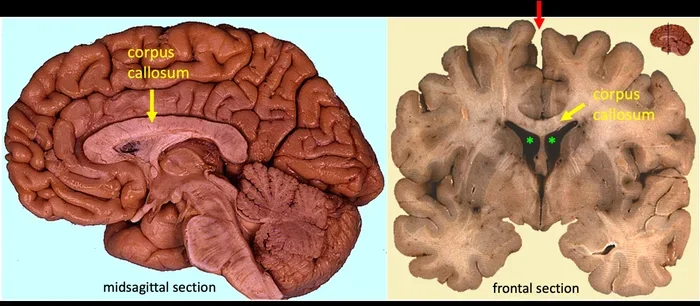
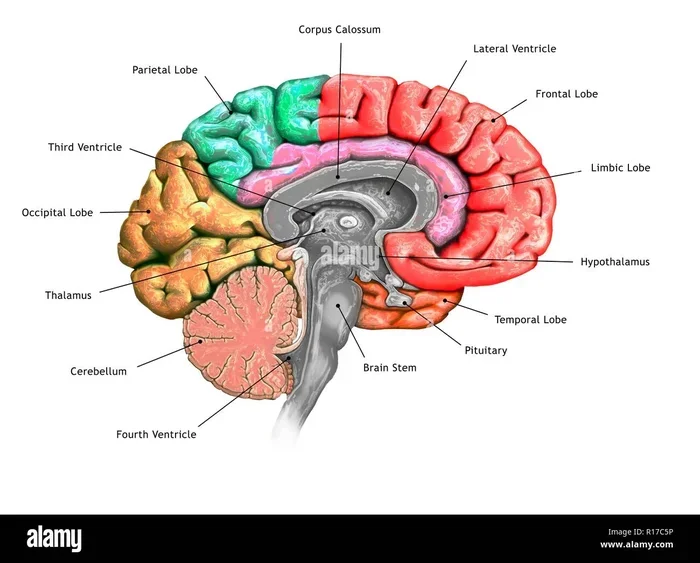
So what connects the two hemispheres of the brain? The answer is the corpus callosum—a flat, wide band of white matter nestled deep in the center of your brain. This structure is the largest collection of white matter in the entire brain, and it’s absolutely essential for unified brain function.
Anatomy of the Corpus Callosum
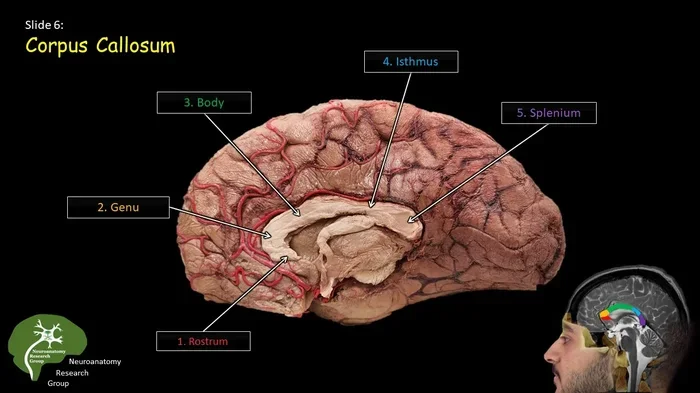
The corpus callosum isn’t just one uniform structure. It has distinct regions, each connecting different parts of the brain:
- The rostrum—the front-bottom portion connecting lower frontal areas
- The genu—the curved front part linking prefrontal cortex regions
- The body—the long middle section connecting motor and sensory areas
- The splenium—the thick back portion linking temporal and occipital lobes
Each region specializes in transferring specific types of information. The front portions handle higher-level thinking and emotional regulation, while the back portions manage sensory integration and visual processing.
Why 200 Million Nerve Fibers Matter
The sheer number of connections in the corpus callosum is staggering. With over 200 million axons packed into this structure, it’s capable of transferring an enormous amount of data every single second. To put that in perspective, that’s more connections than there are fibers in the entire optic nerve—multiplied several times over.
This massive bandwidth means your brain can integrate information almost instantaneously. When someone you’re dating tells you “I’m fine” but their tone says otherwise, your corpus callosum is working overtime—combining the left brain’s processing of the actual words with the right brain’s reading of the emotional subtext.
How the Hemispheres Communicate and Work Together
Visual guide about corpus callosum brain
Image source: c8.alamy.com
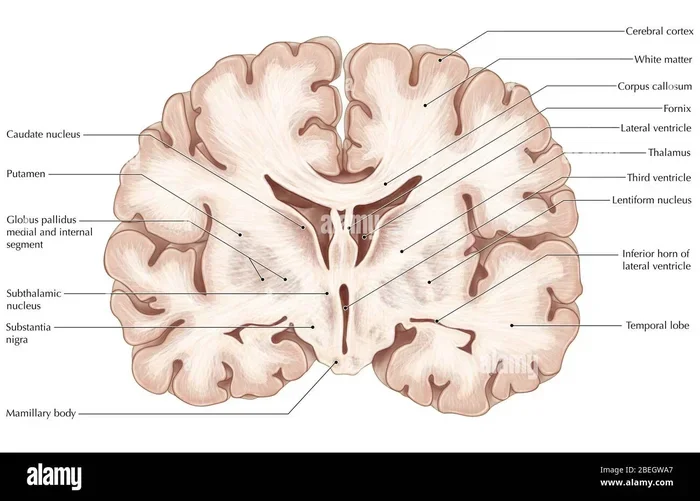
The communication between your brain hemispheres isn’t a simple one-way street. It’s a constant, bidirectional flow of information that happens so fast you never notice it happening.
The Integration Process
Here’s how it works in everyday life:
Step 1: Information enters one hemisphere. For example, you see your partner’s facial expression (right hemisphere processes this visually).
Step 2: The corpus callosum transfers this information to the other hemisphere in milliseconds.
Step 3: Both hemispheres contribute their expertise—the right brain provides emotional context while the left brain helps you formulate an appropriate verbal response.
Step 4: Your brain integrates both perspectives into a unified experience and response.
This process happens continuously, whether you’re having a deep conversation, solving a problem together, or simply enjoying a comfortable silence with someone you care about.
Lateralization vs. Integration
While each hemisphere has specialized functions, modern neuroscience has moved past the simplistic “left brain = logical, right brain = creative” myth. In reality, most tasks require both hemispheres working together. Even something as straightforward as reading a text message from your partner involves:
- Left hemisphere decoding the words
- Right hemisphere interpreting the emotional tone
- Both hemispheres accessing memories and context
- Corpus callosum coordinating all of this simultaneously
This integration is what makes complex human experiences possible. Without it, we’d struggle with everything from basic motor coordination to understanding sarcasm in a relationship.
What Happens When the Connection Is Disrupted?
Visual guide about corpus callosum brain
Image source: c8.alamy.com
Understanding what connects the two hemispheres of the brain becomes even more important when we look at what happens when that connection is damaged, underdeveloped, or surgically severed.
Split-Brain Patients: A Window Into Hemispheric Independence
In the 1960s, neuroscientists Roger Sperry and Michael Gazzaniga studied patients who had their corpus callosum surgically severed to treat severe epilepsy. These split-brain patients revealed fascinating insights:
- When an object was shown only to the right visual field (processed by the left brain), patients could name it easily.
- When the same object was shown only to the left visual field (processed by the right brain), patients couldn’t verbally name it—but their left hand could point to it.
- Each hemisphere could learn and remember information independently.
- The two sides sometimes had different reactions to the same stimulus.
This research proved that the corpus callosum is essential for creating a unified conscious experience. Without it, you essentially have two separate streams of awareness in one head.
Developmental Differences in Corpus Callosum
Not everyone’s corpus callosum is the same size or thickness. Research has shown:
- Autism spectrum disorder is often associated with reduced corpus callosum size, which may contribute to difficulties with social communication and emotional integration.
- ADHD has been linked to structural differences in the corpus callosum, potentially affecting attention and impulse control.
- Childhood trauma can impact corpus callosum development, which may explain why early adversity affects emotional regulation later in life.
- Musicians and bilingual individuals often show increased corpus callosum thickness, suggesting that certain activities can strengthen this connection.
These findings highlight how brain connectivity directly influences behavior, emotional health, and interpersonal functioning. When you’re struggling to communicate effectively in a relationship, there may be neurological factors at play that go beyond simple personality differences.
The Brain’s Role in Emotional Intelligence and Relationships
Here’s where the science of brain hemispheres gets deeply relevant to your love life. The corpus callosum doesn’t just connect logical and creative processing—it bridges emotional and rational thinking. This has profound implications for how you navigate relationships.
Emotional Regulation Requires Both Hemispheres
When conflict arises in a relationship, your brain goes through a complex process:
- The right hemisphere detects emotional intensity and reads your partner’s nonverbal cues.
- The left hemisphere helps you find words to express your feelings constructively.
- The corpus callosum integrates these processes so you can respond thoughtfully rather than react impulsively.
People with stronger interhemispheric communication tend to have better emotional regulation. They can feel intense emotions without being overwhelmed by them. This skill is invaluable in romantic partnerships, where emotional storms are inevitable.
Communication and Brain Connectivity
Effective communication in relationships depends heavily on both brain hemispheres working together. Consider what happens during a difficult conversation:
Left brain contributions: Choosing the right words, organizing your thoughts logically, staying on topic.
Right brain contributions: Reading your partner’s body language, sensing underlying emotions, understanding context beyond words.
Corpus callosum role: Merging these inputs so your response is both accurate and empathetic.
When this system works well, you can say something like, “I notice you seem frustrated—can we talk about what’s bothering you?” instead of snapping defensively. That’s integrated brain function in action.
Research on why stonewalling is the most overlooked form of emotional abuse shows that when people shut down during conflict, it’s often because their brain’s emotional centers are overwhelmed. Understanding the neurological basis of this response can help partners develop healthier communication patterns.
Attachment Styles and Neural Pathways
Your attachment style—the way you bond with romantic partners—is deeply connected to brain function. People with avoidant attachment styles, for example, often show different patterns of interhemispheric communication compared to those with secure attachment.
The needs of an avoidant attachment style often stem from early experiences that shaped how their brain processes emotional closeness. When the corpus callosum effectively integrates emotional and rational processing, people feel safer being vulnerable. When this integration is weaker, emotional intimacy can feel threatening.
How to Strengthen Your Brain’s Connectivity
The good news is that your brain is not fixed. Thanks to neuroplasticity—your brain’s ability to reorganize and form new connections throughout life—you can actually strengthen the communication between your hemispheres.
Activities That Boost Interhemispheric Communication
1. Mindfulness Meditation
Regular meditation has been shown to increase corpus callosum thickness and improve connectivity between brain regions. Even 10-15 minutes daily can make a measurable difference in emotional regulation and self-awareness.
2. Learning New Skills
Activities that require both hemispheres to work together strengthen the corpus callosum:
- Playing a musical instrument
- Learning a new language
- Dance or martial arts
- Drawing or painting
3. Physical Exercise
Aerobic exercise increases blood flow to the brain and promotes the growth of new neural connections. Activities that require coordination—like tennis, swimming, or yoga—are particularly effective because they demand both hemispheres work in sync.
4. Quality Sleep
During sleep, your brain consolidates memories and strengthens neural pathways. Poor sleep disrupts interhemispheric communication, which is why you’re more emotionally reactive when tired.
5. Meaningful Social Connection
Positive social interactions stimulate multiple brain regions simultaneously. Deep conversations, shared laughter, and physical affection all require integrated brain function—and they strengthen it over time.
Relationship Practices That Build Brain Integration
Your romantic relationship can actually become a gym for your brain’s connectivity. Here’s how:
- Practice active listening—focus on both words and emotional undertones
- Engage in novel activities together—new experiences stimulate both hemispheres
- Develop conflict resolution skills—navigating disagreements requires emotional and rational integration
- Share vulnerable conversations—emotional openness strengthens neural pathways for intimacy
- Maintain physical affection—touch activates multiple brain regions simultaneously
Understanding the difference between the silent treatment and giving space is another example of how brain awareness improves relationships. Giving space allows both partners’ brains to regulate and integrate emotions, while the silent treatment triggers threat responses that shut down healthy communication.
Common Myths About Brain Hemispheres
Let’s clear up some persistent misconceptions:
Myth 1: You’re Either Left-Brained or Right-Brained
This is perhaps the most widespread myth in popular psychology. Research using brain imaging shows that no one is dominantly left-brained or right-brained. While certain functions are lateralized, healthy brains constantly use both hemispheres together. The corpus callosum ensures this integration happens seamlessly.
Myth 2: The Corpus Callosum Is the Only Connection
While the corpus callosum is the largest and most important connection between hemispheres, it’s not the only one. Smaller structures called commissures—including the anterior commissure and hippocampal commissure—also connect the hemispheres. However, the corpus callosum handles the vast majority of interhemispheric communication.
Myth 3: Brain Hemispheres Work Independently
Even when you’re doing something seemingly “left-brained” like math, your right brain is contributing. It helps with pattern recognition, spatial reasoning, and the intuitive leaps that often precede logical solutions. The two hemispheres are partners, not competitors.
The Future of Brain Connectivity Research
Neuroscience continues to uncover new insights about what connects the two hemispheres of the brain and why it matters:
- Diffusion tensor imaging (DTI) now allows researchers to map the corpus callosum in unprecedented detail, revealing individual differences in connectivity.
- Transcranial magnetic stimulation (TMS) studies are exploring how modulating activity in one hemisphere affects the other.
- Longitudinal studies are tracking how corpus callosum development from childhood through adolescence predicts adult relationship outcomes.
- Therapeutic interventions targeting interhemispheric communication are being developed for conditions ranging from PTSD to couples therapy.
This research promises to deepen our understanding of human connection—both the neural kind and the romantic kind.
Conclusion
What connects the two hemispheres of the brain is far more than just a biological curiosity. The corpus callosum—with its 200 million nerve fibers—serves as the essential bridge that makes you a unified, integrated human being. It allows your logical left brain and creative right brain to share information, coordinate responses, and work together as one.
This connection shapes everything from how you solve problems to how you love. When your hemispheres communicate effectively, you can navigate conflict with empathy, express your feelings clearly, and build deeper intimacy with your partner. When this connection is compromised—whether by stress, trauma, or neurological differences—relationships suffer.
The beautiful truth is that you’re not stuck with the brain you have right now. Through mindfulness, learning, exercise, quality sleep, and intentional relationship practices, you can strengthen your brain’s connectivity. Every time you choose to really listen to your partner, engage in a new activity together, or pause before reacting in anger, you’re literally building stronger neural pathways.
Your brain’s ability to integrate information across hemispheres is one of nature’s most remarkable achievements. Understanding it gives you the power to become not just a better thinker, but a better partner, friend, and human being.
Frequently Asked Questions
What exactly is the corpus callosum made of?
The corpus callosum is made up of white matter, which consists of myelinated axons—the long projections of nerve cells. These axons are coated in a fatty substance called myelin that speeds up electrical signals, allowing information to travel rapidly between the left and right hemispheres.
Can you live without a corpus callosum?
Yes, some people are born without a complete corpus callosum—a condition called agenesis of the corpus callosum. While many individuals live relatively normal lives, some may experience difficulties with complex reasoning, social processing, and coordinating information between hemispheres.
Does the corpus callosum change as you age?
Research shows the corpus callosum continues developing through young adulthood, typically reaching peak size in the late 20s to early 30s. After that, it gradually thins with age, which may contribute to slower processing speed and changes in emotional regulation later in life.
How does the corpus callosum affect emotional intelligence?
The corpus callosum enables integration between the brain’s emotional centers (primarily right hemisphere) and its language and reasoning centers (primarily left hemisphere). Stronger connectivity allows people to better identify, understand, and express emotions—key components of emotional intelligence.
Can meditation really change the corpus callosum?
Yes, multiple studies have found that regular meditation practice is associated with increased thickness and connectivity in the corpus callosum. Even eight weeks of mindfulness training can produce measurable changes in brain structure and interhemispheric communication.
Why do men and women show differences in corpus callosum size?
On average, women tend to have a relatively larger corpus callosum compared to brain size than men do. Some researchers believe this contributes to observed differences in how men and women process emotions and communicate, though the findings remain debated and individual variation is far greater than group differences.
