
Sampling bias happens when your sample doesn’t fairly represent the larger population you’re studying. Understanding sampling bias types and learning how to avoid sampling bias is essential for anyone who relies on data to make decisions. This guide breaks down the most common types, real-world examples, and proven strategies to keep your research accurate and trustworthy.
Key Takeaways
- What Sampling Bias Is: A systematic error that occurs when a sample is not representative of the target population, leading to skewed results.
- Common Types: Selection bias, non-response bias, survivor bias, undercoverage, and voluntary response bias are the most frequent culprits.
- Real Impact: Sampling bias has caused major failures in politics, medicine, product development, and social science research.
- How To Avoid It: Use random sampling, increase sample size, stratify your groups, and validate your sampling frame.
- Why It Matters: Fixing sampling bias saves time, money, and credibility while improving the reliability of your findings.
- Quick Rule: If your sample is easy to collect, it is probably biased.
📑 Table of Contents
What Is Sampling Bias?
Let’s start with the basics. Sampling bias is a type of error that happens when the people or items you choose for your study don’t accurately reflect the bigger group you’re trying to study. Think of it like trying to figure out what flavor ice cream everyone in your city loves, but you only ask people at a vegan bakery. Your results will be wildly off.
Why does this matter so much? Because most research, surveys, and data analyses don’t have the time or budget to ask every single person. Instead, researchers pick a smaller group — a sample — and hope it mirrors the larger population. When that sample is skewed, your conclusions are unreliable. This is where sampling error and sampling bias differ. Sampling error is random and unavoidable. Sampling bias is systematic and entirely preventable.
Understanding sampling bias types is the first step toward cleaner data. Whether you’re running a customer survey, conducting academic research, or analyzing market trends, knowing how bias creeps in will make your work far more credible.
Sampling Bias Types With Real Examples
Not all bias looks the same. Different situations create different problems. Here are the most common sampling bias types you’ll encounter, along with real-world examples that make them easy to spot.
Selection Bias
Selection bias occurs when you (consciously or accidentally) choose participants who aren’t representative of your target group. This is probably the most common form of sampling bias.
Real Example: A company wants to know how employees feel about a new work-from-home policy. They only survey employees in headquarters — ignoring remote workers and field staff. The results heavily favor those who already preferred office work. The company makes policy decisions based on this skewed data, and remote employees feel unheard.
You can also see this in health research. Studies that only recruit participants from urban hospitals may miss rural populations with very different health needs. If you’re exploring topics like what energy has to do with mental health, your findings could be completely off if your sample only represents one demographic.
Non-Response Bias
Non-response bias happens when the people who refuse to participate in your study differ significantly from those who do. The people who show up are not the people you need.
Real Example: A political poll sends surveys to 10,000 registered voters. Only 800 respond. The respondents tend to be older, more educated, and more politically engaged. The poll predicts a close race, but the actual election shows a landslide. Non-response bias is a major reason why some polls miss the mark.
This type of sampling bias is tricky because you often don’t know why people didn’t respond — or how they differ from those who did.
Survivor Bias
Survivor bias focuses only on the “survivors” — the people or things that made it through a process — while ignoring those that didn’t. This creates a dangerously optimistic picture.
Real Example: During World War II, statisticians studied bullet holes on returning planes to decide where to add armor. They initially recommended reinforcing the areas with the most holes. But a brilliant statistician pointed out the flaw: the planes that were hit in the engine never came back. The “survivors” showed them nothing about the fatal weak spots. This is classic survivor bias.
In business, you see this when entrepreneurs study successful startups to find “secrets of success” while ignoring the thousands that failed with the same strategies.
Undercoverage Bias
Undercoverage bias occurs when part of the population is simply not included in your sampling frame — the list or method you use to select participants.
Real Example: A school district surveys student satisfaction using only email. But younger students share email less frequently than older students. The survey systematically underrepresents the younger group. Their opinions are essentially invisible in the results.
This is one of the most sneaky sampling bias types because the data looks fine on the surface. The problem is hidden in who’s missing.
Voluntary Response Bias
Voluntary response bias is the cousin of non-response bias. Here, people choose to respond, and they usually have strong opinions — either very positive or very negative. The moderately satisfied or indifferent majority stays silent.
Real Example: A restaurant posts an online poll asking customers to rate their experience. The people who take the time to vote are either thrilled or furious. The restaurant thinks it’s universally loved, but many average customers simply didn’t bother. This is why you rarely see truly balanced results from voluntary online reviews.
Convenience Sampling Bias
Convenience sampling means picking whoever is easiest to reach. It’s fast and cheap, but it almost always produces a biased sample.
Real Example: A researcher studies breakfast habits by interviewing people at a gym at 6 AM. These health-conscious early risers are not representative of the general population. Their habits look dramatically different from everyone else’s.
While convenience sampling is sometimes necessary, you should always flag it as a limitation. If you want stronger findings, consider using staying healthy and positive through personal challenges as a research topic with better recruitment methods to reduce this bias.
How Sampling Bias Affects Your Research
Now that you know the types, let’s talk about what happens when sampling bias goes unchecked. The consequences are more serious than most people realize.
Distorted Findings And False Conclusions
The most immediate impact is that your data tells a lie. You might think your product is beloved when half your customer base hates it. You might think a treatment works when it only helps a specific subgroup. Sampling bias distorts your findings and leads to decisions you shouldn’t be making.
Wasted Time And Money
Every hour you spend analyzing biased data is wasted. Worse, you might invest thousands in launching a product or campaign based on flawed research. Fixing the problem later costs far more than preventing it upfront.
Loss Of Credibility
Once stakeholders, clients, or the public discovers your data is compromised, trust evaporates. In academia, it can mean retracted papers. In business, it means stakeholders second-guessing your every recommendation.
Poor Decision-Making
When your sample doesn’t reflect reality, every decision built on that data is a gamble. Leaders make confident choices based on incomplete information. The results can range from minor misses to major failures.
Real-World Examples Of Sampling Bias In Action
History is full of cautionary tales. Here are a few famous cases where sampling bias changed the course of events.
The 1936 Literary Digest Poll
This is the textbook example. A magazine surveyed millions of Americans about their presidential preferences in 1936. They used phone directories and car registration lists — both luxury items at the time. The sample was overwhelmingly wealthy and predicted a landslide win for one candidate. Roosevelt won by one of the largest margins in history. The wealthy simply didn’t represent the broader electorate.
Medical Studies And Gender Bias
For decades, heart disease research focused primarily on men. The assumption was that women’s hearts responded similarly. This sampling bias led to misdiagnoses and inadequate treatments for millions of women. Heart attacks in women often look completely different from those in men, and the data was missing those differences entirely.
Tech Product Development
Many tech companies beta-test products with early adopters — tech-savvy, young, and highly engaged users. The feedback is overwhelmingly positive because these testers love technology by nature. When the product launches to the general public, adoption is far lower. The sampling bias created false confidence in the product’s appeal.
How To Avoid Sampling Bias
Great question. Avoiding sampling bias isn’t about perfection — it’s about intention. Here are proven strategies that make a real difference.
Use Random Sampling Whenever Possible
Random sampling gives every member of your population an equal chance of being selected. This is the gold standard for reducing sampling bias. It’s not always practical, but even partial randomization helps.
Define Your Population Clearly
Before you recruit anyone, be crystal clear about who you’re studying. A “general consumer” is too vague. Are you targeting women aged 25-40 who shop online at least twice a month? The more specific your definition, the easier it is to build a representative sample.
Stratify Your Sample
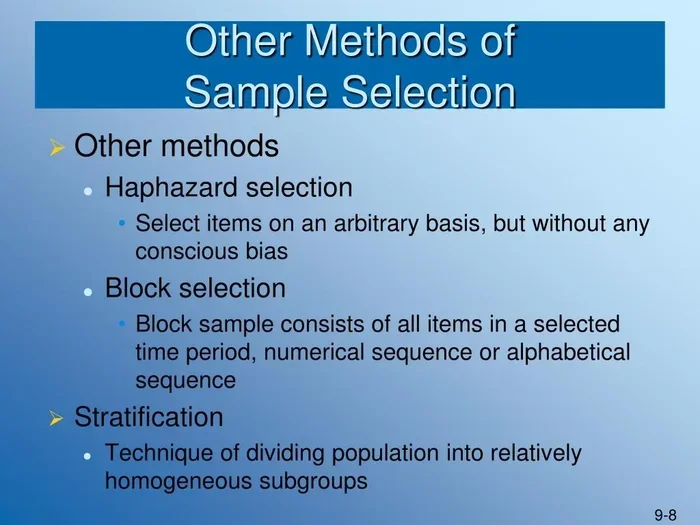
Stratified sampling means dividing your population into subgroups (strata) and sampling from each one proportionally. This is especially useful when you know certain groups are at risk of being underrepresented. If you’re studying something like how to detach from someone with borderline personality disorder, you’d want balanced representation across age, gender, and treatment history to avoid skewed conclusions.
Increase Your Sample Size
A larger sample doesn’t eliminate bias, but it reduces its impact. Small samples are more vulnerable to being thrown off by a few unusual responses. Bigger samples bring the data closer to reality.
Use Multiple Data Collection Methods
Don’t rely solely on online surveys. Combine online polls, phone interviews, in-person interviews, and focus groups. Different methods reach different people, which helps balance out sampling bias types like undercoverage and non-response bias.
Follow Up With Non-Respondents
Where possible, try to learn why people didn’t respond. A short follow-up message or phone call can reveal whether non-respondents differ significantly from respondents. This doesn’t fix the bias, but it helps you understand and account for it.
Validate Your Sampling Frame
Your sampling frame is the list or system you use to select participants. Make sure it actually covers the full population you’re studying. If you’re using a customer email list, ask yourself: does it include all customer segments, or only those who opted into marketing emails?
Quick Tips For Reliable Research
Here are fast, actionable tips you can apply immediately:
- Always question your sample source. Ask yourself who’s missing before trusting your results.
- Report limitations honestly. If your sample has known gaps, say so. Transparency builds trust.
- Use pilot studies. A small test run can reveal bias problems before you commit to a full study.
- Triangulate your data. Compare findings from different sources or methods to see if they agree.
- Document your methodology. Future researchers and reviewers need to understand exactly how you selected your sample.
Common Mistakes People Make With Sampling
Even experienced researchers trip up. Here are the most frequent errors:
- Confusing correlation with causation. A representative sample can still mislead you if you draw the wrong conclusions from it.
- Ignoring margin of error. Every sample has a margin of error. Respect it and communicate it clearly.
- Overgeneralizing. Findings from one group don’t automatically apply to everyone. Be specific about who your results represent.
- Chasing convenience over accuracy. It’s tempting to grab easy data, but convenience sampling often costs you more in the long run.
- Assuming big samples fix everything. A million biased responses are still biased. Quality always beats quantity.
Conclusion
Sampling bias is one of the sneakiest threats to good research. It doesn’t announce itself. Your data can look perfectly fine while quietly telling a distorted story. The key is awareness. By understanding the major sampling bias types — selection bias, non-response bias, survivor bias, undercoverage, voluntary response bias, and convenience sampling — you can spot the warning signs before they ruin your work.
The real-world examples prove this isn’t just a textbook problem. It has shaped elections, medical treatments, and product launches. But the good news is that how to avoid sampling bias is well within your control. Use random sampling, stratify your groups, validate your frame, and always ask the hard question: “Who am I missing?”
Every time you invest in better sampling, you invest in better decisions. And better decisions are what separate good research from great research. Now go build a sample that actually represents the world you’re studying.
Frequently Asked Questions
What is the difference between sampling bias and sampling error?
Sampling error is the natural, random variation that happens when you sample a small group instead of surveying everyone. It’s expected and decreases with larger samples. Sampling bias, on the other hand, is a systematic error caused by a flawed selection process. Unlike sampling error, bias doesn’t go away with bigger samples — you have to fix the method itself.
Can sampling bias be completely eliminated?
In most practical situations, no. You can drastically reduce it, but completely eliminating it is rare. The goal is to minimize bias through careful design, transparent reporting, and triangulation. The key is knowing your limitations and communicating them honestly to anyone using your findings.
What is the most common type of sampling bias?
Selection bias and convenience sampling bias are the most common in everyday research. Selection bias happens when you choose participants who aren’t representative, while convenience sampling grabs whoever is easiest to reach. Both are extremely widespread in surveys, market research, and academic studies.
How does sampling bias affect survey results?
Sampling bias skews survey results toward the opinions or characteristics of the overrepresented group. This means your findings don’t reflect the broader population. Decisions based on biased surveys — whether policy changes, product launches, or medical recommendations — are built on unreliable foundations.
Is voluntary response sampling the same as convenience sampling?
No, but they are closely related. Voluntary response sampling lets people choose to participate (like online polls), while convenience sampling has the researcher pick whoever is nearby. Both produce biased samples, but for slightly different reasons. Voluntary response attracts people with strong opinions; convenience sampling attracts whoever is accessible.
What is a sampling frame and why does it matter?
A sampling frame is the actual list or method used to identify and select participants from your target population. If your sampling frame is incomplete or outdated, your sample will be biased. For example, using a landline phone directory to survey young adults will systematically underrepresent that age group. A strong sampling frame is the backbone of representative research.
