
Thematic analysis and phenomenology are two powerful qualitative research approaches that can work together surprisingly well. Many researchers wonder can thematic analysis be used in phenomenology, and the answer is a resounding yes. This guide breaks down how these methods complement each other, when to use them, and what to watch out for. You will learn practical steps, real examples, and expert tips to strengthen your qualitative research methodology.
Qualitative research can feel overwhelming. You have so many methods to choose from. Two of the most popular are thematic analysis and phenomenology. Many researchers ask the same question: can thematic analysis be used in phenomenology? The short answer is yes. The longer answer is even more interesting.
When you combine these two approaches, you get a powerful way to explore human experience. You can identify patterns in how people live, feel, and understand the world around them. This article will walk you through everything you need to know. We will cover the basics, the benefits, the challenges, and practical steps you can follow today.
Key Takeaways
- Thematic analysis fits naturally within phenomenological research: It helps identify patterns in lived experiences.
- Both methods share a focus on meaning-making: They prioritize understanding human experience over numbers.
- Reflexive thematic analysis is the preferred approach: It aligns better with phenomenological philosophy than older coding methods.
- Common challenges include maintaining philosophical rigor: Researchers must balance thematic patterns with individual experience.
- Start with clear research questions: They guide your entire thematic and phenomenological analysis process.
- Don’t let the perfect be the enemy of the good: A solid framework matters more than a flawless one.
- Three things you can let go of unburden your life: Rigid rules, perfectionism, and fear of mixing methods.
📑 Table of Contents
- What Is Thematic Analysis in Qualitative Research?
- What Is Phenomenology as a Research Approach?
- Can Thematic Analysis Be Used In Phenomenology Research?
- How to Combine Thematic Analysis with Phenomenology
- Common Mistakes to Avoid
- Benefits of Using Thematic Analysis in Phenomenological Studies
- Expert Insights on Combining These Methods
- Conclusion
What Is Thematic Analysis in Qualitative Research?
Thematic analysis is a method for identifying patterns in qualitative data. Researchers use it to organize interview transcripts, field notes, and open-ended survey responses. The goal is to find themes — recurring ideas or concepts that emerge from the data.
Unlike quantitative methods, thematic analysis does not rely on statistics. It focuses on words, meanings, and interpretations. This makes it a natural fit for research that explores human experience. Here are some key features:
- Flexibility: You can adapt the process to your research question.
- Accessibility: It is one of the easier qualitative methods to learn.
- Broad applicability: It works across many disciplines and topics.
- Iterative process: You move back and forth between coding and reviewing themes.
Many researchers start with thematic analysis because it offers a clear structure. You collect data, you code it, you group codes into themes, and you interpret what those themes mean. Simple in theory, though the actual work requires patience and careful thinking.
Types of Thematic Analysis
Not all thematic analysis is the same. There are several approaches, and choosing the right one matters a lot. Here are the most common types:
- Inductive thematic analysis: Themes emerge from the data itself, without a pre-existing framework.
- Deductive thematic analysis: You start with a theory or existing framework and test it against your data.
- Reflexive thematic analysis: This approach, championed by Braun and Clarke, emphasizes the researcher’s role in interpreting data. It is the most compatible with phenomenology.
When you are working within a phenomenological framework, reflexive thematic analysis is usually the best choice. It respects the subjectivity of lived experience and allows for deeper interpretation.
What Is Phenomenology as a Research Approach?
Phenomenology is a philosophical and research approach focused on understanding lived experience. It asks: What is it like to experience something? The method explores how people make sense of their world through direct experience.
Phenomenological research goes deeper than surface-level descriptions. It seeks to uncover the essence of an experience. For example, if you study grief, you are not just looking at symptoms. You are exploring what grief feels like, how it changes a person, and what meaning it holds.
Key Principles of Phenomenology
- Intentionality: All consciousness is directed toward something. Experience is always about something.
- Bracketing: Researchers set aside their own assumptions to understand the participant’s perspective.
- Essence: The goal is to find the core meaning of an experience.
- Lived experience: The participant’s perspective is the primary source of data.
Phenomenology values subjective experience. It treats personal stories as rich data. This is why qualitative data analysis methods like thematic analysis fit so well within this framework.
Can Thematic Analysis Be Used In Phenomenology Research?
Now for the big question. Can thematic analysis be used in phenomenology research? Yes, it can — and many researchers do it successfully. However, the fit requires some careful thought.
Thematic analysis provides a structured way to find patterns in qualitative data. Phenomenology provides a philosophical lens for understanding those patterns. Together, they create a robust methodology. Thematic analysis handles the mechanics of coding and theme development. Phenomenology provides the deeper meaning behind those themes.
Why the Combination Works
There are several reasons this pairing is effective:
- Shared focus on meaning: Both approaches prioritize understanding over measurement.
- Complementary strengths: Thematic analysis offers structure; phenomenology offers depth.
- Rich data handling: Phenomenological interviews produce long, detailed transcripts. Thematic analysis handles this volume well.
- Pattern recognition: Phenomenology looks for essences; thematic analysis looks for patterns. These are not the same, but they inform each other.
Many researchers find that trying to find peace of mind in a dumpster fire of mixed methods becomes much easier when they use thematic analysis as their analytical tool within a phenomenological study. It gives them a reliable process to follow while still honoring the philosophy of lived experience.
When the Combination Needs Care
The pairing is not without challenges. Phenomenology has deep philosophical roots. Some purists argue that thematic analysis is too surface-level. They worry that themes might miss the essence of experience. These concerns are valid and worth considering.
Here are situations where you need to be extra careful:
- When your research question focuses on essence rather than patterns.
- When you are working with very small sample sizes typical of phenomenology.
- When participants share deeply personal or abstract experiences.
- When the philosophical underpinnings of phenomenology are central to your study.
The key is to stay grounded in phenomenological principles while using thematic analysis as your tool. Do not let the method overpower the philosophy.
How to Combine Thematic Analysis with Phenomenology
If you have decided to use both approaches, here is a practical guide. These steps will help you integrate them smoothly into your research design.
Step 1: Start with a Phenomenological Research Question
Your research question should reflect the phenomenological focus. Ask about lived experience, meaning, or essence. For example:
- What is the lived experience of new parents during the first year?
- How do people find meaning after a major life change?
- What does resilience feel like for caregivers?
Your question sets the tone for everything that follows. It guides your data collection, your coding, and your theme development.
Step 2: Collect Rich Phenomenological Data
Phenomenological interviews are typically in-depth and semi-structured. You want participants to share detailed stories. Aim for transcripts that are 5,000 to 15,000 words each. The richer the data, the more meaningful your themes will be.
Here are tips for strong data collection:
- Use open-ended questions that invite storytelling.
- Ask participants to describe their experience, not just facts.
- Follow up on emotional or sensory details.
- Aim for 6 to 12 participants, which is typical for phenomenology.
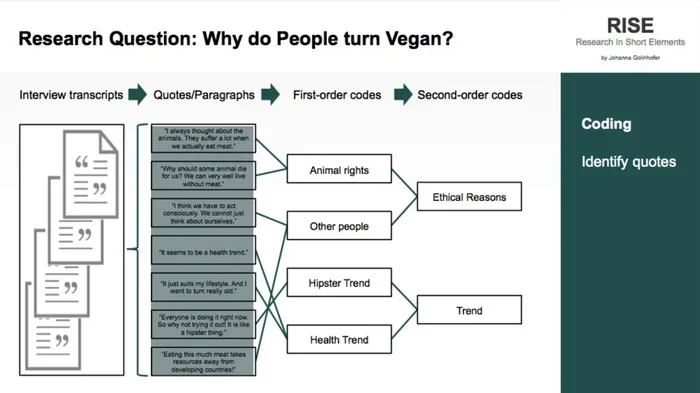
Step 3: Code with Reflexive Thematic Analysis
Now comes the analytical work. Use reflexive thematic analysis to process your data. This means you actively engage with the material and let your interpretation guide the process.
The coding process typically follows these stages:
- Familiarization: Read and re-read your transcripts. Get to know the data deeply.
- Initial coding: Label interesting or relevant segments of data.
- Theme development: Group codes into broader themes that capture patterns.
- Review and refine: Check that your themes accurately represent the data.
- Define and name themes: Give each theme a clear label and description.
- Write up: Present your findings in a coherent narrative.
Throughout this process, stay close to phenomenological principles. Remember that your goal is to capture the essence of lived experience, not just to catalog surface patterns.
Step 4: Interpret Through a Phenomenological Lens
Once you have your themes, step back and look at the bigger picture. Ask yourself: What do these themes tell me about the essence of this experience? How do the themes relate to each other? What new insights emerge?
This is where phenomenology adds depth. Thematic analysis gives you the structure. Phenomenology gives you the meaning. Together, they produce findings that are both rigorous and rich.
Common Mistakes to Avoid
Even experienced researchers make mistakes when combining these methods. Here are some pitfalls to watch for:
Treating Themes as Essences
A theme is a pattern. An essence is the core meaning of an experience. These are different things. Do not confuse a frequently occurring code with the essence of an experience. A theme might be common without being essential.
Skipping Bracketing
Bracketing is a core phenomenological practice. It means acknowledging and setting aside your own biases. If you skip this step, your themes may reflect your assumptions rather than the participants’ experiences. This is a serious threat to research rigor.
Over-Coding
It is tempting to create too many codes and themes. This makes your analysis messy and hard to interpret. Aim for 3 to 7 main themes. Fewer, well-developed themes are better than many thin ones.
Ignoring Negative Cases
Not every participant will share the same experience. Some may describe something very different. These negative cases are valuable. They help you refine your themes and avoid overgeneralizing.
Benefits of Using Thematic Analysis in Phenomenological Studies
There are many reasons to consider this combination for your next study:
- Clarity and structure: Thematic analysis gives you a clear process to follow.
- Transparency: Your coding and theme development are visible and reproducible.
- Flexibility: You can adapt the process to your specific research needs.
- Accessibility: Many researchers already know thematic analysis, making it easier to adopt phenomenology.
- Strong publications: Journals accept well-conducted thematic analysis within phenomenological studies.
Staying healthy and positive in personal challenges is important for researchers too. Mixing methods can feel daunting, but remember that both thematic analysis and phenomenology share the same goal: understanding human experience deeply and authentically.
How to be with someone with a disorganized attachment style teaches us that understanding requires patience and flexibility. The same applies to research methodology. Give yourself permission to learn, adapt, and grow through the process.
Expert Insights on Combining These Methods
Seasoned qualitative researchers offer valuable advice for those exploring this combination:
- Keep your philosophical grounding clear: Always know why you are using each method. Every choice should serve your research question.
- Use the right version of thematic analysis: Reflexive thematic analysis aligns best with phenomenology. Avoid purely deductive or mechanical approaches.
- Practice bracketing throughout: It is not just a one-time step. Return to bracketing as you code and develop themes.
- Let the data speak: Resist the urge to force themes into a predetermined shape. The best themes emerge from genuine engagement with the data.
As the saying goes, do not let the perfect be the enemy of the good. A well-executed thematic analysis within a phenomenological study is far more valuable than a perfect study that never gets done.
Conclusion
Can thematic analysis be used in phenomenology research? Absolutely. The two methods complement each other beautifully. Thematic analysis provides the structure and process for identifying patterns in qualitative data. Phenomenology provides the philosophical depth and focus on lived experience. Together, they create a methodology that is both rigorous and meaningful.
Remember to choose reflexive thematic analysis as your approach. Stay grounded in phenomenological principles like bracketing and intentionality. Avoid common pitfalls like over-coding or confusing themes with essences. And most importantly, let your research question guide every decision you make.
Whether you are a seasoned researcher or just starting out, this combination offers a powerful path for exploring human experience. The next time you design a qualitative study, consider how thematic analysis and phenomenology can work together. Your findings will be richer, deeper, and more impactful because of it.
Frequently Asked Questions
Is thematic analysis the same as phenomenological analysis?
No, they are different but complementary. Thematic analysis is a data analysis method focused on identifying patterns. Phenomenology is a philosophical approach focused on understanding lived experience. You can use thematic analysis as a tool within a phenomenological study.
What type of thematic analysis is best for phenomenology?
Reflexive thematic analysis is the best fit. It allows for researcher interpretation and aligns with phenomenology’s emphasis on subjectivity and meaning. Avoid purely deductive or mechanical approaches when working within a phenomenological framework.
Can I use thematic analysis without a phenomenological approach?
Yes. Thematic analysis is flexible and works across many research paradigms. You can use it in grounded theory, content analysis, or even mixed-methods studies. It does not require a phenomenological foundation.
How many participants do I need for a phenomenological study using thematic analysis?
Phenomenological studies typically use 6 to 12 participants. The goal is data saturation, where new participants no longer add new themes. Thematic analysis can handle smaller sample sizes well because it focuses on depth rather than breadth.
What is the difference between a theme and an essence in this context?
A theme is a recurring pattern in your data. An essence is the core meaning of a lived experience. Themes can be common without being essential. A good phenomenological study ensures that themes capture the essence, not just frequency.
Do I need special training to combine these methods?
While formal training helps, it is not always required. Start by reading foundational texts on both thematic analysis and phenomenology. Practice bracketing and reflexivity. Many researchers learn by doing and refine their approach with experience and feedback.
=== CONCLUSION ===
Thematic analysis and phenomenology are a natural pairing for qualitative researchers. They share a commitment to understanding meaning and human experience. By combining them thoughtfully, you can produce research that is both methodologically sound and philosophically rich. Start with a clear research question, choose reflexive thematic analysis, and let phenomenology guide your interpretation. The results will speak for themselves.
