
Replacing bad habits with good habits isn’t about willpower—it’s about understanding your triggers and building systems that work. This guide reveals the science-backed strategies to break negative patterns, create positive routines, and make lasting behavioral changes that stick.
[FEATURED IMAGE_PLACEHOLDER]
Have you ever sworn you’d finally break that annoying habit, only to find yourself doing it again three days later? You’re not alone. Millions of people struggle to replace bad habits with good habits every single day. The good news? Science has cracked the code on how habits actually work—and it’s way simpler than you think.
The truth is, willpower alone won’t cut it. You need a system. Whether you want to stop scrolling your phone at midnight, quit snapping at your partner, or finally start exercising regularly, the process is surprisingly similar. Let’s dive into exactly how you can rewire your brain and build habits that actually last.
Key Takeaways
- Habit loops drive behavior: Every habit follows a cue-routine-reward cycle that can be rewired with the right approach.
- Replacement beats elimination: Simply trying to stop a bad habit rarely works—you need to substitute it with a positive alternative.
- Small changes compound: Tiny, consistent improvements create massive transformation over time through the power of compounding.
- Environment shapes behavior: Designing your surroundings to support good habits makes success almost automatic.
- Identity drives lasting change: When you see yourself as the type of person who practices good habits, the behavior follows naturally.
- Patience is essential: Research shows it takes an average of 66 days to form a new habit, not the myth of 21 days.
- Relationships influence habits: The people around you significantly impact your ability to maintain positive behavioral changes.
📑 Table of Contents
- Understanding Why Bad Habits Are So Hard to Break
- The Science Behind Habit Formation
- How to Identify the Bad Habits Holding You Back
- Practical Strategies to Replace Bad Habits With Good Habits
- Building a System for Lasting Change
- How Good Habits Transform Your Relationships
- Common Mistakes When Trying to Replace Habits
- Expert Insights on Habit Replacement
- Quick Tips for Immediate Action
- Comparison: Old Approach vs. New Approach
- Conclusion
Understanding Why Bad Habits Are So Hard to Break
Bad habits feel comfortable. That’s the whole problem. Your brain has wired itself to follow familiar patterns because familiar feels safe. Even when a habit hurts you—like staying up too late or avoiding difficult conversations—your brain resists change.
Think about it this way. Every time you repeat a behavior, your neurons fire together and wire together. The more you do something, the stronger that neural pathway becomes. Eventually, the behavior becomes automatic. You don’t even think about it anymore.
This is why bad habits die hard. They’re literally carved into your brain’s circuitry. But here’s the exciting part—your brain remains plastic throughout your entire life. You can always build new pathways.
The Comfort Zone Trap
Your brain craves predictability. Bad habits provide a predictable outcome, even if that outcome is negative. Breaking free means stepping into uncertainty, and your nervous system doesn’t love that.
That’s why so many people get stuck in cycles of trying and failing. They rely on motivation instead of strategy. Motivation is fleeting. Strategy is reliable.
Why Willpower Fails
Willpower is like a battery. It drains throughout the day. By evening, you’ve made hundreds of decisions, and your willpower reserves are depleted. That’s when bad habits creep back in.
Smart people don’t rely on willpower. They design their lives so that good habits become the path of least resistance.
The Science Behind Habit Formation
Visual guide about healthy habit swap
Image source: blogger.googleusercontent.com
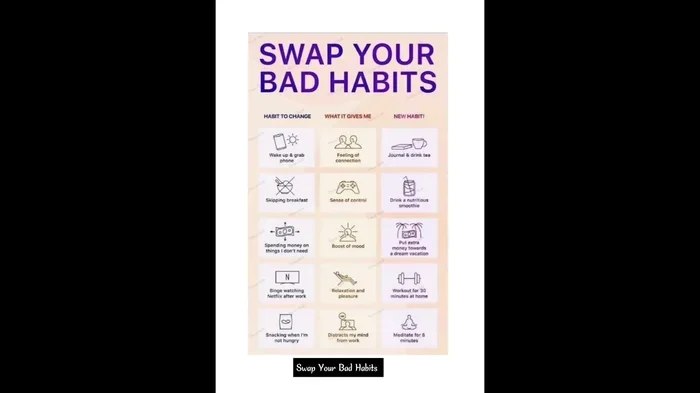
To replace bad habits with good habits, you need to understand the habit loop. Psychologists at MIT discovered that every habit consists of three components: a cue, a routine, and a reward.
The cue is the trigger that initiates the behavior. It could be a time of day, an emotional state, a location, or the people around you.
The routine is the behavior itself—the habit you want to change.
The reward is the satisfaction your brain gets from the behavior. This reward reinforces the loop, making you want to repeat it.
Here’s the golden rule: You can’t easily erase a bad habit. But you can rewrite the loop. Keep the same cue and reward, but change the routine in between.
How Long Does It Really Take?
You’ve probably heard that it takes 21 days to form a habit. That’s a myth. Research from University College London found that it takes an average of 66 days for a new behavior to become automatic. Some people needed as few as 18 days. Others took 254 days.
The key takeaway? Don’t get discouraged if it feels hard after a few weeks. Your brain is still rewiring itself.
The Role of Dopamine
Dopamine isn’t just about pleasure—it’s about anticipation. When your brain expects a reward, dopamine spikes. This is what makes habits so powerful and so hard to break.
When you replace a bad habit with a good one, you need to ensure the new habit delivers a satisfying reward. Otherwise, your brain won’t adopt it.
How to Identify the Bad Habits Holding You Back
Visual guide about healthy habit swap
Image source: i.ytimg.com
Before you can change a habit, you need to see it clearly. Many bad habits operate on autopilot. You do them without conscious awareness.
Keep a Habit Journal
For one week, write down every habit you want to change. Note the time, your emotional state, who you’re with, and what happened right before the behavior. Patterns will emerge quickly.
Common cues include:
- Time-based: Reaching for your phone at 9 PM every night
- Emotion-based: Snapping at your partner when you feel stressed
- Location-based: Eating junk food when you walk into the kitchen
- Social-based: Drinking more when certain friends are around
Ask Yourself the Hard Questions
Not every habit deserves equal attention. Ask yourself:
- What habit is costing me the most in my relationships?
- What habit do I feel most ashamed about?
- What habit would make the biggest positive impact if I changed it?
Start with the habit that shows up most frequently or causes the most harm. Don’t try to change everything at once.
Practical Strategies to Replace Bad Habits With Good Habits
Visual guide about healthy habit swap
Image source: calorietrackerbuddy.com
Now let’s get into the actionable stuff. These strategies are backed by behavioral psychology and real-world results.
Strategy 1: Habit Stacking
Habit stacking means attaching a new habit to an existing one. The formula is simple: “After I [current habit], I will [new habit].”
Examples:
- After I pour my morning coffee, I will write down three things I’m grateful for.
- After I brush my teeth at night, I will read for 10 minutes instead of scrolling.
- After I get into bed, I will take five deep breaths before sleeping.
The existing habit becomes the cue for the new one. This works brilliantly because you’re building on neural pathways that already exist.
Strategy 2: Change Your Environment
Your environment is the invisible hand shaping your behavior. If you want to replace bad habits with good habits, redesign your surroundings.
Want to eat healthier? Put fruit on the counter and hide the chips in the back of the pantry. Want to exercise more? Sleep in your workout clothes. Want to reduce screen time? Charge your phone in another room.
Make good habits easy and bad habits hard. This single principle will transform your results.
Strategy 3: The 2-Minute Rule
New habits feel overwhelming when you think about the full version. Shrink them down until they take less than two minutes.
- “Read every day” becomes “Read one page.”
- “Meditate daily” becomes “Sit quietly for one minute.”
- “Exercise regularly” becomes “Put on my running shoes.”
The goal isn’t to do the whole habit—it’s to show up. Once you start, momentum often carries you further. But even if it doesn’t, you’ve reinforced the identity of someone who shows up.
Strategy 4: Implementation Intentions
Don’t just say “I’ll try to exercise more.” Be specific. Research shows that people who write down when and where they’ll perform a habit are significantly more likely to follow through.
Use this format: “I will [BEHAVIOR] at [TIME] in [LOCATION].”
Example: “I will go for a 20-minute walk at 7 AM in my neighborhood.”
This removes ambiguity and decision fatigue from the equation.
Strategy 5: Reward Yourself Immediately
Bad habits offer instant rewards. Good habits often delay them. To compete, you need to make your new habits immediately satisfying.
After completing your new habit, do something small that feels good. Check it off a tracker. Say “I did it” out loud. Give yourself a mental high-five. These micro-releases of dopamine help cement the new loop.
Building a System for Lasting Change
Individual habits matter, but systems matter more. A system is the infrastructure that supports your habits day after day.
Track Your Progress
What gets measured gets managed. Use a simple habit tracker—a calendar where you mark an X for each day you complete your habit. Don’t break the chain becomes a powerful motivator.
Research on behavior change shows that focusing on what you can control dramatically increases your success rate. You can’t control outcomes, but you can control showing up.
Plan for Failure
You will mess up. That’s guaranteed. The question is whether one slip becomes a full relapse.
Use the “never miss twice” rule. If you skip your habit one day, that’s fine. But you absolutely cannot skip it two days in a row. One miss is a data point. Two misses is the start of a new pattern.
Find an Accountability Partner
Tell someone about your habit change. Better yet, find someone who wants to build a habit too. Check in weekly. Share your wins and struggles.
Accountability works because humans are social creatures. We care what others think, and we can use that to our advantage.
Focus on Identity, Not Outcomes
The most powerful habit changes happen when you shift how you see yourself. Instead of “I’m trying to quit smoking,” tell yourself “I’m not a smoker.” Instead of “I want to be more patient,” say “I’m a patient person.”
Every time you practice your new habit, you’re casting a vote for the person you want to become. Over time, those votes add up.
How Good Habits Transform Your Relationships
Here’s something most habit articles won’t tell you: your personal habits directly impact your relationships. The patience you practice with yourself spills over into how you treat your partner. The discipline you build in one area creates confidence in others.
When you replace bad habits with good habits, you become a better partner, friend, and family member. You show up more present. You react less impulsively. You communicate more clearly.
Consider how dealing with ingratitude in others becomes easier when you’ve built your own gratitude practice. Your internal state shapes your external experience.
Habits That Improve Your Love Life
Some habits worth building for better relationships:
- Daily check-ins: Spend five minutes asking your partner about their day—and actually listening.
- Gratitude expression: Tell your partner one specific thing you appreciate about them each day.
- Emotional regulation: Practice pausing before reacting when you feel triggered.
- Quality time: Put your phone away during conversations and be fully present.
These seem small. But small habits compound into massive relationship improvements over months and years.
Common Mistakes When Trying to Replace Habits
Even with the best strategies, people make predictable mistakes. Here’s what to watch out for:
Mistake 1: Going Too Big Too Fast
You decide to wake up at 5 AM, meditate for 30 minutes, exercise for an hour, read for 30 minutes, and meal prep—all starting Monday. By Wednesday, you’ve quit everything.
Start with one habit. Master it. Then add another. Slow and steady wins this race.
Mistake 2: Relying on Motivation
Motivation is an emotion, and emotions change. Some days you’ll feel inspired. Other days you’ll feel lazy. Build systems that work regardless of how you feel.
Mistake 3: Not Addressing the Root Cause
Bad habits often serve a purpose. Stress eating soothes emotional pain. Procrastination protects you from fear of failure. Scrolling numbs boredom.
Ask yourself: what need is this habit meeting? Then find a healthier way to meet that same need.
Mistake 4: Perfectionism
You missed two days and decided you failed completely. So you gave up. This is the most dangerous trap. Progress isn’t linear. Every day is a new opportunity to practice your habit.
Expert Insights on Habit Replacement
Behavioral psychologists emphasize that the key to lasting change is self-compassion. Beating yourself up after a slip actually makes you more likely to repeat the bad habit. Shame triggers the stress response, and stress drives us toward familiar comfort—which is usually the bad habit.
Instead, treat yourself like you’d treat a good friend. “You slipped up. That’s normal. What can you learn? Let’s get back on track tomorrow.”
James Clear, author of Atomic Habits, puts it perfectly: “You do not rise to the level of your goals. You fall to the level of your systems.”
Build systems. Trust the process. Show up consistently.
Quick Tips for Immediate Action
- Start today: Pick one habit and commit to just two minutes of it right now.
- Write it down: Put your habit intention on paper with a specific time and place.
- Tell someone: Share your goal with a friend or partner for accountability.
- Design your space: Remove friction for good habits and add friction for bad ones.
- Be patient: Remember that 66-day average. You’re playing the long game.
- Celebrate small wins: Every single day you practice is a victory worth acknowledging.
Comparison: Old Approach vs. New Approach
| Old Approach | New Approach |
|---|---|
| Rely on willpower and motivation | Build systems and design environment |
| Try to eliminate bad habits | Replace bad habits with good alternatives |
| Set big, ambitious goals | Start with tiny, consistent actions |
| Focus on outcomes | Focus on identity and process |
| Shame yourself after slipping | Practice self-compassion and restart |
| Change everything at once | Master one habit before adding another |
| Keep goals private | Use accountability and social support |
Conclusion
Replacing bad habits with good habits isn’t about being perfect. It’s about being persistent. It’s about understanding how your brain works and using that knowledge to your advantage.
You now have the science. You have the strategies. You have the tools. The only thing left is to start.
Pick one habit. Make it tiny. Stack it onto something you already do. Track your progress. Be kind to yourself when you stumble. And never miss twice.
Lasting change doesn’t happen overnight. But it does happen—one small habit at a time.
Your future self is watching. Make them proud.
Frequently Asked Questions
How long does it take to replace a bad habit with a good one?
Research shows it takes an average of 66 days for a new habit to become automatic, though it can range from 18 to 254 days depending on the person and the complexity of the habit. The key is consistency, not perfection.
Why is it so hard to break bad habits?
Bad habits are hard to break because they’re wired into your brain through repeated neural pathways. Your brain associates them with rewards and comfort, making them feel automatic and resistant to change without a deliberate replacement strategy.
Can I change multiple habits at once?
While it’s possible, research suggests you’re more successful when focusing on one habit at a time. Once a new habit becomes automatic, you can layer on additional changes without overwhelming your willpower and attention.
What is the habit loop?
The habit loop consists of three parts: a cue (trigger), a routine (the behavior itself), and a reward (the satisfaction you get). To change a habit, keep the same cue and reward but replace the routine in between.
How do I stay motivated when replacing habits?
Rather than relying on motivation, build systems that make habits easy. Design your environment, use habit stacking, track progress, and find accountability partners. Motivation follows action, not the other way around.
What should I do if I slip up?
Slipping up is normal and expected. Follow the “never miss twice” rule—one miss is fine, but don’t let it become two. Practice self-compassion, learn from the slip, and restart your habit the very next day.
