
Recognizing a toxic boyfriend early can save you from years of heartache. This guide walks you through common warning signs—like control, disrespect, and emotional manipulation—so you can make informed decisions about your relationships. You deserve someone who lifts you up, not brings you down.
When you first start dating someone new, it’s natural to see the best in them—especially when things feel exciting or intense. But over time, subtle (and sometimes not-so-subtle) behaviors can reveal whether your partner supports your growth… or holds you back. Spotting the **signs of a toxic boyfriend** early gives you the power to act before emotional damage deepens.
This isn’t about labeling every disagreement as “toxic.” Healthy couples argue—but they do so respectfully, take responsibility, and work toward solutions together. What separates a difficult phase from a pattern of harm? It’s consistency. It’s impact on your mental health. And above all, it’s how your partner treats you when no one else is watching.
Let’s break down the most telling indicators so you can recognize what a truly supportive relationship looks like—and what to walk away from.
—
Key Takeaways
- Control is a major red flag: A healthy partner respects your independence; a toxic one tries to limit your friendships, choices, or freedom.
- Disrespect happens often: Name-calling, mocking, or dismissing your feelings aren’t flukes—they’re patterns that erode your self-worth.
- Emotional manipulation is common: Gaslighting, guilt-tripping, or playing the victim are tactics used to keep you off-balance.
- Jealousy isn’t romantic—it’s possessive: Constant suspicion of your interactions with others signals insecurity and control issues.
- Accountability is rare: Toxic boyfriends blame others for their mistakes instead of owning up and making amends.
- Your happiness takes a backseat: In a toxic relationship, your needs and boundaries consistently come second to his desires.
- Change is unlikely without effort: If he refuses therapy or self-reflection, staying may only delay inevitable pain.
📑 Table of Contents
- 1. He Controls Your Life and Decisions
- 2. He Disrespects You Regularly
- 3. He Uses Emotional Manipulation Tactics
- 4. Jealousy Turns Into Possession
- 5. He Avoids Accountability and Blames Others
- 6. Your Self-Esteem Takes a Hit
- 7. He Refuses to Grow or Change
- 8. Physical or Verbal Aggression Appears
- How to Protect Yourself: Practical Steps
- Conclusion: Trust Your Gut
1. He Controls Your Life and Decisions
One of the clearest **signs of a toxic boyfriend** is when he starts dictating how you live. At first, it might seem harmless—maybe he insists on driving you everywhere or checks in after work. But over time, that control grows into micromanagement. You find yourself canceling plans with friends because “he doesn’t like them.” Or you stop applying for jobs out of state because “what if we break up?”
Control isn’t just about big moves—it’s in the small stuff too. He monitors your phone messages. Questions every text from a coworker. Gets upset if you wear certain clothes in front of others. These behaviors aren’t signs of love—they’re red flags for possession.
In healthy relationships, partners encourage autonomy. They say, “Go hang out with Sarah—I’ll be fine,” or “Apply for that dream job! I believe in you.” A toxic partner thrives on dependency. Why? Because when you rely solely on him emotionally or practically, you become more pliable to his demands.
If you catch yourself thinking, “I can’t do X without his permission,” it’s time to ask: Is this respect… or restriction?
—
2. He Disrespects You Regularly
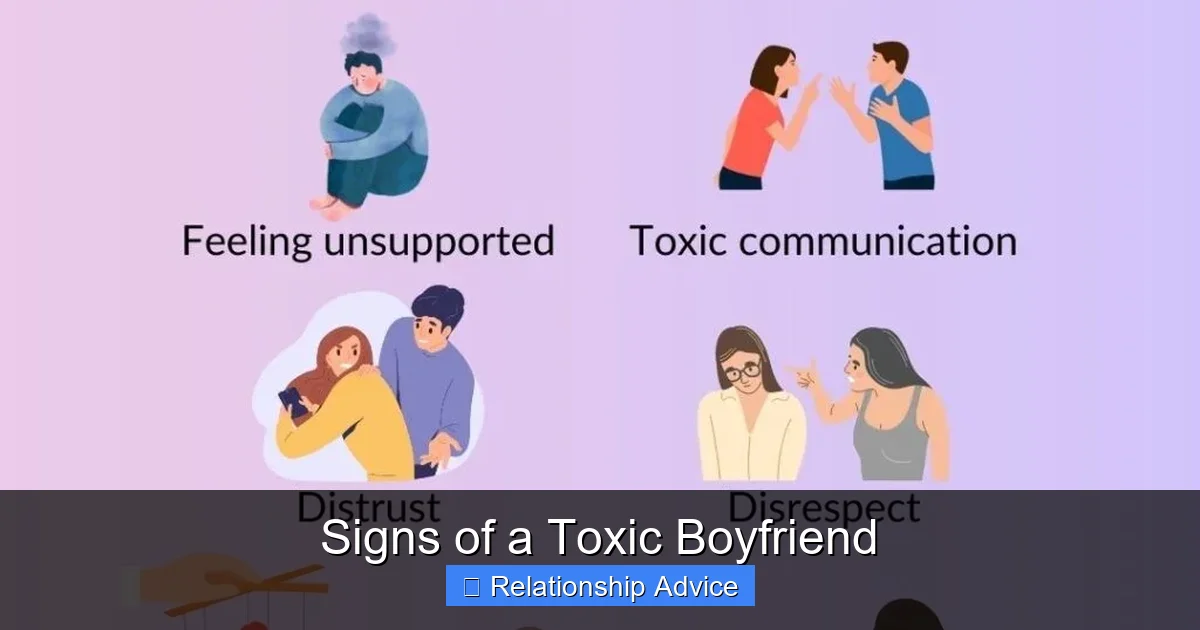
Visual guide about Signs of a Toxic Boyfriend
Image source: simplypsychology.org
Respect is non-negotiable. Yet many women stay in relationships where their partner routinely belittles them. Maybe he rolls his eyes when you share an idea at work. Or calls you “crazy” when you express concern about something. Perhaps he makes jokes at your expense during family gatherings—jokes that leave you feeling foolish and invisible.
Disrespect wears many hats:
– Mocking your interests (“Why do you even care about knitting? That’s so lame.”)
– Dismissing your opinions (“You don’t understand politics—let me handle this.”)
– Criticizing your appearance publicly (“Did you gain weight?” said at dinner with friends)
These aren’t isolated incidents—they’re repeated patterns. Over time, they chip away at your confidence. You begin doubting your judgment, your worth, even your reality.
A good man listens without interrupting. He validates your feelings, even if he disagrees. He celebrates your strengths instead of focusing on flaws. If your boyfriend constantly undermines you, consider whether he sees you as an equal… or just an extension of himself.
—
3. He Uses Emotional Manipulation Tactics
Manipulation is insidious. Unlike direct conflict, it sneaks in under the guise of concern, care, or logic. Common tactics include:
– **Guilt-tripping**: “If you really loved me, you’d skip the girls’ night.”
– **Playing the victim**: “You always ignore me—I guess I’m just not important.”
– **Gaslighting**: “That never happened. You’re imagining things.”
– **Love bombing followed by devaluation**: He showers you with affection early on, then pulls away suddenly, leaving you confused and needy.
These strategies keep you emotionally drained. You end up apologizing for emotions you’re entitled to have. You second-guess your memory or sanity. Worst of all, you start blaming yourself for his behavior.
Healthy communication means saying, “I feel hurt when you cancel last minute. Can we talk about why?” Toxic partners avoid accountability and redirect blame. They make you feel guilty for setting boundaries—even basic ones like needing alone time.
If you frequently feel anxious around your partner or question whether you’ve done something wrong, that’s a sign of manipulation. Real love doesn’t leave you walking on eggshells.
—
4. Jealousy Turns Into Possession
Jealousy is normal in early dating stages—everyone gets a little protective. But when it crosses into obsession, it becomes dangerous. A toxic boyfriend doesn’t just get jealous—he acts on it.
He might accuse you of flirting when you laugh with a friend. Demand to know who you’re texting late at night. Accuse you of cheating without evidence. Some even resort to tracking apps or social media surveillance.
True love trusts. It encourages space. It says, “I trust you completely,” even when he’s unsure. Possessiveness isn’t romantic—it’s a mask for insecurity. Men who can’t handle your independence often project their own fears onto you.
Ask yourself: Does he get angry when you spend time apart? Does he interpret innocent conversations as threats? If yes, that’s not passion—that’s control disguised as devotion.
—
5. He Avoids Accountability and Blames Others
Everyone messes up. The difference between immature and toxic behavior? Whether your partner owns their mistakes.
Imagine this scenario: He shows up late to your important event, ruins your mood, then says, “Traffic was terrible,” without apologizing. Or worse—he blames you: “You should’ve reminded me earlier.”
Toxic men rarely accept fault. Instead, they deflect:
– “You provoked me.”
– “Everyone else does that.”
– “I was stressed, but you’re too sensitive.”
They may apologize once—just enough to keep you hooked—but revert to old habits within days. Without genuine remorse or effort to change, apologies ring hollow.
In contrast, emotionally mature partners say, “I messed up. I’m sorry. How can I do better?” Their focus isn’t on winning arguments—it’s on repairing trust.
If your boyfriend consistently shifts blame, especially for serious issues like dishonesty or aggression, that’s a major **sign of a toxic boyfriend**. No relationship can survive without mutual accountability.
—
6. Your Self-Esteem Takes a Hit
Relationships should make you feel valued, not diminished. But in toxic dynamics, your confidence slowly crumbles. You start believing negative things he says about you. You second-guess every decision. You shrink yourself to fit his expectations.
Signs your self-esteem is suffering:
– You avoid sharing your thoughts because you fear judgment.
– You tolerate mistreatment “for the sake of peace.”
– You feel exhausted after interactions with him.
– You compare yourself unfavorably to others.
A healthy partner uplifts you. He notices your efforts. He celebrates your uniqueness. A toxic one drains you. He criticizes your ambitions. He mocks your dreams. He makes you feel small.
Ask yourself honestly: When I’m with him, do I feel lighter… or heavier? Do I look forward to our time together… or dread it?
Your intuition knows. If something feels off—even if you can’t name it—trust it.
—
7. He Refuses to Grow or Change
People evolve. Relationships thrive when both partners grow alongside each other. But if your boyfriend resists self-improvement—or worse, actively sabotages it—that’s concerning.
Maybe he mocks therapy. Calls you “weak” for reading self-help books. Gets angry when you suggest couples counseling. Or dismisses feedback: “I’m perfect as I am.”
Real change requires humility. It means admitting flaws, seeking help, and working on weaknesses. Toxic individuals often lack insight into their behavior. They may acknowledge surface-level issues (“Yeah, I yell sometimes”) but refuse deeper reflection.
Consider this: Has he ever taken steps to address anger management, jealousy, or communication problems? Or does he simply expect *you* to adapt to *his* needs?
Growth isn’t linear—but stagnation is a dealbreaker. If he shows zero willingness to improve, staying may mean accepting ongoing harm.
—
8. Physical or Verbal Aggression Appears
While emotional abuse is devastating enough, physical violence is never acceptable. Any history of hitting, throwing objects, threatening harm, or restraining you is an immediate red flag.
Even “playful” aggression—like pushing, grabbing, or slamming doors—can escalate. Many women minimize these incidents: “It wasn’t that bad,” “He didn’t mean it,” “He’s stressed.” But every aggressive act reinforces power imbalance.
If you’ve experienced even one instance of violence, reach out to a trusted friend, counselor, or domestic violence hotline immediately. Safety comes first.
Remember: A man who respects you won’t raise his voice. He won’t use fear to control you. Period.
—
How to Protect Yourself: Practical Steps
Recognizing toxic signs is powerful—but action matters most. Here’s how to safeguard your well-being:
Document Everything
Keep a journal of concerning incidents: dates, what happened, how you felt. Text logs, voicemails, or screenshots also help if you need proof later.
Talk to Someone Trusted
Confide in a close friend, family member, or therapist. Objectivity helps you see patterns clearly. They may offer perspectives you’ve overlooked.
Set Clear Boundaries
Say no to behaviors that cross lines. Example: “I won’t discuss my phone with you.” Be firm—but calm.
Prioritize Your Needs
Schedule time for hobbies, friends, and self-care. Reconnect with activities that bring joy outside the relationship.
Consider Professional Help
Couples counseling can help—but only if *both* partners commit. If he refuses, individual therapy supports your healing.
Most importantly: **You deserve better than conditional love.** True partners want what’s best for you—even if it means letting go.
—
Conclusion: Trust Your Gut
Spotting the **signs of a toxic boyfriend** isn’t about being paranoid—it’s about self-preservation. Every person deserves a relationship built on mutual respect, trust, and kindness. If yours lacks those foundations, walking away isn’t weakness; it’s courage.
Remember: Staying “because you’re invested” or “what if he changes?” often leads to deeper regret. Growth requires effort from *both* sides. If he won’t meet you halfway, your energy is better spent elsewhere.
You’re worthy of someone who sees your light—not one who dims it. Trust your instincts, lean on your support system, and choose relationships that honor your whole self.
For more guidance on healthy relationships, check out our article on [early signs of a controlling man](https://lovetra.com/early-signs-of-a-controlling-man/) or explore [steps for moving on from a toxic relationship](https://lovetra.com/steps-for-moving-on-from-a-toxic-relationship/).
Frequently Asked Questions
What are the earliest signs of a toxic boyfriend?
Early signs include excessive jealousy, frequent criticism, and attempts to isolate you from friends. These behaviors often start subtly but intensify over time if unaddressed.
Can a toxic boyfriend change?
Yes, but only if he genuinely wants to and commits to therapy or self-work. Without accountability and effort, patterns typically repeat.
How do I know if I’m in a toxic relationship?
If you feel drained, anxious, or constantly second-guessing yourself around your partner, it’s likely unhealthy. Trust your feelings—they’re valid.
Should I confront my boyfriend about his behavior?
Confrontation can help—but prioritize safety. If he reacts defensively or aggressively, seek support from a counselor or trusted person first.
Is jealousy always a sign of toxicity?
Occasional jealousy is normal, but when it turns into accusations, monitoring, or isolation, it crosses into control—a major red flag.
Where can I get help leaving a toxic relationship?
Contact domestic violence hotlines, therapists, or support groups. Our guide on [moving on from toxicity](https://lovetra.com/steps-for-moving-on-from-a-toxic-relationship/) offers practical steps.
