Discreet vs Discrete: Meaning, Trick & Examples
Discreet vs discrete: “discreet” means careful, modest and able to keep private matters private, while “discrete” means separate, distinct and individually countable. A discreet person does not gossip. A discrete item stands apart from other items. The two words sound exactly the same, so the only way to choose correctly is to know the meaning and the spelling. This guide gives you the answer in one line, a simple memory trick, more than twenty example sentences, the related words (discretion, discreetly, discretely), common mistakes, and a quiz with answers.
Discreet and discrete are homophones, which means they sound alike but have different meanings and spellings, just like the pairs in our lessons on affect vs effect, desert vs dessert and principal vs principle. You can find the wider set of rules in our English grammar rules guide.
What is the difference between discreet and discrete?
- Discreet (adjective): careful about what you say or do, especially to protect privacy or avoid causing embarrassment. A discreet person is tactful, modest and trustworthy.
- Discrete (adjective): separate and distinct; made up of individual parts that can be counted or told apart. It is often used in math, science and technical writing.
Both are pronounced dih-SKREET. Only the spelling tells them apart.
How can you remember discreet vs discrete?
This trick works because of the two letter e’s:
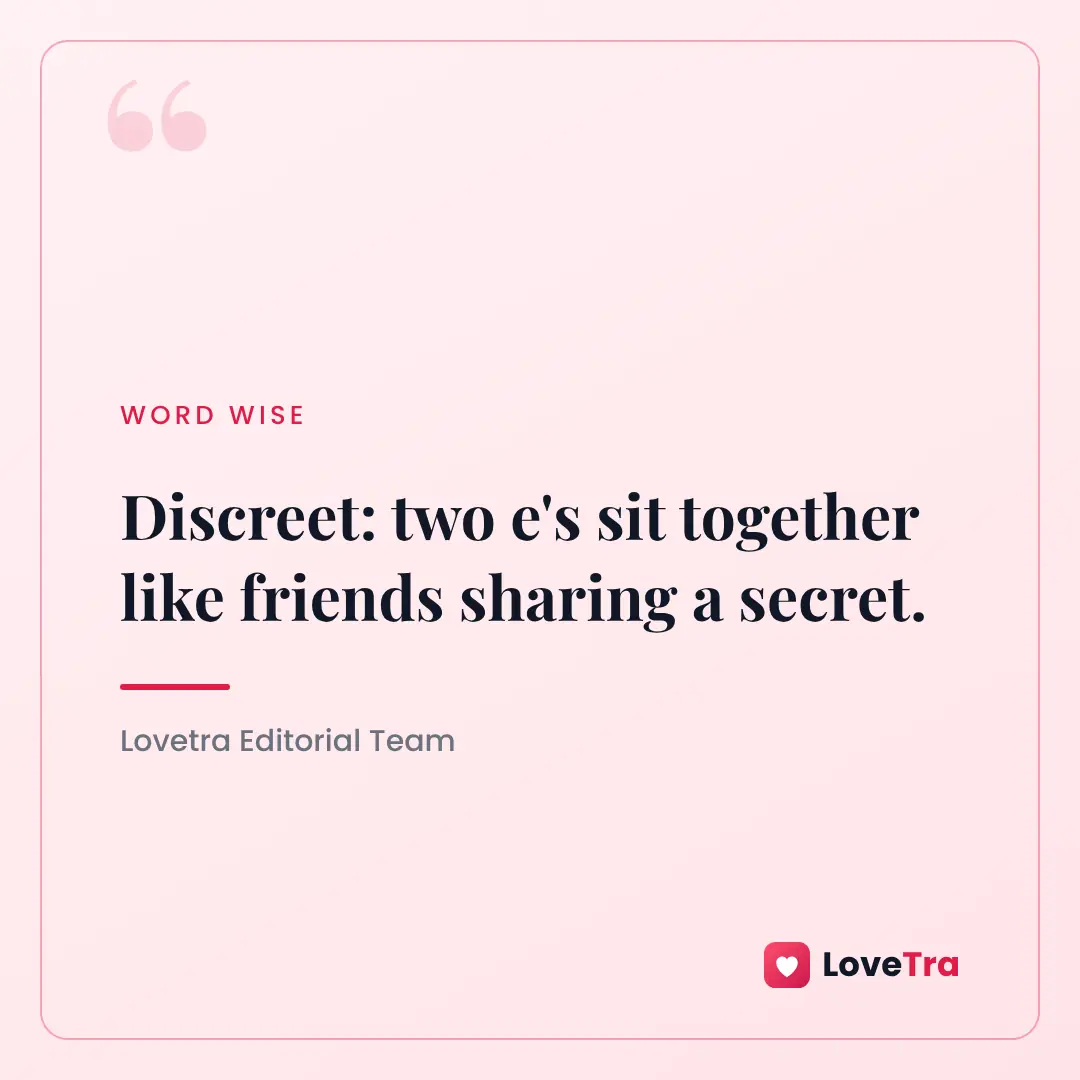
- Discreet has the two e’s together (ee), like two friends sitting close and sharing a quiet secret.
- Discrete has the two e’s separated by the letter t, like two things standing apart. Discrete = separate.
Another tip: when you want to keep something “hush-hush,” think of the word discreet with the double e as a pair of friends whispering together.
What does “discreet” mean, and how do you use it?
Discreet describes careful, respectful behaviour. A discreet person knows when to speak and when to stay quiet. In a family, discretion is a wonderful quality: it means you do not share private matters with outsiders, you handle sensitive subjects gently, and you protect the dignity of others.
Here are twelve example sentences:
- She was discreet about her neighbour’s troubles and never repeated them.
- A discreet friend keeps your secrets safe.
- He made a discreet enquiry so as not to embarrass anyone.
- The doctor was discreet and spoke quietly to the family.
- My grandmother taught me to be discreet in what I say about other people.
- Please be discreet when you give advice, and do it in private.
- The guest left discreetly so as not to disturb the meeting.
- It is wise to be discreet about family matters.
- A discreet reminder is kinder than a loud correction.
- The helper was quiet and discreet throughout the evening.
- We asked him to be discreet, and he never mentioned it again.
- A discreet person does not boast about the good they do.
What does “discrete” mean, and how do you use it?
Discrete means separate and distinct, not connected. It is common in subjects such as mathematics and science, where it describes things that can be counted one by one, such as whole numbers, rather than measured on a smooth scale.
Here are twelve example sentences:
- The book is divided into five discrete sections.
- Whole numbers are discrete, because you cannot have 2.5 children in a room.
- The teacher sorted the beans into discrete groups by size.
- The garden has three discrete beds for vegetables, herbs and flowers.
- Each project has a discrete goal and a clear finish.
- The scientist recorded discrete measurements, one at each hour.
- The cake was sold as discrete slices.
- These are two discrete problems and need separate solutions.
- The farm has several discrete fields divided by hedges.
- A year can be seen as twelve discrete months.
- The recipe has three discrete steps.
- The shop keeps pens and pencils in discrete boxes.
What are the related words: discretion, discreetly and discretely?
Each word has a noun and an adverb form. They follow the same split.
- Discretion (noun): the quality of being discreet; good judgment in what to say and do. Example: “She handled the matter with great discretion.” It also means the freedom to decide: “It is at your discretion.”
- Discreetly (adverb): in a careful, tactful way. Example: “He discreetly left a note for his friend.”
- Discreteness (noun): the quality of being separate. Example: “The discreteness of the data made counting simple.”
- Discretely (adverb): separately, as distinct units. Example: “The values were recorded discretely, one at a time.”
Notice that the noun “discretion” comes from the discreet family, not from discrete. Only discretely and discreteness belong to the “separate” family.
Discreet vs discrete: side-by-side comparison
- Spelling: discreet has “ee” together; discrete has the “e” and “e” separated by “t.”
- Meaning: discreet = careful, tactful; discrete = separate, distinct.
- Used for: discreet describes people and behaviour; discrete describes things and parts.
- Noun form: discreet has discretion; discrete has discreteness.
- Adverb form: discreetly (carefully) and discretely (separately).
- Example pair: “Be discreet when you sort the discrete piles of family papers.”
Why is discretion such a valuable quality?
The word “discreet” is more than a spelling lesson. Discretion is a mark of good character and a pillar of trust in families and friendships.
- It protects dignity. People feel safe with someone who does not talk about their mistakes.
- It builds trust. A husband and wife who are discreet about each other’s private matters strengthen their bond.
- It prevents harm. Gossip spreads quickly and can hurt. Silence protects.
- It shows wisdom. Knowing what not to say is often harder than knowing what to say.
- It teaches children respect. When children see their parents keep confidences, they learn to do the same.
Practise discretion with simple habits: do not repeat what you overhear, correct in private, avoid sharing others’ news without permission, and think before you speak. Our guide to improving English speaking has more ideas for speaking with care.
Where does discrete appear in school and daily life?
- Math: whole numbers like 1, 2, 3 are discrete; you cannot have a number between them in a count of people.
- Science: individual items such as grains of sand or bricks are discrete units.
- Organising a home: discrete storage boxes keep toys, books and tools in separate places.
- Planning: a large job divided into discrete tasks becomes easier to finish.
- Writing: a well-organised essay has discrete paragraphs, each with one main idea. See how to write a paragraph.
What are the most common discreet vs discrete mistakes?
- Using discrete for tact. Wrong: “Please be discrete about the surprise.” Right: “Please be discreet about the surprise.”
- Using discreet for separate parts. Wrong: “The book has three discreet chapters.” Right: “The book has three discrete chapters.”
- Confusing discretion with discreteness. The word for tact is discretion.
- Mixing the adverbs. “He left discreetly” means quietly. “The data were stored discretely” means separately.
- Trusting spell-check. Both are real words, so spell-check cannot catch the error. Read your sentence slowly.
How can you teach discreet vs discrete to children?
- Use the two e’s picture. Draw two friends whispering for discreet, and two houses with a fence between them for discrete.
- Act out discreet. Whisper a message and walk quietly. Say, “That was discreet.”
- Sort objects. Place beans in separate cups and say, “These are discrete groups.”
- Talk about secrets. Explain that a good friend keeps private things private, and why.
- Use a sentence game. Read a sentence and let the child choose which word fits.

Discreet vs discrete practice quiz
Choose discreet or discrete. Answers follow.
- A good friend is ______ and never gossips.
- The cupboard has four ______ shelves.
- She made a ______ phone call so no one would be embarrassed.
- Counting people gives ______ data, not continuous data.
- Please be ______ about the surprise gift.
- The story is told in three ______ parts.
- He left the room ______ when the visitors arrived.
- The garden is made up of ______ flower beds.
- My grandfather is known for his ______.
- These are two ______ questions and need separate answers.
Answers:
- discreet
- discrete
- discreet
- discrete
- discreet
- discrete
- discreetly
- discrete
- discretion
- discrete
How do discreet and discrete sound in a real conversation?
Seeing the words in a short dialogue makes the difference clear. Read this example aloud:
- “Father, may I ask you something in private?” asked Tom.
- “Of course,” said his father. “Let us go to the garden. I will be discreet.”
- “I have a problem with my homework. It has three discrete parts, and I do not understand the second.”
- “Then we will take the parts one at a time. Nobody needs to know you asked for help, and asking is a sign of wisdom.”
- “Thank you for being so discreet, Father.”
In this exchange, “discreet” describes the father’s careful, private manner, and “discrete” describes the homework parts that stand apart from each other.
What are some more example sentences to practise?
Read each sentence aloud and say why the chosen word fits.
- The neighbours were discreet and never spoke about the argument.
- The farmer planted two discrete fields of wheat on either side of the river.
- It was discreet of him to close the door before giving the advice.
- A year is divided into discrete seasons, each with its own weather.
- She gave a discreet nod to show she understood.
- The scientist counted discrete drops of water falling from the tap.
- Being discreet means thinking before you share what you know.
- The classroom was arranged into discrete reading corners.
- Her discretion made her the one the whole family trusted.
- The exam had four discrete sections, and each began on a new page.
What is a quick checklist before you write the word?
- Ask: am I talking about a person’s behaviour (careful, private)? Use discreet.
- Ask: am I talking about separate parts, groups or units? Use discrete.
- Check the e’s: together (ee) for discreet, apart (e-t-e) for discrete.
- Read the sentence aloud and swap in “tactful” or “separate.” Whichever fits is your word.
Frequently asked questions about discreet vs discrete
Do discreet and discrete sound the same?
Yes. Both are pronounced dih-SKREET. Only the spelling and meaning differ.
Which one means keeping a secret?
Discreet. Remember the two friends (ee) sitting close together.
Which one is used in math?
Discrete, as in discrete numbers and discrete data that can be counted.
What is the noun for discreet?
Discretion. The noun for discrete is discreteness.
Is “discretely” the same as “discreetly”?
No. Discreetly means in a tactful way; discretely means separately.
Final thoughts: be discreet, think in discrete steps
Discreet people protect trust, and discrete things stand apart. Keep the two e’s trick in mind, read your sentences slowly, and you will choose correctly every time. May your words always be careful and your work always be well organised. For more word pairs, explore good vs well, complement vs compliment and how to improve vocabulary.