
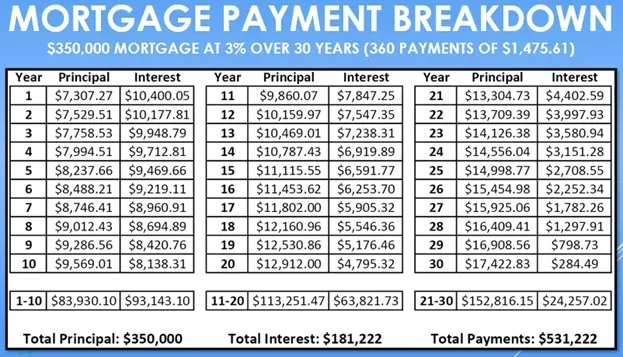
What percentage of mortgage goes to principal depends on your loan stage, interest rate, and payment schedule. Early payments mostly cover interest, while later payments build equity. Understanding this shift helps you plan smarter, save money, and own your home sooner.
Key Takeaways
- Early payments are interest-heavy: In the first few years, most of your payment goes to interest, not principal.
- The split changes over time: As the balance drops, a larger share of each payment reduces the loan amount.
- Amortization schedules show the breakdown: Your lender provides a table that maps every payment to principal and interest.
- Extra payments accelerate equity: Adding even small amounts to principal cuts interest costs and shortens the loan term.
- Refinancing can reset the clock: A new loan may lower your rate but can push you back to high-interest early payments.
- Biweekly payments help: Splitting your monthly payment into two weekly chunks adds one extra payment per year.
- Check your statements regularly: Tracking the principal balance keeps you motivated and informed.
📑 Table of Contents
- Understanding What Percentage Of Mortgage Goes To Principal
- How Mortgage Payments Split Between Principal And Interest
- What Percentage Of Mortgage Goes To Principal In The Early Years
- What Percentage Of Mortgage Goes To Principal In Later Years
- Factors That Change The Principal Percentage
- Quick Tips To Increase What Percentage Of Mortgage Goes To Principal
- Common Mistakes To Avoid
- Expert Insights On Principal Vs Interest
- Comparison Table: 30-Year Vs 15-Year Loan
- Conclusion
Understanding What Percentage Of Mortgage Goes To Principal
Buying a home feels exciting until you look at the payment breakdown. Many buyers ask the same question: what percentage of mortgage goes to principal each month? The answer surprises people. In the beginning, only a small slice of your payment reduces the loan balance. The rest covers interest. This setup is normal. It comes from how lenders structure home loans.
The good news is that the split changes. Over time, more of your money goes toward the principal. That shift builds equity and brings you closer to full ownership. Knowing how this works helps you make better choices. You can plan extra payments, compare loan options, and avoid costly mistakes. Let us walk through the details in plain language.
How Mortgage Payments Split Between Principal And Interest
Every standard home loan uses amortization. That is a fancy word for a simple idea. You pay the same amount each month, but the money gets divided differently over time. At first, the lender wants interest. Interest is the profit on the loan. The principal is the actual debt you owe. Because interest is calculated on the remaining balance, early payments lean heavily toward interest.
Here is a simple way to picture it. Imagine a pie chart that changes every month. In month one, the interest slice is large. The principal slice is small. By year ten, the slices look more balanced. By year twenty, the principal slice dominates. This pattern applies to most fixed-rate mortgages. Adjustable loans can shift differently, but the core idea stays the same.
Why The Split Changes Over Time
The math behind amortization is straightforward. Interest is based on the current balance. When your balance is high, interest is high. As you pay down the principal, the balance drops. A lower balance means less interest. That leaves more room for principal reduction. The payment amount stays fixed, so the extra room goes straight to the loan.
This is why people say mortgages are front-loaded with interest. It is not a trick. It is just how the schedule works. If you want to change the outcome, you need to change the inputs. Extra payments, shorter terms, or lower rates can all tilt the balance in your favor.
What Percentage Of Mortgage Goes To Principal In The Early Years
Let us look at a real example. Suppose you borrow $300,000 at a fixed rate of 6 percent for 30 years. Your monthly payment lands near $1,800. In the first month, about $1,500 goes to interest. Only around $300 reduces the principal. That means roughly 17 percent of your payment hits the principal balance. The rest services the interest.
Fast forward to year five. Your balance has dropped a bit. Interest now takes a smaller share. Principal might get close to 25 percent of the payment. It is still not the majority, but the trend is clear. The percentage climbs steadily. If you want to see your exact numbers, ask for an amortization schedule. It shows every payment line by line.
Real Example: A 30-Year Fixed Loan Breakdown
Here is a quick snapshot of how the split evolves:
- Month 1: About 17 percent to principal, 83 percent to interest.
- Year 5: About 25 percent to principal, 75 percent to interest.
- Year 10: About 35 percent to principal, 65 percent to interest.
- Year 20: About 60 percent to principal, 40 percent to interest.
- Final years: Most of the payment goes to principal until the balance hits zero.
These numbers are approximate. Your rate, loan size, and term will change the exact percentages. Still, the pattern holds. Early on, interest dominates. Later, principal takes the lead.
What Percentage Of Mortgage Goes To Principal In Later Years
The later years feel very different. By the time you reach the halfway point, the balance has shrunk enough that interest no longer eats most of your payment. Principal starts to lead. This is the phase where equity grows faster. You are finally chipping away at the core debt instead of mostly paying borrowing costs.
If you keep the same payment, the loan finishes on schedule. If you add extra money, you can shave years off the term. That is where many homeowners find big savings. A small extra payment each month can remove thousands in interest. It also speeds up the day when you own the home free and clear.
How Equity Builds As Principal Grows
Equity is the part of the home you truly own. It grows in two ways. First, the principal balance drops. Second, the property value may rise. When principal payments increase, your equity grows faster from the debt side. That gives you more financial flexibility. You can refinance, take a home equity line, or simply enjoy less debt.
Think of equity as a safety cushion. More equity means less risk. It also means more options. If you ever need to sell, a higher equity stake can mean more cash in your pocket. That is why understanding what percentage of mortgage goes to principal matters so much. It is not just about monthly budgets. It is about long-term wealth.
Factors That Change The Principal Percentage
Not all loans behave the same. Several factors shift the principal-to-interest ratio. Knowing these helps you compare offers and plan ahead.
Loan Term Length
Shorter terms mean higher monthly payments, but more principal each month. A 15-year loan usually carries a lower rate too. That combination speeds up equity growth. A 30-year loan lowers the monthly payment, but interest hangs around longer. If you can afford the higher payment, a shorter term often saves money overall.
Interest Rate
Rate changes move the needle a lot. A higher rate pushes more money toward interest in the early years. A lower rate lets principal grow faster from the start. Even a small rate drop can change the percentage split noticeably over time. That is why shoppers compare rates carefully before signing.
Extra Payments And Prepayment
Extra payments are the fastest way to change the story. When you pay more than the required amount, you can direct the surplus to principal. That reduces the balance right away. Less balance means less interest next month. The effect compounds. Over time, this strategy can cut years off the loan and save serious money.
Payment Frequency
How often you pay also matters. Biweekly payments add one extra full payment per year. That extra payment goes mostly to principal. It is a simple habit that many people overlook. If your lender allows it, this approach can be an easy win.
Quick Tips To Increase What Percentage Of Mortgage Goes To Principal
If you want more of your payment to reduce debt, try these practical moves:
- Make extra principal payments: Even one extra payment a year helps.
- Round up your payment: Adding a small amount each month adds up.
- Switch to biweekly payments: This creates an extra payment annually.
- Refinance to a shorter term: A 15-year loan boosts principal share.
- Use windfalls wisely: Tax refunds or bonuses can knock down the balance.
- Check for prepayment penalties: Make sure extra payments are allowed.
- Track your amortization schedule: Seeing progress keeps you motivated.
Common Mistakes To Avoid
Well-meaning homeowners sometimes make choices that slow their progress. Here are the usual traps:
- Ignoring the amortization schedule: Without it, you may not know where your money goes.
- Assuming all extra payments reduce principal: Some lenders apply extras to future interest unless you specify otherwise.
- Refinancing without running the numbers: A lower rate can help, but resetting the clock may increase total interest.
- Skipping payments during hardship: Missed payments can add fees and delay equity growth.
- Focusing only on monthly payment size: A low payment can hide a long, expensive loan.
Expert Insights On Principal Vs Interest
Mortgage professionals often say the same thing: the loan term and rate drive the split. They also stress the value of clarity. When borrowers see the schedule, they make better decisions. Many experts recommend early extra payments if your budget allows. The reason is simple. Early principal reduction saves more interest than later extra payments. That is because interest is highest at the start.
Another common insight is to align your strategy with your goals. If you plan to move soon, a long loan may be fine. If you want to stay for decades, paying down principal faster can make sense. There is no single right answer. The best choice fits your cash flow, risk tolerance, and timeline.
Comparison Table: 30-Year Vs 15-Year Loan
Here is a simple side-by-side look at how term length affects the principal share:
- 30-year loan: Lower monthly payment, slower principal growth, more total interest over time.
- 15-year loan: Higher monthly payment, faster principal growth, less total interest over time.
- Best for flexibility: 30-year loan gives more breathing room in your budget.
- Best for savings: 15-year loan builds equity quicker and costs less overall.
This table is a general guide. Your actual numbers depend on the rate, loan amount, and lender terms. Always compare the full cost, not just the monthly payment.
Conclusion
So, what percentage of mortgage goes to principal? It starts small and grows over time. Early payments lean heavily toward interest, while later payments focus on reducing the balance. This is the heart of amortization. Once you see the pattern, you can work with it instead of feeling puzzled by your statement.
The most powerful lever is your behavior. Extra payments, shorter terms, and smarter refinancing can all increase the principal share. Even small changes add up. They cut interest, build equity, and bring you closer to owning your home outright. Keep an eye on your schedule, ask questions, and choose the path that matches your goals. With a clear plan, every payment can work harder for you.
Frequently Asked Questions
How much of my mortgage payment goes to principal at the start?
At the beginning, only a small portion goes to principal, often around 15 to 25 percent depending on your rate and term. The rest covers interest. Over time, the principal share grows as the balance drops.
Why does most of my payment go to interest early on?
Interest is calculated on the remaining balance, which is highest at the start. Since your payment is fixed, the lender takes the interest first and applies the remainder to principal. As the balance falls, more of each payment reduces the loan.
Can I increase what percentage of mortgage goes to principal?
Yes. You can make extra payments, switch to biweekly payments, or choose a shorter loan term. Directing extra funds to principal lowers the balance faster and reduces future interest costs.
Does refinancing change the principal percentage?
It can. Refinancing may lower your rate, which helps more of each payment go to principal. However, if you reset to a new 30-year term, you may return to an interest-heavy early stage. Always compare the total cost before refinancing.
Is a 15-year mortgage better for paying down principal?
Usually, yes. A 15-year loan has higher monthly payments, but a larger share goes to principal from the start. It also typically carries a lower rate, which saves interest and builds equity faster.
How can I see how much of my payment goes to principal?
Ask your lender for an amortization schedule. It shows each payment broken into principal and interest. You can also check your monthly statement, which often lists the principal and interest amounts separately.
