Then vs Than: The Easy Difference (With 25 Examples)
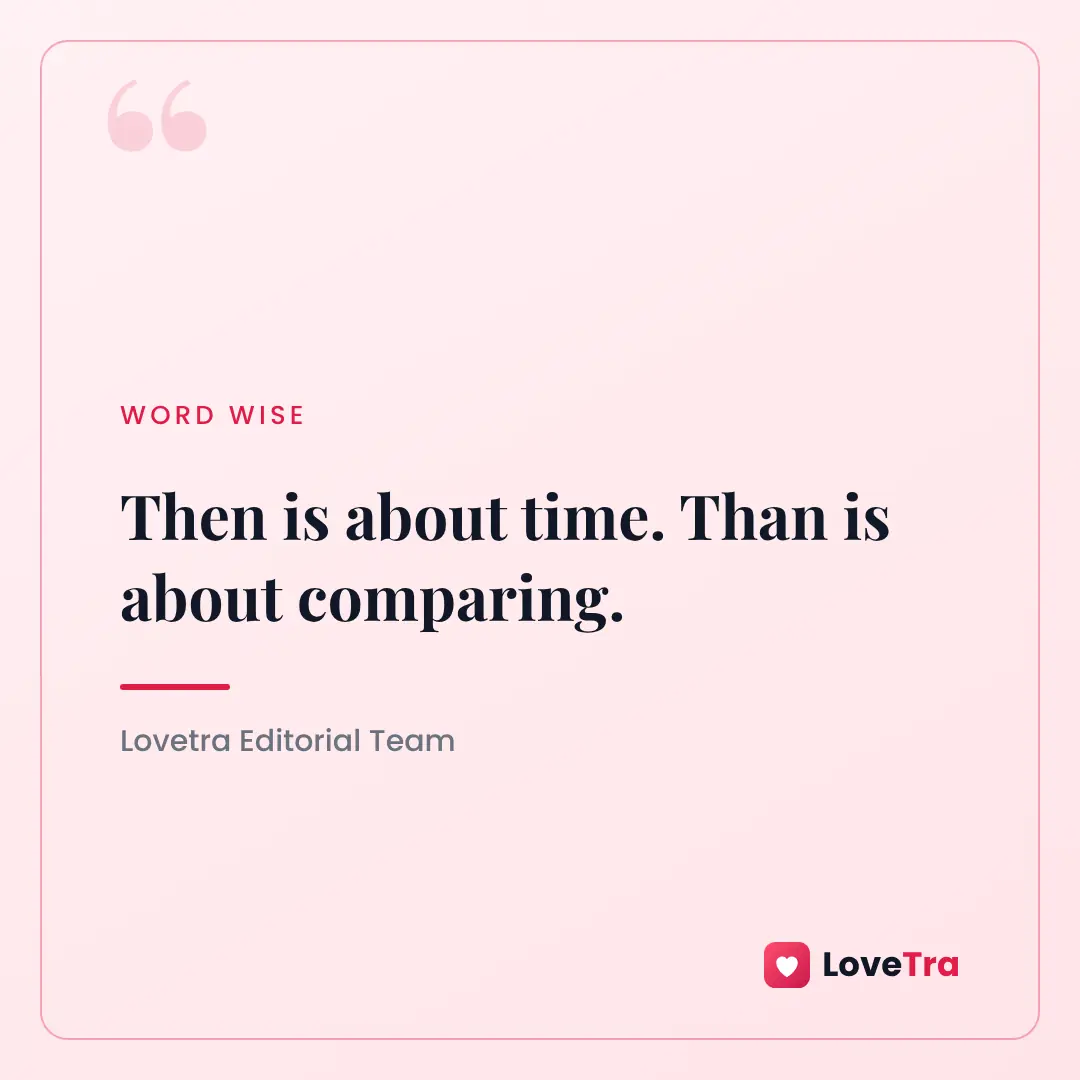
Then vs than in one line: use then when you talk about time or order (“first this, then that”), and use than when you compare two things (“taller than,” “better than”). If you are comparing, you need *than*. If you are saying what happens next, you need *then*.
These two words differ by a single letter, and many people type the wrong one without noticing. Don’t worry: the rule is easy once you see it. In this guide you will find the meaning of each word, a memory trick, 25 example sentences, a side-by-side table, the most common mistakes and a ten-question quiz with answers. For another pair that follows the same “one letter changes everything” pattern, see our guide to affect vs effect, and for the bigger picture see English grammar rules.
What Is the Difference Between Then and Than?
The difference is that *then* is about time and *than* is about comparison. They also sound a little different: *then* rhymes with “when,” while *than* rhymes with “can.”
- Then answers the question “When?” or “What next?”
- Than answers the question “Compared with what?”
A quick example shows both: “I finished my homework, then I helped my mother. Helping her made me happier than playing.”
A Simple Memory Trick
There are two easy tricks:
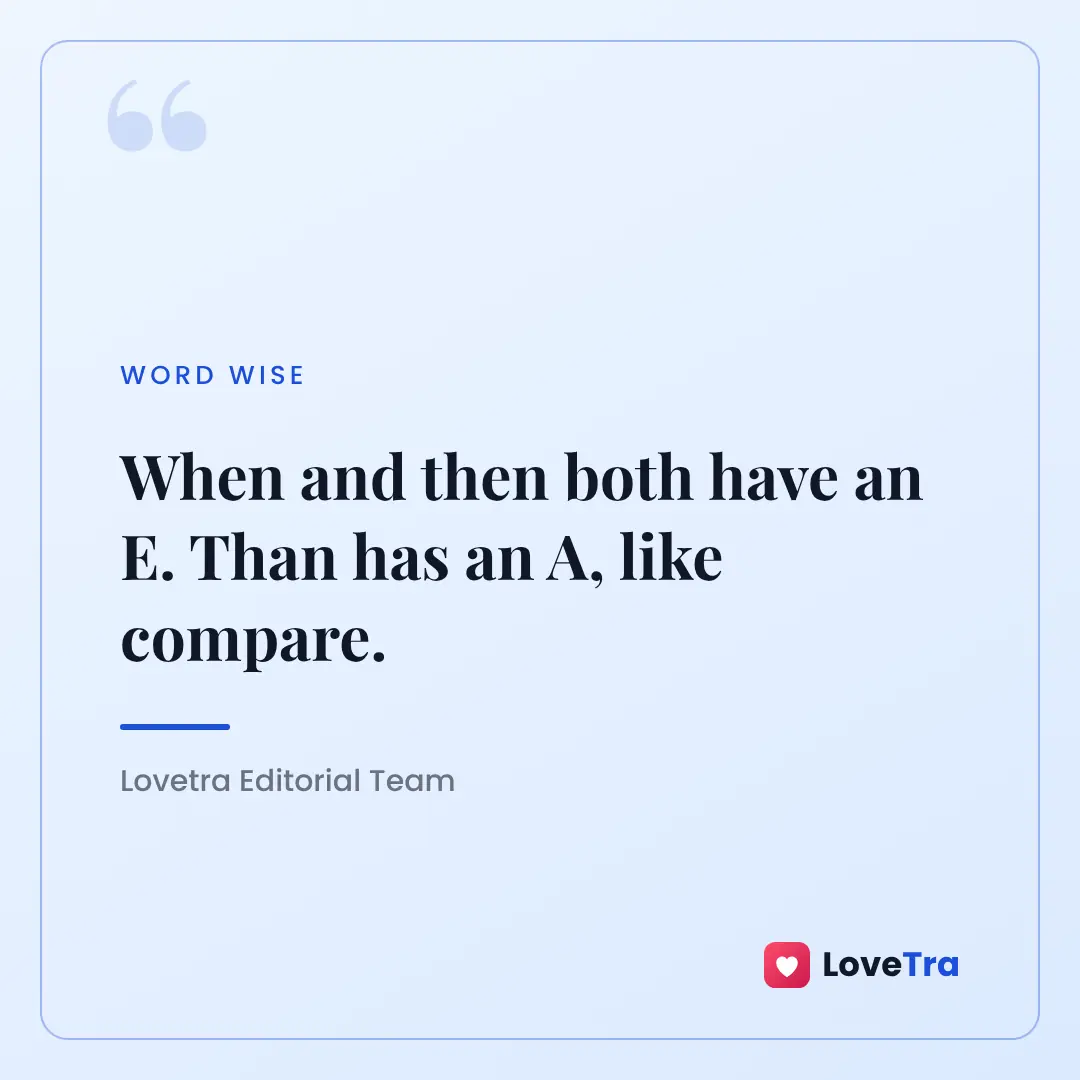
- Then has an E, like “time” and “next.” *Then* and *when* both have an E, and both are about time. Remember: *when* and *then* belong together.
- Than has an A, like “compare.” The A in *than* matches the A in *comparison*. Both have the letter A.
A third trick is to ask yourself: “Am I comparing two things?” If yes, write *than*. If not, write *then*.
Then: Meaning and Use
Then is mostly an adverb. It tells us when something happens, what happens next or what follows as a result. It can also act as a noun or an adjective in a few phrases.
1. Then Means “At That Time”
- In those days, we lived in a small village. We were happy then.
- I was a boy then, and now I am a father.
- She was tired then, so she rested.
2. Then Means “Next” or “After That”
- First wash your hands, then sit down to eat.
- We finished dinner, and then we cleared the table.
- Mix the flour and water, then add a pinch of salt.
- Open the door, then step inside.
3. Then Means “In That Case” or “As a Result”
- If you study carefully, then you will understand the lesson.
- If the weather is fine, then we will visit our grandparents.
- You have finished? Then you may go and play.
4. Other Uses of Then
- By then, the sun had set. (noun use: “by that time”)
- The then leader of the village was very kind. (adjective use: “the leader at that time”)
Than: Meaning and Use
Than is a conjunction (and sometimes a preposition) used to compare two things, amounts or people. It almost always follows a comparative word such as *taller, better, faster, more, less, rather, other* or *different*.
- My brother is taller than I am.
- This cake is sweeter than that one.
- She walks faster than her sister.
- Honesty is worth more than gold.
- I would rather read than watch television.
- He has more books than I do.
- It takes less time than you think.
- The garden is bigger than the house.
- Nothing is better than a clear conscience.
- She works harder than anyone I know.
Words That Signal Than
Look for these words just before a comparison. They tell you that *than* is coming:
- more
- less
- rather
- other
- different
- fewer
- better, worse, older, younger, taller, shorter (any word ending in -er)
Then vs Than Side by Side
| Feature | Then | Than |
|---|---|---|
| — | — | — |
| Main job | Shows time or order | Compares things |
| Part of speech | Adverb (also noun, adjective) | Conjunction or preposition |
| Rhymes with | when, pen | can, man |
| Question it answers | When? What next? | Compared with what? |
| Memory trick | E for time (when, then) | A for compare |
| Example | We ate, then we talked. | Rice is cheaper than meat. |
How Do You Know Which One to Use?
Use this short checklist:
- Is the sentence comparing two things? Choose than.
- Does the sentence say what happened first, next or later? Choose then.
- Can you replace the word with “after that” or “at that time”? Choose then.
- Is there a comparative word such as *more, less, better, taller* just before it? Choose than.
- Read the sentence aloud. The correct word will fit naturally.
Common Mistakes With Then and Than
Here are the mistakes people make most often, with the corrected sentences.
- Wrong: My sister is older then me. Right: My sister is older than me.
- Wrong: I’d rather stay home then go out. Right: I’d rather stay home than go out.
- Wrong: She is better then I am at drawing. Right: She is better than I am at drawing.
- Wrong: If you work hard, than you will succeed. Right: If you work hard, then you will succeed.
- Wrong: More then ten children came. Right: More than ten children came.
- Wrong: He ran faster then I did. Right: He ran faster than I did.
- Wrong: We went to the shop and than to the park. Right: We went to the shop and then to the park.
Two Tricky Phrases
- “Rather than.” Always use *than*: “I chose to walk rather than ride.”
- “Other than.” Always use *than*: “Nobody other than my father knew.”
Then vs Than in Family Life
Seeing these words in a family setting makes them easier to remember:
- First we set the table, then we call everyone to eat.
- A kind word costs less than a harsh one but is worth far more.
- Our grandfather is wiser than many of us, and then some.
- Wash the vegetables, then chop them.
- Spending time with children matters more than any gift.
Should You Say “Than I” or “Than Me”?
After *than*, both forms are common, and the right choice depends on how formal you want to be. In careful writing, treat *than* as a link to a short sentence that has been shortened. “She is taller than I” really means “She is taller than I am.” In everyday speech, “She is taller than me” is also widely accepted. If you are writing an essay or a letter, adding the verb avoids the problem: “She is taller than I am.”
- Formal: My cousin runs faster than I do.
- Everyday: My cousin runs faster than me.
- Clearest: My cousin runs faster than I run.
More Example Sentences to Read Aloud
Reading sentences aloud trains your ear. Read each pair and notice which word fits.
- We cleaned the kitchen, then we swept the yard.
- The yard is bigger than the kitchen.
- First he listened, then he answered.
- Listening is harder than talking.
- We waited for the rain to stop, then we walked home.
- A walk home is better than a ride in the rain.
- If you ask politely, then people are glad to help.
- People are happier to help a polite child than a rude one.
- She finished her schoolwork early, then read a book.
- Reading is more useful than wasting time.
- Plant the seeds, then water them gently.
- A garden grows faster than you expect when it is loved.
- Back then, our grandmother cooked on a small stove.
- Her stories are warmer than any blanket.
- Check your work, then hand it to your teacher.
A Short Story That Uses Both Words
A short story shows how natural these words become in real writing. Read it slowly and spot every *then* and *than*.
On Saturday, Ben woke earlier than his sister. He made his bed, then went to the kitchen to help his mother. First he washed the plates, then he dried them and put them away. His mother smiled and said that a helpful son is worth more than a pile of gifts. After breakfast, the family walked to the market. The walk was longer than usual, but Ben did not mind. He carried the bags, then offered to carry his grandmother’s basket too. Back at home, his father said that Ben had done better than he had expected. Ben felt happy, and then he took a nap.
Count the words: there are three uses of *then* (time and order) and four uses of *than* (comparison). Try writing your own short story with three of each.
Practice Quiz: Then or Than?
Fill in the blank with *then* or *than*. Answers follow.
- Mix the eggs and sugar, ______ add the flour.
- My brother is two years older ______ I am.
- If you finish your chores, ______ you may read.
- Nothing makes me happier ______ a quiet evening with family.
- We had breakfast, and ______ we went to school.
- This road is longer ______ the other one.
- I was very small ______.
- Would you rather walk ______ ride?
- Wash your hands first, ______ touch the food.
- She is more patient ______ I am.
Answers
- then (what happens next)
- than (older, a comparison)
- then (in that case)
- than (happier, a comparison)
- then (next in order)
- than (longer, a comparison)
- then (at that time)
- than (rather, a comparison)
- then (what happens next)
- than (more patient, a comparison)
How to Teach Then vs Than to Children
Games make this pair stick. Try these:
- Sequence cards. Write steps for a simple job, such as making tea, on cards. Ask the child to say the order using “first,” “then” and “next.”
- Comparison game. Put two objects on the table and ask, “Which is bigger? Say it with *than*.” For example, “The apple is bigger than the grape.”
- Letter clue. Write the A in “than” and the E in “then” in different colours.
- Mistake hunt. Write a few wrong sentences and let the child find and fix them.
- Daily practice. Ask for one *then* sentence and one *than* sentence at dinner each night.
Related Confusing Words to Learn Next
If you enjoyed this lesson, these pairs are worth learning too:
- Affect vs effect: action and result.
- Advice vs advise: noun and verb.
- Complement vs compliment: completing and praising.
- Principal vs principle: a person or a rule.
Better writing comes from small habits repeated daily. Our guide on how to improve writing skills shares more.
Frequently Asked Questions
Is it “more than” or “more then”?
It is always “more than.” It is a comparison, so use *than*.
Is it “rather than” or “rather then”?
It is “rather than.” The word *rather* signals a comparison.
Can I say “than” for time?
No. Use *then* for time and order. “Than” never talks about time.
What does “and then some” mean?
It means “and even more.” For example, “He gave his best and then some.” The word *then* here is correct because it follows an earlier statement.
Do *then* and *than* sound the same?
They sound similar, but not identical. *Then* has the vowel in “pen,” and *than* has the vowel in “man.” Practise saying both slowly.
Why do people mix them up?
They look and sound alike, and many people type quickly. Using the A and E trick prevents the mistake.
Final Thoughts
Then is about time, than is about comparison. Remember “when and then,” think of A for compare, and check your sentence by asking what it is doing. A few minutes of practice a day will make you confident for life. For more lessons like this, visit our Character category.