

You deserve love that’s real—not just pretend. Many women stay in relationships where their partner acts loving but doesn’t truly care. Recognizing the signs he pretends to love you is crucial for your emotional well-being. From empty promises to emotional distance, these behaviors signal deeper issues. This guide helps you identify manipulation, set healthy boundaries, and move toward authentic connection. Whether you’re questioning your current relationship or healing from past hurt, understanding these red flags empowers you to choose respect over illusion.
Love should feel like coming home—warm, safe, and full of mutual care. But what happens when someone says they love you while doing everything short of showing it? You might find yourself wondering: *Is he pretending to love me?* It’s a painful question, especially if you’ve invested emotionally. The truth is, some people wear masks of affection while hiding their true intentions. Recognizing the difference between genuine love and performative devotion can save you years of heartache.
When a man pretends to love you, it’s rarely about malice—more often, it stems from fear, insecurity, or selfish motives. Maybe he’s afraid of commitment but enjoys the perks of being loved. Or perhaps he’s using your kindness as emotional currency without reciprocating. Whatever the reason, the result is the same: your emotional needs go unmet, and your self-worth gets eroded over time. Spotting these patterns early gives you the power to walk away before more damage is done.
In this article, we’ll explore the most telling signs he pretends to love you, why people behave this way, and how to protect your heart. We’ll also share practical steps to rebuild your confidence and attract real, respectful love. Because you don’t need a performance—you deserve a partnership built on honesty and care.
Key Takeaways
- Emotional absence despite physical closeness: He shows up for dates and sex but avoids deep conversations about feelings, future plans, or personal struggles.
- Inconsistent affection: Love comes in waves—sometimes he’s warm and attentive; other times he’s cold, distant, or dismissive without clear reasons.
- Lack of accountability: When mistakes happen (like lying or breaking trust), he blames you, refuses to apologize, or makes excuses instead of taking responsibility.
- Conditional support: He only offers encouragement when it benefits him—during his tough times, not yours. You’re rarely prioritized.
- Future talk with no follow-through: He uses phrases like “I see us getting married” or “We’ll live together someday” but never takes concrete steps toward those goals.
- Gaslighting tendencies: He twists reality to make you doubt your memory, perception, or sanity—especially when confronted about his behavior.
- Protects you from his inner circle: He keeps you separate from friends, family, or important decisions, limiting your access to support systems.
📑 Table of Contents
- Why Men Pretend to Love You
- Sign #1: Emotional Distance Masked by Physical Intimacy
- Sign #2: Empty Promises and No Follow-Through
- Sign #3: Conditional Affection and Emotional Manipulation
- Sign #4: Lack of Accountability and Deflection
- Sign #5: Isolation Tactics and Control Over Your Social Circle
- Sign #6: Future Plans That Never Materialize
- What to Do When You Suspect He’s Pretending
- Healing and Moving Forward
Why Men Pretend to Love You
People don’t usually pretend to love someone out of pure cruelty. More often, there’s a hidden motive—fear of vulnerability, desire for control, or simply not being ready for real intimacy. Understanding these underlying reasons helps you see beyond the surface and respond with clarity, not anger.
One common reason is **emotional immaturity**. Some men avoid deep connections because they haven’t learned how to handle vulnerability, conflict resolution, or long-term responsibilities. They may say “I love you” to keep you close but freeze up when asked to commit. Others are **pathologically dishonest**, using charm and false promises to manipulate others into staying in relationships that serve their own interests.
Another possibility is **fear of abandonment**. A man who grew up with inconsistent caregivers might unconsciously sabotage stable relationships, believing they’re doomed to fail anyway. By pretending to love you while creating distance, he protects himself from getting hurt again. Then there’s the **self-serving manipulator**—someone who enjoys the status, attention, or material benefits that come with having a girlfriend without putting in equal effort.
It’s also worth noting that cultural or social pressures play a role. In some environments, “being a good boyfriend” means saying all the right things—even if you don’t mean them. Over time, these empty rituals become normalized, making it harder to distinguish between sincerity and performance.
The key takeaway? Don’t assume ill intent. Instead, focus on actions versus words. Genuine love shows up consistently, even when it’s inconvenient. If your partner’s behavior contradicts his declarations, that’s a red flag worth investigating.
Sign #1: Emotional Distance Masked by Physical Intimacy
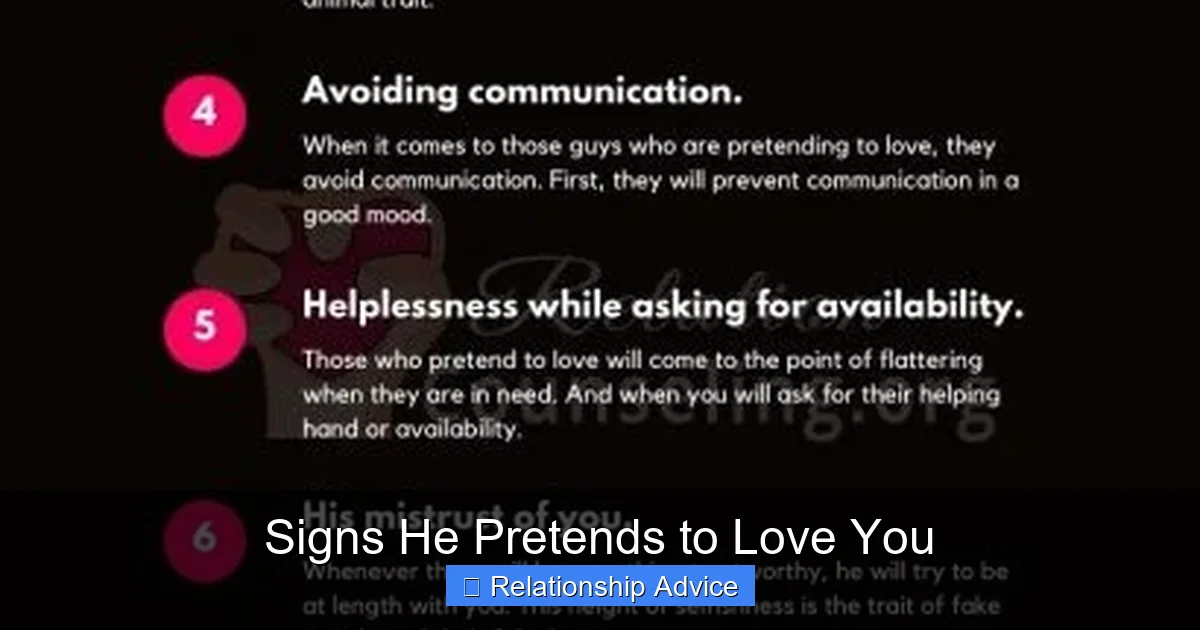
Visual guide about Signs He Pretends to Love You
Image source: relationcounseling.org
Physical attraction and emotional intimacy are two entirely different things. You can kiss passionately one night and avoid eye contact during a serious conversation the next. When a man pretends to love you, he often maintains closeness in bed or during casual hangouts while staying emotionally guarded.
For example, he might text “Good morning! Miss you!” every day, yet refuse to discuss your future plans. Or he’ll hold your hand in public but roll his eyes when you bring up therapy or family issues. These contradictions scream inconsistency.
Here’s another telltale sign: **he talks about love but avoids vulnerability**. Genuine partners open up about fears, dreams, and past hurts. If yours changes the subject whenever you get too deep, he’s likely keeping you at arm’s length. Ask yourself: *Does he ever ask about my childhood or share his own struggles?* If the answer is no, he’s not building emotional intimacy—he’s maintaining a transactional dynamic.
Also watch for **selective availability**. He’s always free for sex or fun activities but disappears during stressful moments in your life—like job loss, illness, or grief. True love isn’t just convenient—it’s present through thick and thin.
To test this pattern, try sharing something vulnerable (e.g., “I failed my certification exam today”). Notice how he responds. Does he offer comfort? Help brainstorm solutions? Or does he pivot to talking about his day? If he sidesteps your pain, that’s a major warning sign.
Sign #2: Empty Promises and No Follow-Through
Nothing reveals pretense faster than broken promises. When a man says he loves you but repeatedly fails to act on his words, he’s signaling that your relationship isn’t a priority. Common examples include:
– Telling you he’ll introduce you to his parents… then canceling last minute.
– Saying “Let’s plan a trip together” but never booking anything.
– Promising to change after arguments… but repeating the same hurtful behavior.
These aren’t just oversights—they’re patterns. Pay attention to whether he makes commitments that require effort from him. If he only promises things that benefit you (e.g., “I’ll buy you flowers tomorrow”) while avoiding sacrifices for you, that’s a problem.
Another version of this is **future talk without foundation**. He might say, “We’ll get married in five years!” but lives three hours away and hasn’t visited your hometown once. Or he claims you’re “the one” but refuses to meet your closest friends or join you at family gatherings.
Ask yourself: *What would change if I left?* If nothing—no apology, no effort to reconcile, no attempt to understand what went wrong—then he probably wasn’t invested in the first place.
If you’re unsure, try setting a boundary and observing his reaction. For instance, say, “I need us to start planning our future seriously. Can we schedule a time to talk about it?” Watch whether he resists, delays, or dismisses the request. Avoidance here isn’t just rude—it’s proof of disinterest.
Sign #3: Conditional Affection and Emotional Manipulation
When love feels like a reward system, it’s not real. You earn affection through compliance, flattery, or constant availability—and withdrawal happens when you disappoint him. This creates a toxic cycle where your self-worth becomes tied to his mood swings.
Examples include:
– Only hugging you when he’s in a good mood.
– Giving you the silent treatment after a minor disagreement.
– Using guilt trips: “After all I do for you…” or “You never appreciate me.”
This kind of behavior is classic **love bombing followed by devaluation**. Early on, he showers you with attention to secure your loyalty. Later, he pulls away to assert control. It’s exhausting and deeply damaging.
Another form of conditional love is **transactional generosity**. He buys expensive gifts before asking for favors—like helping him move apartments or covering his rent. When you decline, he becomes cold or accusatory. Again, this isn’t love—it’s bartering.
Notice whether he respects your boundaries. If you say “No” to intimacy or personal space, does he respect it? Or does he pressure you with phrases like “You owe me” or “I thought you cared”?
Healthy relationships thrive on mutual respect, not coercion. If affection depends on your obedience, you’re not loved—you’re controlled.
Sign #4: Lack of Accountability and Deflection
Everyone makes mistakes. What separates caring partners from pretenders is accountability. When your man avoids blame, shifts fault, or gaslights you, he’s signaling that your feelings don’t matter as much as preserving his ego.
Common deflection tactics include:
– Blaming you for his actions: “If you didn’t nag, I wouldn’t lie.”
– Stonewalling during conflicts: Going quiet until you back down.
– Denying events happened: “That never happened! Why are you so dramatic?”
Gaslighting is especially insidious. It starts subtly—“Are you sure you said that?”—but escalates to full-blown reality distortion. Over time, you begin doubting your own memory or sanity. That’s not love—that’s psychological manipulation.
True love involves humility. A sincere partner admits fault, says sorry, and tries to fix things. If yours refuses to acknowledge harm—even when presented with evidence—he’s protecting his image, not your well-being.
Try this exercise: After a disagreement, ask him directly, “Can you explain why you did that?” If he dodges, accuses you, or denies everything, that’s a red flag. Healthy partners seek understanding—even when they disagree.
Remember: You don’t need perfection. You need honesty. If he can’t admit he was wrong once in a while, how can you trust him with bigger things?
Sign #5: Isolation Tactics and Control Over Your Social Circle
Pretenders often work hard to isolate you from sources of support. Why? Because outside perspectives threaten their narrative. They may criticize your friends, discourage you from spending time with family, or claim your loved ones don’t approve of him.
Watch for these warning signs:
– He belittles your best friend: “She’s jealous of you.”
– He pressures you to cut ties with relatives: “They don’t want us to be happy.”
– He monitors your phone or social media: “Who were you texting?”
Isolation isn’t just rude—it’s dangerous. It leaves you dependent on him for validation and companionship. Real lovers celebrate your friendships and encourage growth outside the relationship.
Another control tactic is **financial dependency**. If he discourages you from working, pressures you to quit your job, or controls shared expenses to limit your independence, that’s a major red flag. Freedom is essential in any healthy romance.
Ask yourself: *Do I still feel like myself when I’m around my old friends?* If not—if you feel judged, diminished, or pressured to change—that’s a sign he wants to reshape you into someone easier to manage.
Sign #6: Future Plans That Never Materialize
Genuine partners paint pictures of shared futures—not just fantasies, but actionable steps. They book weekend trips, research housing options, or introduce you to coworkers. When a man pretends to love you, future talk stays vague and non-binding.
Compare these statements:
– Real partner: “I found an affordable apartment near our office. Want to tour it next week?”
– Pretender: “Someday we’ll live downtown.”
Notice the difference? One includes specifics; the other floats on clouds.
Another clue is **avoiding long-term logistics**. He won’t discuss finances, insurance beneficiaries, or retirement plans. Even simple things like splitting utility bills or planning holiday visits get postponed indefinitely.
Test this by bringing up concrete ideas: “Should we start saving for a vacation?” or “How should we handle holidays this year?” If he shuts it down with “Not now,” “Too soon,” or “Let’s not think about that,” he’s likely stalling because he has no intention of following through.
Also check his calendar. Does he block time for you? Or are you always “on call” for spontaneous plans that rarely materialize? Consistency matters—especially regarding future-oriented commitments.
What to Do When You Suspect He’s Pretending
Discovering your partner’s insincerity is painful. But instead of spiraling into self-doubt, use this moment as a chance to reclaim your power. Here’s how:
1. **Trust your gut**: If something feels off, it probably is. Emotional intuition is rarely wrong.
2. **Communicate clearly**: Say, “I’ve noticed inconsistencies in how we connect. Can we talk honestly?” Give him space to respond—without accusations.
3. **Set boundaries**: Decide what you’re no longer willing to accept (e.g., empty promises, isolation). Stick to them firmly.
4. **Seek external perspective**: Talk to trusted friends or a therapist. They can help you see patterns you’re too close to notice.
5. **Prioritize self-care**: Rebuild your identity outside the relationship. Rediscover hobbies, friendships, and goals.
If he’s genuinely interested, he’ll meet you halfway. If he doubles down on manipulation or denial, that’s your answer. You deserve better than conditional love.
Healing and Moving Forward
Ending a relationship with a pretender is hard—but necessary. Healing starts by forgiving yourself for staying too long. You weren’t naive; you were hoping for the best. Now, focus on rebuilding trust in yourself.
Consider journaling about what you learned. What red flags did you miss? How did you justify his behavior? Writing these insights prevents repeating old patterns.
Also explore **why you stayed**. Was it fear of being alone? Hope he’d change? Understanding your motivations helps you avoid similar traps in future relationships.
Most importantly, remember: You are worthy of consistent, unconditional love. Don’t confuse attention for affection, or convenience for commitment. True partners show up—every day, in big and small ways.
Frequently Asked Questions
How can I tell if he’s pretending to love me?
If he says “I love you” but avoids deep conversations, breaks promises, and isolates you from friends or family, he’s likely pretending. Look for inconsistency between words and actions—especially regarding future plans and accountability.
What does emotional distance look like in a relationship?
Emotional distance appears as avoidance of vulnerability, quick topic changes during serious talks, or lack of interest in your life outside the relationship. He may stay physically close but emotionally absent.
Why do men pretend to love someone?
Men may pretend to love due to fear of commitment, emotional immaturity, selfish motives, or past trauma. Some use fake affection to gain status, attention, or material benefits without reciprocating genuine care.
Can a pretender ever become truly loving?
Possibly, but only if he acknowledges his behavior, seeks therapy, and actively works on emotional honesty. Without effort, the pattern will repeat. You shouldn’t wait for miracles—protect your peace first.
What should I do if I suspect manipulation?
Document incidents, talk to a therapist, and surround yourself with supportive people. Set firm boundaries and consider ending the relationship if he refuses to change. Your safety and self-respect come first.
How can I rebuild trust in future relationships?
Focus on self-growth, choose partners who respect your independence, and observe consistency over time. Therapy helps heal past wounds and build healthier attachment styles.
