Peak vs Peek vs Pique: The Difference With 30 Examples
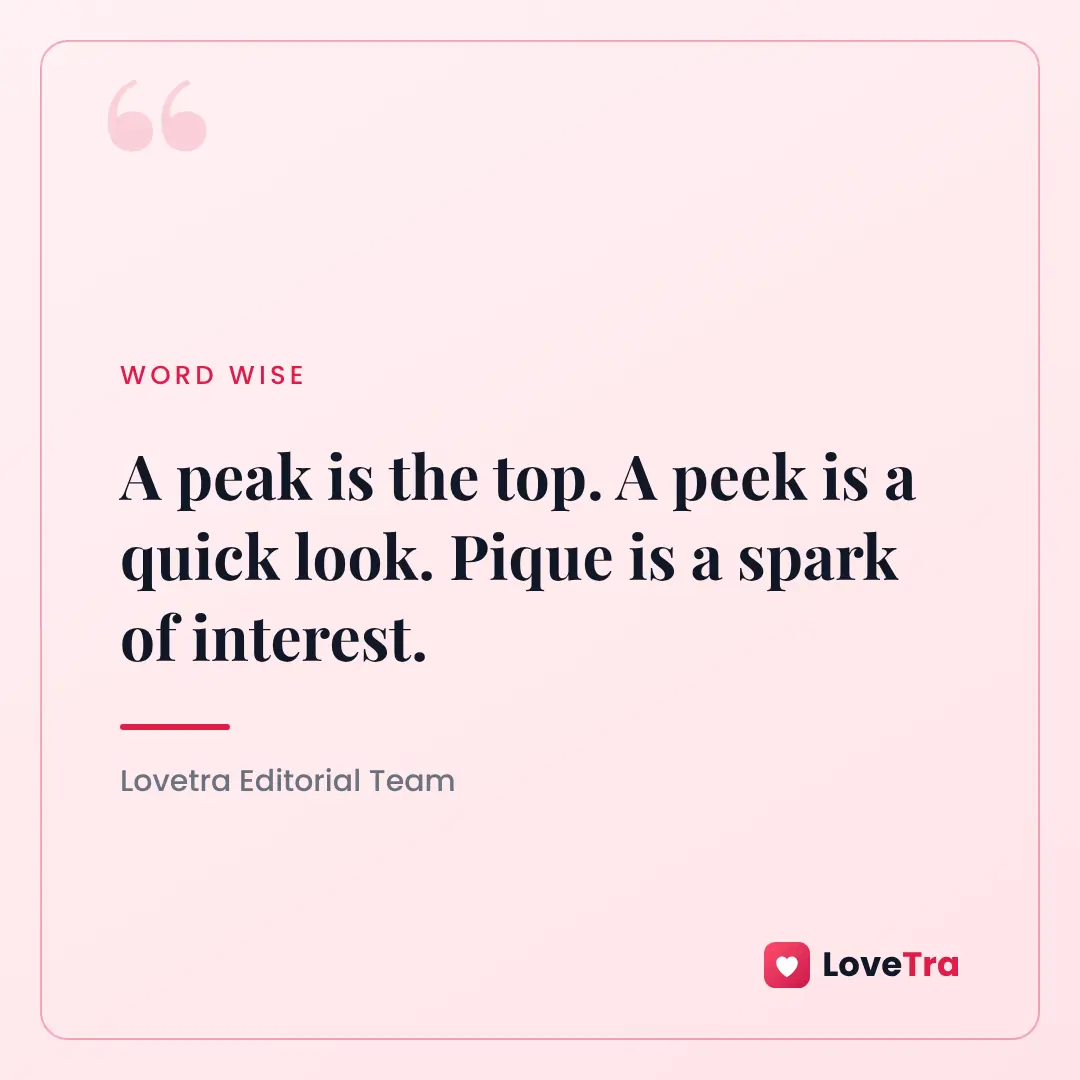
“Peak” means the highest point of something, “peek” means a quick look, and “pique” means to arouse interest or a feeling of annoyance. All three sound exactly the same, so they are easy to mix up in writing. Here is the quick rule: a peak is the top, a peek is a look, and pique is a spark of curiosity.
This guide explains each word, gives a memory trick, shows 30 example sentences and ends with common mistakes and a ten-question quiz with answers. For more on how words behave, see our guide to the parts of speech, the hub on English grammar rules and our first guide to commonly confused words, affect vs effect.
Quick answer: peak, peek and pique
- Peak (noun, adjective, verb) means the top, the highest point, or to reach the highest point. Example: “We reached the peak of the hill.”
- Peek (verb, noun) means to look quickly or secretly, or a quick look. Example: “He took a peek at the cake.”
- Pique (verb, noun) means to arouse interest or curiosity, or a feeling of annoyance. Example: “The story piqued her curiosity.”
These words are homophones, which means they sound alike but have different meanings and spellings.
A simple memory trick
- Peak has the word “ea” like “sea” or “each”. Think of a mountain peak: the “a” looks like the top of a mountain, tall and pointed.
- Peek has two e’s in the middle, like two eyes. A peek is a look, so remember the two eyes.
- Pique looks fancy, because it comes from French. It rhymes with “peek” and “peak”, but it has the unusual letters “qu”, like “unique” and “technique”. Remember: pique your curiosity, and think of the “qu” as a question mark.
A quick check is to replace the word with “top”, “look” or “interest”. If “top” fits, write peak. If “look” fits, write peek. If “arouse interest” fits, write pique.
What does “peak” mean?
“Peak” is used as a noun, an adjective and a verb.
As a noun, it means the highest point of a mountain, or the highest level of anything: “the peak of the mountain”, “the peak of his career”.
As an adjective, it means the highest or best: “peak season”, “in peak condition”.
As a verb, it means to reach the highest point: “The river peaked at noon.”
What does “peek” mean?
“Peek” is a verb and a noun.
As a verb, it means to look quickly or secretly, often through a small gap: “She peeked through the curtain.”
As a noun, it means a quick look: “Take a peek at this.”
The word has a playful feel. Children play “peek-a-boo”, and we say that something “peeks out” from behind a cloud.
What does “pique” mean?
“Pique” is the least common of the three, and it comes from French. It has two meanings.
As a verb, it means to arouse or stir up interest or curiosity: “The strange noise piqued my curiosity.” It can also mean to annoy slightly: “He was piqued by the remark.”
As a noun, it means a feeling of annoyance or wounded pride: “She left in a fit of pique.”
The most common use today is in the phrase “pique someone’s interest” or “pique someone’s curiosity”. Many people write “peak their interest” or “peek their interest”, which is a mistake. The correct phrase is pique.
Peak vs peek vs pique: side-by-side comparison
| Word | Part of speech | Meaning | Example |
|---|---|---|---|
| peak | Noun, adjective, verb | the top, highest point | The peak was covered in clouds. |
| peek | Verb, noun | a quick look | Take a peek inside. |
| pique | Verb, noun | to arouse interest; annoyance | The title piqued my interest. |
10 example sentences with “peak”
- We climbed to the peak of the hill before sunset.
- The runner was at the peak of his fitness.
- The garden is at its peak in spring.
- Sales were at their peak in the busy season.
- The mountain’s peak was covered with snow.
- The temperature will peak at noon.
- Rush hour is the peak time for traffic.
- The cake had a peak of whipped cream on top.
- She reached the peak of her skill after years of practice.
- The child’s excitement peaked when the guests arrived.
10 example sentences with “peek”
- The little girl peeked around the door.
- Do not peek until I say “Ready!”
- He took a quick peek at the surprise.
- The sun peeked out from behind the clouds.
- She peeked at her sleeping baby.
- The kitten peeked out of the basket.
- Please do not peek at your neighbour’s paper.
- The children gave a peek into the old trunk.
- May I take a peek at your new book?
- Flowers peek through the soil in early spring.
10 example sentences with “pique”
- The old map piqued the boy’s curiosity.
- A good title will pique the reader’s interest.
- Her question piqued my interest.
- The teacher told a short story to pique the class’s curiosity.
- He left the room in a fit of pique.
- The strange smell from the kitchen piqued our curiosity.
- The book’s cover piqued my sister’s interest.
- She was piqued that nobody had thanked her.
- A surprise at the end of the story will pique their attention.
- Visiting a garden can pique a child’s interest in plants.
All three in one sentence
The ultimate test is to see all three words working together.
- “At the peak of the hill, a small sign piqued my curiosity, so I took a peek behind it.”
- “The peak of the day was when the child took a peek at the gift, which piqued her excitement.”
Read the sentences aloud, and say what each word means.
Common mistakes with peak, peek and pique
- Writing “peak my interest”. Correct: “pique my interest”. A peak is a top, and it cannot arouse interest.
- Writing “sneak peak”. Correct: “sneak peek”. A peek is a look. Only a mountain has a peak.
- Writing “peek of the mountain”. Correct: “peak of the mountain”.
- Writing “peak through the keyhole”. Correct: “peek through the keyhole”.
- Mixing up pique and peak in “pique someone’s curiosity”. Use pique.
- Forgetting that “peak” can be a verb. “The fever peaked on Tuesday.”
Phrases and idioms with each word
Learning words inside common phrases helps them stick. Here are some you will meet often.
Phrases with peak:
- “At the peak of his powers” means at his strongest.
- “Peak hours” are the busiest hours of the day.
- “Peak condition” means in the best possible health.
- “A peak season” is the busiest time of a business or farm year.
Phrases with peek:
- “A sneak peek” is a short, early look at something.
- “Peek-a-boo” is a game played with babies, where a face hides and appears.
- “Peek over the fence” means to look quickly over the top.
- “No peeking!” is what we say in games where players must keep their eyes closed.
Phrases with pique:
- “Pique your curiosity” means to make you want to know more.
- “In a fit of pique” means in a short burst of wounded pride or annoyance.
- “Pique my interest” means to catch my attention.
Where the words come from
Knowing where a word comes from can make it easier to remember. “Peak” is an old English word that is related to “pike”, meaning something pointed, like the top of a mountain. “Peek” is a short, playful word that has been used for hundreds of years to mean a quick glance. “Pique” came into English from French, where it meant to prick or sting. When something pricks your curiosity, it stings your mind awake. That is a handy way to remember it: pique pricks your interest.
Real-life writing practice
Here are four short notes in which the words appear. Ask your child to find each one and say what it means.
A family trip note: “We reached the peak just after noon. The view was wonderful, and the cool air made us hungry.”
A note from a younger sister: “I took a peek at the cake in the kitchen, but I did not touch it, I promise.”
A book review: “The first page piqued my curiosity, so I read the whole book in one evening.”
A weather report: “The wind will peak this afternoon and calm down after sunset.”
Reading real sentences shows children that these words are not only for tests. They appear in the stories, letters and conversations of everyday life.
A quick check you can do every time
Before writing one of these words, ask three quick questions:
- Does it mean the top or highest point? Write peak.
- Does it mean a quick look? Write peek.
- Does it mean to stir up interest or annoyance? Write pique.
This three-question habit takes seconds and prevents the mistakes above. If you teach children, give them three cards, one with a mountain, one with an eye and one with a question mark, and let them hold up the right card as you read sentences. To grow your skills further, see our guides on improving your writing skills and improving your vocabulary.
Practice quiz: peak, peek or pique?
Fill in the blank with the right word. Answers follow.
- The children stood at the ______ of the hill.
- The strange sound ______ my curiosity.
- Please do not ______ at the present.
- The river will ______ tomorrow after the rain.
- A good book title will ______ the reader’s interest.
- She took a ______ through the window.
- The flowers are at their ______ in spring.
- He was in a fit of ______ and left early.
- The kitten ______ed out from under the bed.
- Rush hour is the ______ time for buses.
Answers:
- peak
- piqued
- peek
- peak
- pique
- peek
- peak
- pique
- peeked
- peak
Teaching peak, peek and pique to children
- Draw the pictures. A mountain for peak, an eye for peek and a question mark for pique.
- Play peek-a-boo with words. Say a sentence and let the child “peek” at the right card.
- Act it out. Climb to a “peak” (a stool), “peek” around a door and look curious to show “pique”.
- Story time. Read a short story and ask the child to listen for any of the three words.
- Make a sentence. Ask the child to write one sentence with each word and read them aloud to a grandparent.
Since “pique” is advanced, introduce it last, perhaps around age ten or later.
Frequently asked questions
What is the difference between peak and peek?
“Peak” means the top or highest point. “Peek” means a quick look.
Is it “peak my interest” or “pique my interest”?
It is “pique my interest”. “Pique” means to arouse.
Is it “sneak peak” or “sneak peek”?
It is “sneak peek”, because it means a quick secret look.
How do you pronounce pique?
It is pronounced like “peek” (rhymes with “week”).
What part of speech is peak?
It can be a noun, an adjective or a verb.
A closing thought
Peak, peek and pique are three small words that show how rich and quirky English can be. With a picture in your mind for each, you will never confuse them again. Keep reading, keep noticing and enjoy each new word that catches your eye.