How Many Weeks in a Month? Simple Math and Tips
On average, there are 4.35 weeks in a month. Most months are slightly longer than four weeks, so a month usually has four full weeks plus two or three extra days. Only February in a common year has exactly four weeks (28 days). This guide shows the simple calculation, a month-by-month table, worked examples, and tips for planning your family’s weeks.
How Many Weeks Are in a Month?
The answer depends on the month, but here is the easiest way to remember it:
- A week has 7 days.
- A month has 28, 29, 30 or 31 days.
- Divide the days in the month by 7 to get the weeks.
- For an average month, 30.44 days / 7 = about 4.35 weeks.
So you can say “about four weeks” in everyday talk, or “four and a third weeks” when you want to be more exact.
Why Is the Answer 4.35 and Not Exactly 4?
If every month had exactly 28 days, every month would have 4 weeks. But the calendar we use was built to match the length of the year, which is about 365 days, not 336. Here is the math:
- A year has 365 days (366 in a leap year). If you are not sure why, read how many days are in a year.
- 365 / 7 = 52 weeks and 1 day. See also how many weeks are in a year.
- A year has 12 months, so 52.14 weeks / 12 = 4.35 weeks per month.
- Check it another way: 365 days / 12 months = 30.42 days; then 30.42 / 7 = 4.35 weeks.
That extra 0.35 of a week is about 2.4 days. This is why months do not begin on the same weekday each time and why a calendar sometimes shows five rows of weeks, and sometimes six.
Weeks in Each Month: A Complete List
Here are the 12 months with their days, converted into weeks and extra days. Use this list for planning.
- January: 31 days = 4 weeks and 3 days (4.43 weeks)
- February: 28 days = exactly 4 weeks (29 days in a leap year = 4 weeks and 1 day, 4.14 weeks)
- March: 31 days = 4 weeks and 3 days (4.43 weeks)
- April: 30 days = 4 weeks and 2 days (4.29 weeks)
- May: 31 days = 4 weeks and 3 days (4.43 weeks)
- June: 30 days = 4 weeks and 2 days (4.29 weeks)
- July: 31 days = 4 weeks and 3 days (4.43 weeks)
- August: 31 days = 4 weeks and 3 days (4.43 weeks)
- September: 30 days = 4 weeks and 2 days (4.29 weeks)
- October: 31 days = 4 weeks and 3 days (4.43 weeks)
- November: 30 days = 4 weeks and 2 days (4.29 weeks)
- December: 31 days = 4 weeks and 3 days (4.43 weeks)
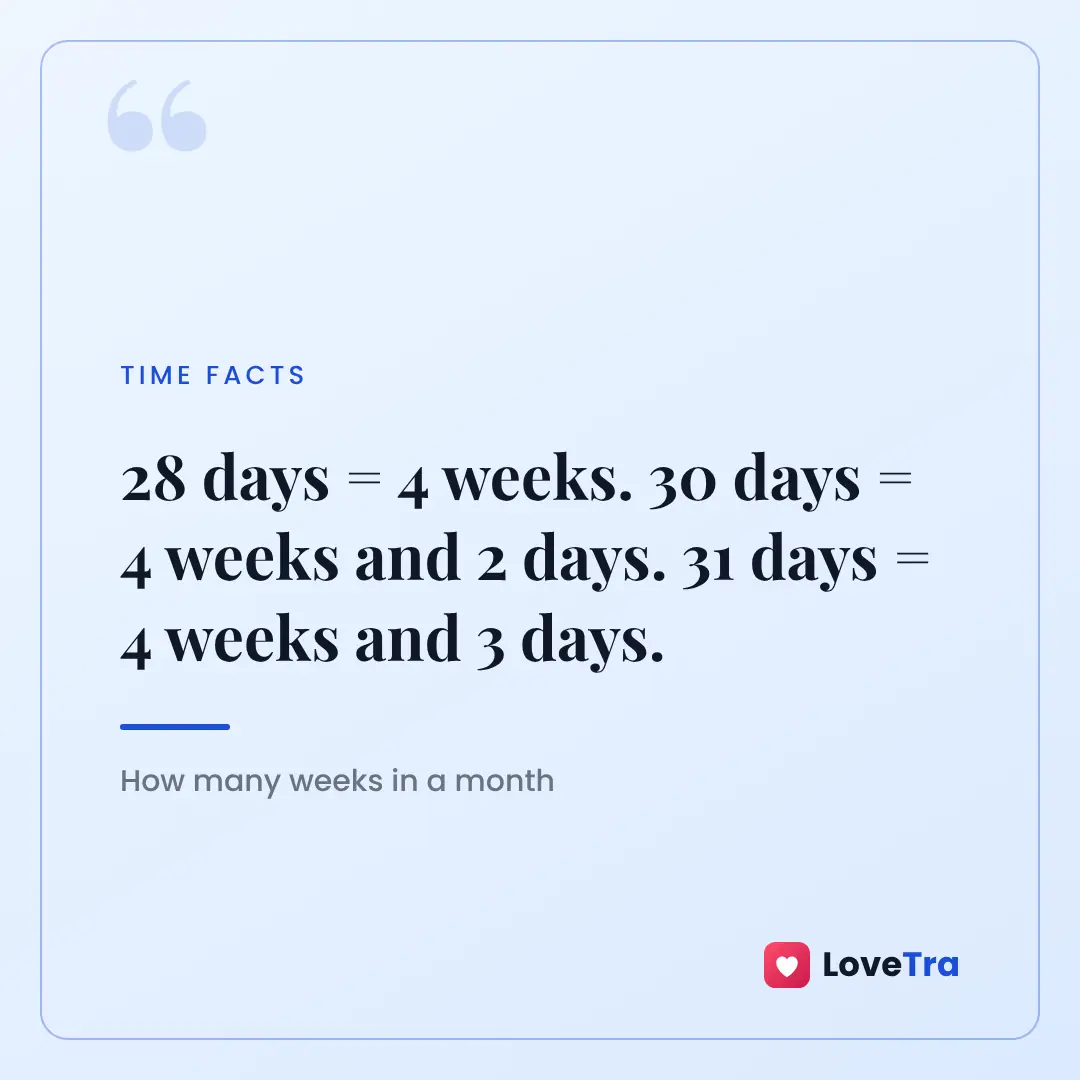
So the answer in simple form: 28-day month = 4 weeks, 30-day month = 4 weeks and 2 days, and 31-day month = 4 weeks and 3 days. For more on month lengths, see how many days are in a month.

Worked Examples
Example 1: How many weeks in 30 days?
30 / 7 = 4.28. So 30 days is 4 full weeks and 2 days.
Example 2: How many weeks in 31 days?
31 / 7 = 4.43. This is 4 weeks and 3 days.
Example 3: How many weeks in 3 months?
3 months of average length is 3 x 4.35 = 13.05 weeks. A quarter of a year is about 13 weeks, which fits with 52 / 4 = 13.
Example 4: How many weeks in 6 months?
6 x 4.35 = 26.1 weeks, so about 26 weeks, which is half of 52.
Example 5: A homework plan
A school project is due in one month. If the month has 30 days, you have 4 weeks and 2 days. A good plan is: week 1 research, week 2 first draft, week 3 improve and week 4 final check, with the extra 2 days for rest or problems.
Example 6: Weekly savings for a gift
A family wants to put aside a small, fixed amount each week for a family gift. They need 9 weeks. Since a month is about 4.35 weeks, that is 9 / 4.35, or about 2 months.
Example 7: How many weekends in a month?
Every month has four or five weekends. Whenever a month has 29, 30 or 31 days, some weekdays will appear five times. A 31-day month will have three weekdays that occur five times.
Why Do Some Months Have Five Saturdays?
Because 31 days is 4 weeks and 3 extra days. The first three days of the month will appear a fifth time. If the month starts on a Friday, then Friday, Saturday and Sunday each occur five times. That is why you sometimes see five Saturdays or five Mondays in one month. A 30-day month has two days that occur five times, and a 28-day February has none.
Weeks in a Month for Different Needs
- For school: a school month is usually counted as 4 weeks of teaching.
- For work and pay: some people are paid weekly, some every two weeks and some monthly. A year has 52 weeks, which is 26 two-week periods.
- For household planning: think in four-week cycles for shopping, cleaning and bills, and keep the extra days as a buffer.
- For baby and child growth: parents often count age in weeks for babies. A month is about 4 to 4.5 weeks.
- For projects: use 4 weeks for a month plan and add one buffer week if the project is important.
Conversion List: Weeks and Months
- 1 week = 7 days = about 0.23 months
- 2 weeks = 14 days = about half a month
- 4 weeks = 28 days = just under 1 month
- 5 weeks = 35 days = a little over 1 month
- 8 weeks = 56 days = about 2 months (1.84 months)
- 13 weeks = 91 days = about 3 months
- 26 weeks = 182 days = about 6 months
- 39 weeks = 273 days = about 9 months
- 52 weeks = 364 days = about 12 months (1 year, minus 1 day)
How to Explain Weeks and Months to a Child
- Use a wall calendar. Colour each week a different colour to show that a month is made of four or five rows.
- Count the rows. Let your child count the weeks on this month’s calendar.
- Point out extra days. Show the days that stick out at the start or end of the month.
- Use a weekly chart. Write the days of the week on a chart and tick off each day. Read how to teach kids the days of the week for more ideas.
- Link with a story. “A month is four Sundays and a few days more.”
Using Weeks to Plan Family Life
Weeks are a handy size for planning because they match the rhythm of school, work and rest. Many families find it easier to plan weekly than monthly. Here are some simple ways to use the week:
- Choose one evening each week for a family meal with no screens.
- Set a weekly time to clean the house together.
- Plan weekly meals before shopping, to reduce waste.
- Review homework and school notices every Sunday.
- Choose one act of kindness each week, such as visiting a grandparent or helping a neighbour.
Learn how to put these ideas into practice in how to plan your week and time management tips.
How Many Rows Does a Calendar Need?
A printed calendar shows weeks as rows. Because months start on different weekdays, the number of rows changes.
- A 28-day February that starts on the first day of the week fits in exactly 4 rows.
- Most months need 5 rows.
- A 30-day or 31-day month that starts late in the week can need 6 rows, because the first and last weeks are only partly filled.
This is why a month can seem to have five or even six weeks on the calendar even though it has only about 4.35 weeks of time. The partial weeks at the start and end are counted as separate rows.
A Simple Four-Week Family Plan
Use this plan as a template and add the leftover days at the end of the month for rest or catching up.
- Week 1: Set the goals. Choose one or two family goals for the month, such as reading together every evening or reducing waste.
- Week 2: Build the habit. Do the goal at the same time each day and tick it off on a chart.
- Week 3: Check and adjust. Talk about what is working. Change the plan if it is too hard or too easy.
- Week 4: Finish strong. Complete any unfinished tasks and celebrate your progress with something simple, like a family walk.
- Extra days: Rest and review. Use the remaining two or three days to clean up, plan the next month and thank everyone for their effort.
Common Mistakes
- Saying every month has exactly 4 weeks. Most have 4 weeks plus 2 or 3 days.
- Forgetting leap years. February has 29 days in a leap year.
- Mixing up 52 weeks with 12 months x 4 weeks = 48 weeks. The second calculation misses about 4 weeks of the year.
- Counting a partial week as a full week.
- Planning a project for exactly 4 weeks when the month has extra days.
Practice Questions
- How many full weeks are in April?
- How many weeks and extra days are in July?
- How many weeks are in 8 months, using 4.35 weeks per month?
- February has 28 days. How many weeks is that?
- If you save something every week for 13 weeks, about how many months is that?
- How many weeks are in a year, and how many days are left over?
Answers:
- April has 30 days: 4 full weeks (and 2 extra days).
- July has 31 days: 4 weeks and 3 days.
- 8 x 4.35 = 34.8, about 35 weeks.
- 28 / 7 = 4 weeks exactly.
- 13 weeks is about 3 months.
- 52 weeks and 1 day (2 days in a leap year).
Frequently Asked Questions
How many weeks are in a month on average?
About 4.35 weeks, which is a little more than four weeks.
How many weeks are in a month for most months?
Months with 30 or 31 days have 4 weeks plus 2 or 3 extra days.
Is a month four weeks long?
Only February in a common year has exactly four weeks. Other months are a few days longer.
How many weeks are in a year?
52 weeks and 1 day in a normal year, and 52 weeks and 2 days in a leap year.
How many weeks are in 2 months?
About 8.7 weeks, which is almost 9 weeks.
How many weeks are in 6 months?
About 26 weeks, or half the weeks in a year.
Final Words
Remember the easy rule: a month is four weeks plus a few days, or about 4.35 weeks. Use the list above to plan homework, family time and chores with confidence. For more family learning ideas, explore our Family section.