Brain Teasers for Kids: 50 Fun Puzzles With Answers and Hints
Brain teasers for kids are short puzzles that make a child stop, think and look at a problem in a new way. Some use numbers, some use shapes, some use words, and some are small tricks of logic where the answer is hiding in plain sight. This page has 50 brain teasers for kids with answers and hints, sorted by type from easy to hard, and it explains how to help a child without giving the answer away too soon.
Why Are Brain Teasers Good for Children?
Brain teasers train the habits of a careful thinker. A child learns to read the question slowly, notice what is really being asked, test an idea, and change course when it fails. Those habits help with maths, reading and everyday decisions. Teasers also teach humility: the first answer that comes to mind is often not the right one, and a thinker who checks is a thinker who learns.
A family that solves puzzles together also gains a shared language of play. A child who sees a parent say, “I don’t know yet, let me try another way,” learns that struggling is normal and that persistence works.
How Should You Use Brain Teasers With Children?
- Read the puzzle aloud twice, slowly.
- Give thinking time. Count to thirty silently before offering a hint.
- Give a hint, not the answer. For example: “Count the corners one at a time.”
- Let the child explain their thinking, even if it is wrong. The explanation shows where the idea went off track.
- Reveal the answer with the reasoning behind it, then ask, “Which clue would have helped us find it faster?”
Easy Number Brain Teasers
- What comes next: 2, 4, 8, 16, …? Answer: 32. Each number is double the one before.
- What comes next: 1, 4, 9, 16, …? Answer: 25. These are square numbers (1×1, 2×2, 3×3, 4×4, 5×5).
- What comes next: 100, 90, 80, 70, …? Answer: 60. Subtract ten each time.
- What comes next: 1, 1, 2, 3, 5, 8, …? Answer: 13. Each number is the sum of the two before it.
- A farmer has 3 chickens and 2 goats. How many legs are there altogether? Answer: 14 (3 × 2 = 6 and 2 × 4 = 8).
- I am a number between 10 and 20. I am odd, and my digits add up to 8. Who am I? Answer: 17.
- How many months have 28 days? Answer: All twelve. Every month has at least 28 days.
- If you have a basket with 6 apples and take away 4, how many do you have? Answer: 4, the ones you took.
- Four friends meet and each shakes hands once with every other friend. How many handshakes are there? Answer: 6. (A with B, C, D = 3; B with C, D = 2; C with D = 1.)
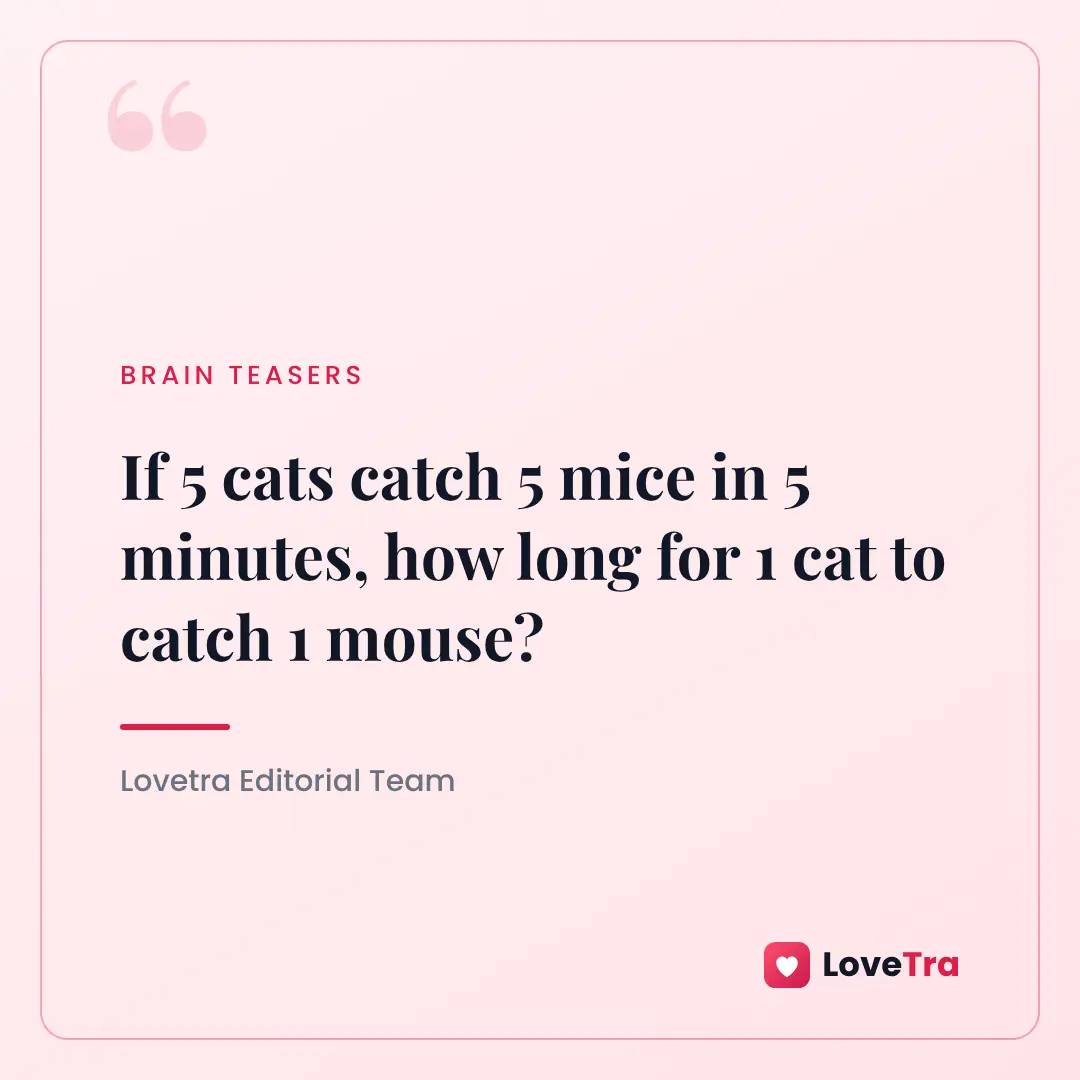
- If 5 cats catch 5 mice in 5 minutes, how many cats are needed to catch 100 mice in 100 minutes? Answer: 5. Each cat catches one mouse every 5 minutes, so in 100 minutes each cat catches 20.
Shape and Counting Brain Teasers
- A triangle is divided into 4 smaller triangles by joining the middle points of its sides. How many triangles are there in all? Answer: 5 (the 4 small ones and the big one).
- A square has both of its diagonals drawn. How many triangles can you find? Answer: 8 (4 small triangles and 4 larger ones made from pairs).
- How many squares are in a 2 by 2 grid? Answer: 5 (four small squares and one big one).
- How many squares are in a 3 by 3 grid? Answer: 14 (9 small, 4 medium and 1 large).
- How many sides does a rectangle have, and how many corners? Answer: 4 sides and 4 corners.
- If you fold a square piece of paper in half twice and open it, how many equal rectangles or squares do you see? Answer: 4 equal squares.
- How many faces does a cube have? Answer: 6.
- What shape has no corners and no straight sides? Answer: A circle.
Word and Letter Brain Teasers
- What word becomes shorter when you add two letters to it? Answer: Short (it becomes “shorter”).
- What word contains 26 letters but has only three syllables? Answer: Alphabet.
- What is seen in the middle of March and April? Answer: The letter R.
- What 4-letter word reads the same forward, backward and upside down? Answer: Noon.
- What comes next: O, T, T, F, F, S, S, …? Answer: E. They are the first letters of One, Two, Three, Four, Five, Six, Seven, Eight.
- What comes next: J, F, M, A, M, J, J, A, S, O, N, …? Answer: D. They are the first letters of the months, and the last is December.
- What comes next: A, C, E, G, …? Answer: I. It skips every other letter.
- Which word is always spelled wrong? Answer: “Wrong.”
- Which letter sounds like a question? Answer: Y, which sounds like “why.” Ask children to find other letters that sound like words: B (be), C (sea), I (eye), U (you).
- What begins with an E, ends with an E, but usually contains only one letter? Answer: An envelope.
Lateral Thinking Brain Teasers
Lateral thinking puzzles have an answer that comes from looking at the situation differently. Encourage children to ask, “What else could this mean?”
- A boy fell off a ten-metre ladder but was not hurt. How? Answer: He fell off the bottom step.
- What has to be broken before you can use it? Answer: An egg.
- I am light as a feather, yet the strongest person cannot hold me for five minutes. What am I? Answer: Breath.
- How far can a dog run into a forest? Answer: Halfway. After that, it is running out of the forest.
- Two fathers and two sons went fishing. They each caught one fish, and in total they caught three fish. How is that possible? Answer: There were only three people: a grandfather, his son and his grandson.
- Boil one egg in five minutes. How long does it take to boil three eggs together in the same pot? Answer: Five minutes. They cook at the same time.
- If you are running a race and pass the person in second place, what place are you in? Answer: Second place.
- Which is heavier, a kilogram of feathers or a kilogram of stones? Answer: They weigh the same. Both are one kilogram.
- A girl has three brothers. Each brother has one sister. How many children are in the family? Answer: Four: three brothers and one girl, who is the sister.
- What can you hold in your right hand but never in your left hand? Answer: Your left hand.
Picture-in-Your-Head Brain Teasers
- Imagine you are in a room with a bed, a table and a chair. What do you sit on? Answer: The chair. (The question is easy, but many children overthink it.)
- You have a drawer with 10 red socks and 10 blue socks in the dark. How many must you take out to be sure of a matching pair? Answer: 3. Two might be different colours, but the third must match one of them.
- A clock strikes six in five seconds. How long does it take to strike twelve? Answer: About eleven seconds. There are five gaps between six strikes (1 second each) and eleven gaps between twelve strikes.
- A bus has 10 children. At the first stop, 3 get off and 2 get on. At the next stop, 4 get off and 1 gets on. How many are on the bus now? Answer: 6 (10 − 3 + 2 − 4 + 1 = 6).
- You are walking in a garden and see 3 trees. Each tree has 3 branches, and each branch has 3 apples. How many apples? Answer: 27 (3 × 3 × 3).
- If today is Wednesday, what day will it be in ten days? Answer: Saturday. Seven days is another Wednesday, plus three more days is Saturday.
Harder Brain Teasers for Older Children
- A snail climbs a wall 5 metres high. Each day it climbs up 2 metres, and each night it slides back 1 metre. On which day does it reach the top? Answer: Day 4. After three days it is at 3 metres. On day 4 it climbs 2 more metres and reaches 5, and it stops there before sliding back.
- A father is 30 years older than his son. In 5 years, the father will be 4 times as old as the son. How old is the son now? Answer: 5. Check: father is 35 now; in 5 years, father is 40 and son is 10, so the father is 4 times as old.
- You have two ropes that each burn in exactly one hour, but they burn unevenly. How can you measure 45 minutes? Answer: Light the first rope at both ends and the second at one end at the same time. The first burns out in 30 minutes. At that moment, light the other end of the second rope. It burns out 15 minutes later, giving 45 minutes in all.
- A farmer needs to carry a bag of grain, a goat and a dog across a stream in a boat that holds the farmer and one item. The goat cannot be left with the grain, and the dog cannot be left with the goat. How does he do it? Answer: Take the goat across first. Return and take the grain across, then bring the goat back. Leave the goat and take the dog across. Return alone and bring the goat across last.
- What is the next number: 2, 3, 5, 7, 11, …? Answer: 13. These are prime numbers.
- If it takes 3 people 3 hours to paint 3 fences, how long does it take 6 people to paint 6 fences at the same speed? Answer: 3 hours. Each person paints one fence in 3 hours.
How Do You Make Your Own Brain Teaser?
Creating a teaser is a lovely challenge for older children and it deepens their understanding. Here is a simple recipe.
- Choose a real situation, such as a basket of fruit, a clock or a garden path.
- Write a short question that has a clear, surprising answer. The surprise may come from an easily missed word, such as “all but” or “only.”
- Try it on a friend. If they solve it too quickly, make it a bit trickier. If they cannot solve it at all, add a hint.
- Write the answer with a clear reason, so that anyone who reads it can learn from it.
- Collect the best ones in a notebook titled “Our Family Puzzles.”
How Can You Help a Child Get Better at Brain Teasers?
- Draw it. Many teasers become easy when you make a quick sketch.
- Use small numbers first. Try the puzzle with 2 or 3 instead of 100.
- Check each word. Words like “all,” “only” and “but” change the question.
- Act it out. Use blocks, coins or paper cut-outs to test the situation.
- Look for a pattern. If numbers or letters repeat, say the rule out loud.
- Be willing to guess and check. A wrong guess narrows the options.
Where Can You Find More Puzzle Fun?
If your child enjoyed these teasers, add more to your routine. Our collection of riddles for kids has clue-style puzzles, and would you rather questions for kids helps with decision-making and conversation. For quiet building puzzles, try how to do a jigsaw puzzle, and for planned evenings see learning games for kids and family game night ideas.
Frequently Asked Questions About Brain Teasers for Kids
At what age can children do brain teasers?
Simple pattern and counting teasers suit children from about five. Word and logic teasers suit ages eight and up.
What if my child gets frustrated?
Offer a break or a hint. Say, “Even adults find this one hard.” Avoid saying “It’s easy,” because it makes a struggling child feel small.
Are brain teasers the same as riddles?
They are close. Riddles describe something in clues; brain teasers cover numbers, shapes, words and logic. Both train careful thinking.
How many should we do in a day?
Three to five is enough. Little and often builds the habit.

Choose three teasers from this page for tonight. Let the children explain their thinking, and enjoy the surprise when the answer arrives.