Better Late Than Never Meaning, Stories and Examples
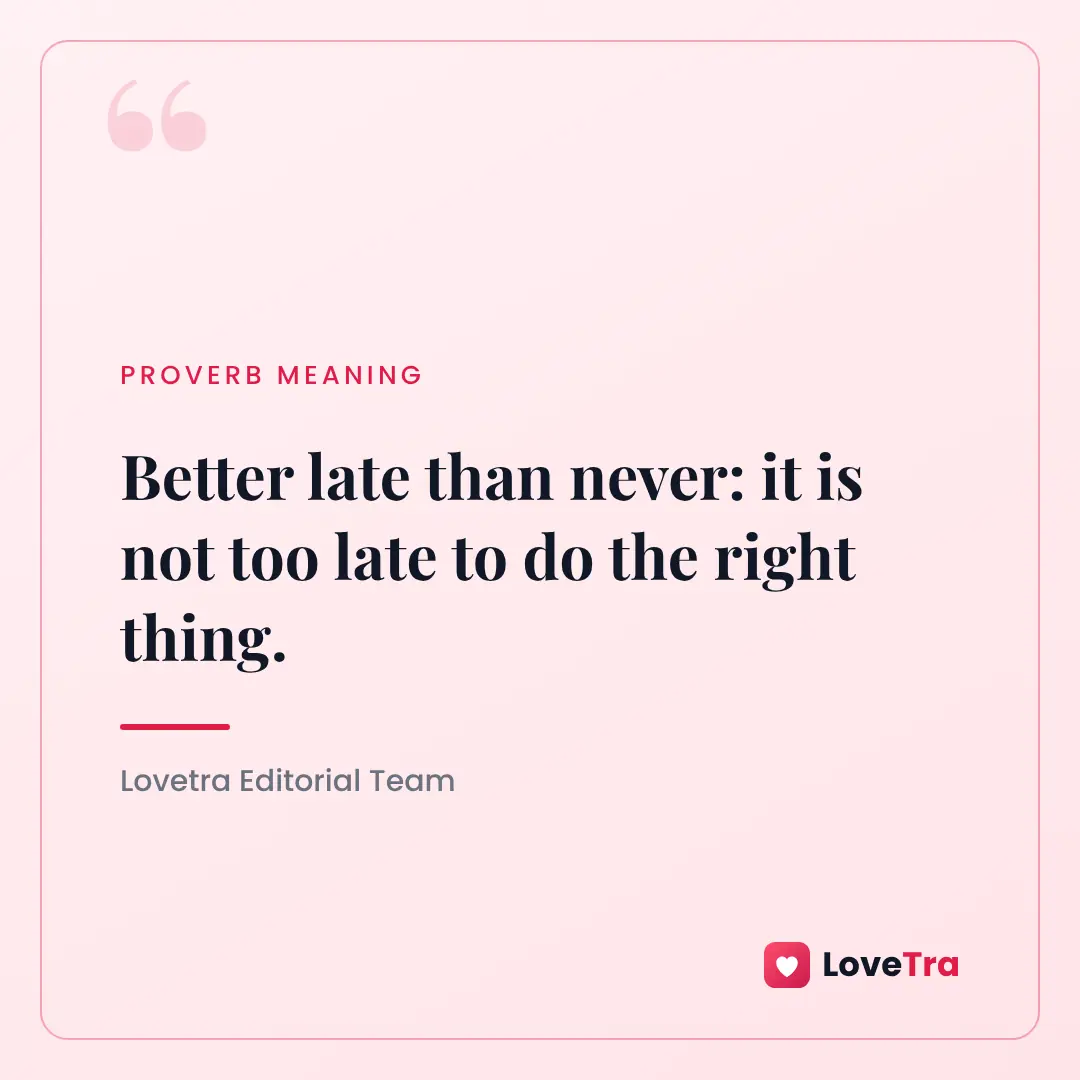
“Better late than never” means it is better to do something, finish something or arrive somewhere after the right time than not to do it at all. The old saying gives hope to anyone who has missed a chance, forgotten a duty or delayed an apology: it is still worth doing the right thing today. This guide explains the meaning, gives three original short stories, 12 example sentences, similar and opposite sayings, a short paragraph and essay for students, ideas to teach children, and answers to common questions. It is part of our collection of proverbs and their meanings.
Better Late Than Never Meaning in Simple Words
The proverb compares two situations: doing a good thing late and not doing it at all. It says that the first is always better. A late thank-you, a late repayment of a debt of kindness, a late start to study, or a late visit to a sick relative is still worth much more than silence and neglect.
The meaning has two sides. On one side, it is an encouragement: do not give up just because you are behind. On the other side, it is a gentle warning that being late is not ideal. The saying does not mean that we can always be late. It means that when a delay has already happened, we should still act.
The Deeper Lesson
- It is never too late to start. Whether you want to learn to read well, mend a friendship or improve your health, the best day to begin is today.
- Regret should lead to action. Feeling bad about a missed chance is not enough. A late apology or late help turns regret into something good.
- Do not let shame stop you. Some people never apologise or return a borrowed item because they feel it is “too late”. The proverb removes that excuse.
- Effort counts. A project finished after the deadline in honest hard work is better than one never finished.
- Respect time too. Having said that, a wise person learns from the delay and tries to be on time next time.
Three Short Stories That Show the Proverb
Story 1: The Late Visit
Imran had always been busy with work. Months passed and he did not visit his old uncle, who lived in a small house at the end of the road. One evening Imran felt a pang of guilt, put aside his tiredness and went. His uncle opened the door with tears of joy. “I have waited for you,” he said, “but I am so glad you came.” They talked until it was dark. Imran promised to visit every week. His friend later heard the story and said, “You were late, but late is better than never.” The uncle had many more good years, and the visits filled them with warmth.
Story 2: The Late Student
Sara was behind in mathematics all term. She felt ashamed and told herself that it was too late to catch up before the exam. One day her teacher said, “Better late than never. Come to me for twenty minutes after class each day.” Sara went. At first the numbers were confusing, but she practised a little every day. She did not become the top student, but she passed with good marks and, more importantly, she understood the subject. She learned that effort never wastes, even when it starts late.
Story 3: The Returned Book
Karim had borrowed a book from his neighbour two years earlier and forgot it on a shelf. When he found it, he felt embarrassed. “It is so late now,” he thought. But his mother said, “A trust is a trust. Return it with an honest apology.” He walked next door with the book. The neighbour smiled and said, “I had forgotten myself, but I am happy you are honest. Better late than never.” Karim learned that returning what is not ours is always right, no matter how long it takes. This lesson links closely to teaching kids honesty.
12 Example Sentences
- I forgot my cousin’s birthday, but I sent a kind message the next day. Better late than never.
- He started learning to swim at the age of forty. It is better late than never.
- The bus came an hour late, but at least we reached the wedding.
- She paid back the favour many years later, proving that better late than never.
- “I am sorry I missed your call yesterday,” said Ali. “Better late than never,” his friend replied.
- The team finished the school project after the deadline, but the teacher accepted it because it was honest work.
- My father began to exercise only after retirement. He says better late than never.
- The neighbour fixed the broken fence at last. Better late than never.
- You have come late to the meeting, but your ideas are welcome. Better late than never.
- They thanked their teacher after twenty years. It was late, but it was never too late to be grateful.
- Better late than never, he thought, and he called his brother to end the quarrel.
- I did not read much as a child, but I enjoy books now. Better late than never.
Similar Proverbs
- It is never too late to mend. (We can always correct a mistake.)
- It is never too late to learn.
- Where there is a will, there is a way.
- Slow and steady wins the race.
- Do it now, or later you may wish you had.
Opposite Proverbs and Balancing Sayings
- A stitch in time saves nine. Small tasks done on time prevent bigger problems. See a stitch in time saves nine meaning.
- Time and tide wait for none. The clock does not stop, so do not waste it.
- Procrastination is the thief of time. Delay steals the hours we need.
- Strike while the iron is hot. Act at the right moment.
Together these show a balance: be on time whenever you can, but if you are late, do not give up.
When “Better Late Than Never” Does Not Apply
Some things lose their purpose if delayed too long, such as taking medicine on time, reaching an exam hall, or helping someone in an emergency. In those cases, being on time is a duty and the proverb is not an excuse. It is meant for repair and recovery, not as permission to be careless. A wise person tries to avoid delay, and uses this saying only to move forward after one has happened.
How to Use This Proverb in Daily Life
A proverb is only useful when it changes what we do. Here are real moments in a family where “better late than never” can guide a good choice.
- A forgotten call. If you promised to call a parent or grandparent and forgot, call now. Say, “I am sorry I am late, I wanted to hear your voice.”
- A neglected chore. If your room, your homework or a household task was put off, begin today, even for ten minutes.
- A broken promise. If you could not keep a promise to a younger sibling, keep it a day later and say sorry for the delay.
- An old quarrel. If a relative is still upset over something said long ago, a visit or letter now is better than another year of silence.
- A late-start habit. Reading, exercise, saving a little, or learning a skill can be started at any age.
- A late thank-you. Write a short note to a teacher, helper or neighbour who once did you a kindness.
Why Honest People Value This Saying
People of good character do not run away from their mistakes. They face them. The proverb supports this habit because it shuts the door on the excuse “it is too late now.” When we accept that a delay has happened and still choose to act, we show courage, honesty and respect for others. In families, this habit prevents small hurts from growing into large ones. A parent who admits a mistake to a child, even years later, teaches the child that apologising is a strength and not a weakness.
Short Paragraph on “Better Late Than Never”
“Better late than never” teaches us that it is better to do a good thing late than not at all. If a student forgets to submit homework, he should still submit it with an apology. If a person has hurt someone, a late apology is better than none. The proverb tells us not to lose hope when we are behind, but it also reminds us to value time and to try to be punctual in the future.
Short Essay on “Better Late Than Never” (250 Words)
Everyone has a time when they arrive late, forget a promise or start something after others. At such moments, the old saying “better late than never” brings comfort and direction.
The first meaning of the proverb is hope. A person who learns to read at the age of fifty has still gained a lifetime of knowledge. A farmer who plants seeds a week after the others still gets a harvest. The point is not to give up.
The second meaning is responsibility. If we have failed to return a loan of goods, to thank a helper, or to apologise to a friend, we should do it now. A late apology can heal a wound that silence would keep open. Many family quarrels end when one person says, “I am sorry, I should have called earlier.”
The third meaning is humility. We admit that we were late and do not hide behind excuses. We say, “I was wrong to delay, and I am here now.”
However, this proverb should not become a habit. If we are always late, we lose the trust of others, waste time and miss chances that never return. The wise person plans, keeps promises and respects the time of others, and only uses this proverb to rise after a fall.
In conclusion, “better late than never” is a message of hope with a lesson of discipline. Do the right thing today, and try to do it on time tomorrow.
How to Teach This Proverb to Kids
- Tell a simple story such as a child who returns a toy to a friend after a long time.
- Ask: “Would the friend rather get the toy late, or never?” Children usually understand at once.
- Let them act out a short role play: a late apology, a late thank-you note.
- Draw a “late card”: on one side, a clock; on the other, a smiling face and the words “I did it.”
- Pair the saying with the opposite lesson: show them how to use a daily timetable so that being late does not become a habit.
- Explain that the proverb is for mending mistakes, not for excusing them.
For more easy sayings that children enjoy, visit proverbs for kids and proverbs about family. You can also compare with a friendship saying in proverbs about friendship.
Practice Corner
- Write one sentence using “better late than never” about school.
- Write one sentence using it about family.
- Name one thing you have been delaying that you can do this week.
- Think of a proverb that warns against delay.
- Explain the proverb to a younger brother or sister in your own words.
FAQ: Better Late Than Never
What is the meaning of better late than never?
It means that doing something late is better than not doing it at all.
Is “better late than never” a rude phrase?
It can sound sharp if you say it to someone who arrived late in a joking way. Use a warm tone, or say “I am glad you came.” Do not use it to blame.
Where does the saying come from?
It is an old traditional English saying that has been used for many generations. The exact beginning is not known to us, and it does not matter for understanding its message.
What is the opposite of better late than never?
Sayings such as “a stitch in time saves nine” and “time and tide wait for none” stress doing things on time.
Can I use it in a formal letter?
It is better used in speech and informal writing. In a formal letter, say “I apologise for the delay” instead.
How can I stop being late?
Use a timetable, sleep early, prepare the night before and leave ten minutes earlier than needed.