The average cost to buy down mortgage rate depends on how many points you purchase and your loan amount. Typically, one point costs 1% of the loan and lowers your interest rate by 0.25% to 0.50%. We break down the real numbers, hidden fees, and smart strategies so you can decide if a rate buydown is worth it for your home purchase.
Buying down your mortgage rate can feel like a smart move when you see lower monthly payments on paper. But the real question is always about the average cost to buy down mortgage rate and whether that upfront spend actually pays off. Many homebuyers hear the term “mortgage points” and assume it is a simple swap. In reality, it is a financial decision that depends on your loan size, how long you plan to stay in the home, and current market rates.
In this guide, we will walk through exactly what a rate buydown costs, how the math works, and when it makes sense to pay extra upfront. You will learn the difference between temporary and permanent buydowns, how to calculate your break-even point, and what factors can change the final price. By the end, you will have a clear picture of whether a mortgage rate buydown fits your budget and long-term goals.
Key Takeaways
- One mortgage point costs 1% of your loan amount and typically reduces your interest rate by 0.25% to 0.50%.
- The average cost to buy down mortgage rate ranges from $3,000 to $15,000+ depending on loan size and how many points you buy.
- Temporary buydowns (like 2-1 or 1-0) lower payments for the first few years, while permanent buydowns last the life of the loan.
- Break-even analysis is critical to determine if upfront costs are recouped through lower monthly payments.
- Seller-paid buydowns and lender credits can reduce your out-of-pocket expense and make rate buydowns more affordable.
- Market conditions, credit score, and loan type heavily influence how much a rate buydown actually costs and saves you.
- Always compare the total cost of buying down your rate versus investing that money elsewhere or negotiating a lower home price.
📑 Table of Contents
- What Does the Average Cost To Buy Down Mortgage Rate Really Mean?
- How To Calculate the Average Cost To Buy Down Mortgage Rate
- What Factors Change the Average Cost To Buy Down Mortgage Rate?
- Is the Average Cost To Buy Down Mortgage Rate Worth It?
- How To Negotiate and Reduce the Average Cost To Buy Down Mortgage Rate
- Common Mistakes When Evaluating the Average Cost To Buy Down Mortgage Rate
What Does the Average Cost To Buy Down Mortgage Rate Really Mean?
When people ask about the average cost to buy down mortgage rate, they are usually trying to understand how much cash they need at closing to secure a lower interest rate. A mortgage rate buydown happens when you pay an upfront fee, often called a “point” or “discount point,” to reduce your interest rate for all or part of the loan term. The cost is not a flat fee. It scales with your loan amount and the number of points you purchase.
Think of it like pre-paying interest to lock in a cheaper rate later. Each point typically equals 1% of your total loan amount. On a $300,000 loan, one point costs $3,000. On a $500,000 loan, that same point costs $5,000. The rate reduction per point varies by lender, market conditions, and your credit profile, but a common range is 0.25% to 0.50% per point. That means the average cost to buy down mortgage rate is highly personalized. There is no universal price tag.
It also helps to know that buydowns are not the only way to lower your rate. You can sometimes negotiate a lower rate directly with the lender, improve your credit score before applying, or put more money down to reduce the loan size. But if you are specifically looking at paying points, you need to understand the upfront cost, the monthly savings, and how long it takes to recoup your investment.
How Mortgage Points Are Priced
Lenders price discount points based on the current bond market, investor demand, and the risk profile of your loan. In a high-rate environment, points may cost more because lenders need to offset the lower yield from your reduced rate. In a low-rate environment, points may be cheaper because the spread between your rate and investor returns is already tight.
Here is a simple way to think about point pricing:
- One point = 1% of the loan amount paid at closing.
- Rate reduction per point usually falls between 0.25% and 0.50%, though some lenders offer different pricing grids.
- Partial points are common, so you might pay 0.5 points for a 0.125% rate drop or 1.5 points for a 0.375% drop.
- Pricing varies by loan type, with conventional, FHA, and VA loans sometimes structured differently.
The average cost to buy down mortgage rate is not a fixed number because it depends on your specific loan amount and the lender’s pricing sheet. A small loan may only require a few thousand dollars to buy down the rate, while a large jumbo loan could require tens of thousands. That is why it is so important to request a written rate sheet from your lender before deciding.
Temporary vs. Permanent Buydowns
Not all buydowns work the same way. The two most common structures are temporary buydowns and permanent buydowns. Understanding the difference will help you judge the true average cost to buy down mortgage rate for your situation.
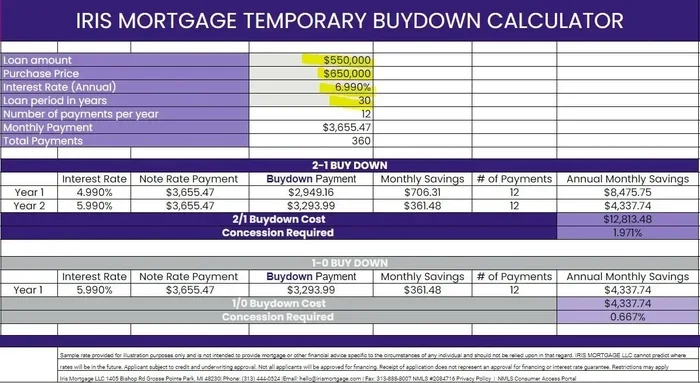
A temporary buydown lowers your interest rate for a set period, usually the first one to three years of the loan. A common example is a 2-1 buydown, where the rate is reduced by 2% in year one, 1% in year two, and then returns to the original note rate for the rest of the loan. These buydowns are often funded by the seller, the builder, or the buyer at closing. They can be helpful if you expect your income to rise soon or if you want lower payments during the early years of homeownership.
A permanent buydown, on the other hand, reduces your interest rate for the entire life of the loan. You pay the points upfront, and the lower rate stays in place until the mortgage is paid off or refinanced. This option usually costs more upfront, but it can create bigger long-term savings if you keep the loan for many years.
Here is a quick comparison to make the distinction clearer:
- Temporary buydowns offer short-term relief and are often used as a seller concession or incentive.
- Permanent buydowns require more cash at closing but can save you money over the full loan term.
- Temporary buydowns may be easier to afford if you have limited closing funds.
- Permanent buydowns make the most sense when you plan to hold the loan long enough to pass the break-even point.
How To Calculate the Average Cost To Buy Down Mortgage Rate
The best way to understand the average cost to buy down mortgage rate is to run the numbers on your own loan. The calculation is straightforward once you know your loan amount, the cost per point, and the rate reduction you will receive. You can then compare the upfront cost to the monthly savings to see whether the buydown is worth it.
Let us walk through a simple example. Imagine you are taking out a $350,000 mortgage at a base rate of 7.0%. Your lender offers you a lower rate of 6.5% if you pay one discount point. One point on a $350,000 loan costs $3,500. That is your upfront cost. Now you need to see how much the lower rate saves you each month.
Using a standard amortization estimate, a 30-year fixed loan at 7.0% on $350,000 produces a principal and interest payment of roughly $2,328 per month. At 6.5%, the same loan produces a payment of about $2,212 per month. That is a monthly savings of around $116. If you divide the $3,500 upfront cost by the $116 monthly savings, you get a break-even period of about 30 months, or two and a half years.
This is the core of the decision. If you plan to keep the home and the loan for longer than 30 months, the buydown may make financial sense. If you expect to sell or refinance sooner, you might not recoup the cost. The average cost to buy down mortgage rate only tells part of the story. Your personal timeline matters just as much.
Break-Even Analysis Made Simple
A break-even analysis helps you answer one key question: how long will it take for the monthly savings to cover the upfront cost? This is the most important step when evaluating the average cost to buy down mortgage rate. Without it, you are guessing instead of making a data-driven decision.
Here is a simple process you can follow:
- Step 1: Ask your lender for the exact cost of each point or fraction of a point.
- Step 2: Get the monthly payment at the original rate and the reduced rate.
- Step 3: Subtract the two payments to find your monthly savings.
- Step 4: Divide the upfront cost by the monthly savings to find the break-even month.
- Step 5: Compare the break-even timeline to how long you plan to keep the loan.
It is also wise to factor in taxes, insurance, and any changes to escrow. While those costs do not usually change with the interest rate, your total housing payment may shift if your lender adjusts escrow amounts. Keep the focus on principal and interest when comparing rate buydowns, since that is where the savings show up.
Example Scenarios With Different Loan Sizes
The average cost to buy down mortgage rate changes dramatically when the loan amount changes. A smaller loan requires less cash to buy points, but it also produces smaller monthly savings. A larger loan costs more upfront, but the monthly savings can be much more significant. Here are a few illustrative scenarios:
- $200,000 loan, one point at 1% = $2,000 upfront. If the rate drops from 7.0% to 6.5%, the monthly savings may be around $66. Break-even is roughly 30 months.
- $400,000 loan, one point at 1% = $4,000 upfront. The same rate drop may save about $132 per month. Break-even is still around 30 months, but the dollar savings are larger.
- $700,000 loan, 1.5 points at 1.5% = $10,500 upfront. A larger rate reduction could save several hundred dollars per month, which may shorten the break-even period if the rate drop is meaningful.
These numbers are illustrative, not exact quotes. Your actual payment depends on the loan term, rate structure, and lender pricing. Still, the pattern is clear: the average cost to buy down mortgage rate grows with the loan size, and so does the potential monthly benefit. That is why larger loans often make buydowns more attractive to buyers who plan to stay put.
What Factors Change the Average Cost To Buy Down Mortgage Rate?
Several variables can push the average cost to buy down mortgage rate higher or lower. Some of these factors are within your control, while others depend on the broader market. Knowing what influences pricing can help you shop smarter and avoid overpaying for points.
Your credit score is one of the biggest drivers. Borrowers with higher credit scores usually qualify for better base rates, which can change how much a point is worth. If your score is lower, the starting rate may already be higher, and the rate reduction per point might not be as favorable. Improving your credit before locking a rate can sometimes reduce the overall cost of a buydown.
Loan type also matters. Conventional loans, FHA loans, and VA loans can have different pricing structures. Some government-backed loans may limit how points are charged or how they affect the rate. If you are using a specialized loan program, ask your lender how discount points work under that program before you commit.
Market conditions play a major role too. When interest rates are volatile, lenders may adjust their pricing grids more frequently. In some markets, points are more expensive because investors demand a higher yield. In other markets, points may be cheaper because the lender is trying to move loans faster. This means the average cost to buy down mortgage rate can shift from one week to the next.
Credit Score and Loan Type Impact
Your credit profile and loan choice can change both the base rate and the value of each point. A borrower with a 780 credit score may receive a more attractive rate sheet than a borrower with a 640 score, even if both are buying the same number of points. That difference can affect the total cost and the savings you actually realize.
Loan type can also change the math. For example, some loans have stricter rules about how discount points are structured or whether they can be financed into the loan. If you are considering an FHA or VA loan, it is worth asking whether the program allows points to be paid by the seller or rolled into the loan in a different way. These details can affect your cash-to-close and your long-term savings.
Market Conditions and Lender Pricing
Lender pricing is not identical across the board. One lender may offer a lower base rate but charge more for points. Another may offer a higher base rate but give a bigger rate reduction per point. That is why it is so important to compare full loan estimates rather than focusing only on the interest rate. The average cost to buy down mortgage rate is really a combination of the base rate, the point cost, and the rate reduction you receive.
You should also ask about any relationship discounts, promotional pricing, or lender credits. Sometimes a lender will offer a credit toward closing costs in exchange for a slightly higher rate. In other cases, you may be able to negotiate a better point price if you have a strong financial profile or a large loan. The more transparent you are about your options, the easier it is to find a deal that fits your budget.
Is the Average Cost To Buy Down Mortgage Rate Worth It?
This is the question most buyers really want answered. The average cost to buy down mortgage rate can be worth it, but only under the right conditions. If you plan to keep the loan for a long time, have the cash available, and the break-even timeline is reasonable, a buydown may be a solid financial move. If you expect to move soon, refinance, or stretch your cash too thin at closing, it may not be the best use of your money.
One way to think about it is to compare the buydown to other uses of your cash. If paying points leaves you without enough reserves for moving costs, emergency expenses, or home repairs, the lower rate may not be worth the risk. On the other hand, if you have extra cash and you want to reduce your monthly payment for long-term stability, a buydown can be a practical tool.
It also helps to consider your broader financial picture. If you expect your income to rise, a temporary buydown might give you breathing room during the early years. If you are buying a forever home and want predictable payments, a permanent buydown could be more appealing. The average cost to buy down mortgage rate is not just about the numbers. It is also about your goals, your timeline, and your comfort level with upfront costs.
When Buying Down Makes Sense
A rate buydown tends to make the most sense when several conditions line up:
- You plan to keep the loan long enough to pass the break-even point.
- You have enough cash on hand to cover the upfront cost without draining your emergency fund.
- The rate reduction is meaningful enough to create real monthly savings.
- You value payment stability and want to lock in a lower rate for years to come.
- You are in a higher-rate environment where a lower rate would significantly improve affordability.
In these situations, the average cost to buy down mortgage rate can be a strategic investment rather than just an extra closing expense. The key is to make sure the math supports the decision and that you are not sacrificing financial security to chase a lower rate.
When It Might Not Be the Best Choice
There are also times when buying down the rate is not the smartest move. For example, if you are likely to sell the home within a year or two, you may never recoup the upfront cost. If your cash is limited, it may be better to preserve liquidity and focus on a stronger down payment or a more comfortable closing budget.
A buydown may also be less attractive if the rate reduction is too small to matter. Paying $4,000 to save $15 a month is usually not a good trade, even if the lender presents it as a way to “lower your rate.” The average cost to buy down mortgage rate only makes sense when the savings are large enough to justify the expense.
Finally, if you think you may refinance soon, paying points now could be wasted. Refinancing typically resets the loan, and any upfront points you paid on the previous loan may not carry over in a meaningful way. Before buying down the rate, ask yourself whether the loan is likely to stay in place long enough to reward the investment.
How To Negotiate and Reduce the Average Cost To Buy Down Mortgage Rate
If you want a lower rate but do not want to pay the full average cost to buy down mortgage rate out of pocket, there are a few strategies worth exploring. One common approach is to ask the seller to contribute toward a buydown as part of the purchase agreement. In some markets, sellers are willing to offer closing cost assistance or temporary buydowns to make the deal more attractive.
Another option is to compare multiple lenders and request their point pricing sheets. Some lenders may offer more favorable terms than others, especially if you have a strong credit profile or a substantial down payment. Even a small difference in point pricing can change the total cost significantly on a larger loan.
You can also ask about lender credits. Instead of paying points to lower the rate, you might accept a slightly higher rate in exchange for a credit that reduces your closing costs. This does not lower the rate, but it can free up cash for other expenses. Depending on your priorities, that trade-off may be more practical than a traditional buydown.
Seller Concessions and Lender Credits
Seller concessions can be a powerful way to reduce your out-of-pocket expense. If the seller agrees to fund a temporary buydown or contribute to closing costs, you may be able to secure a lower payment without using as much of your own cash. This is especially common in slower markets or with motivated sellers who want to keep the transaction moving.
Lender credits work differently. They are often used when a borrower chooses a slightly higher rate in exchange for help with closing costs. While this is not a traditional buydown, it can still improve your cash flow at closing. The right choice depends on whether you care more about lowering the rate for the long term or reducing the money you need upfront.
Shopping Multiple Lenders for Better Pricing
Shopping around is one of the simplest ways to avoid overpaying. Different lenders may quote different base rates, different point costs, and different rate reductions per point. By collecting at least a few loan estimates, you can compare the average cost to buy down mortgage rate across lenders and choose the option that gives you the best balance of upfront cost and long-term savings.
When you compare offers, look at the full picture: interest rate, point cost, closing costs, lender fees, and the resulting monthly payment. A slightly higher rate with no points may be cheaper overall than a lower rate that requires a large point payment. The best deal is the one that aligns with your budget and your plans for the home.
Common Mistakes When Evaluating the Average Cost To Buy Down Mortgage Rate
One of the biggest mistakes buyers make is focusing only on the monthly payment without checking the break-even timeline. A lower payment looks great on paper, but if the upfront cost takes too long to recoup, the buydown may not be worth it. Always run the math before you commit.
Another common mistake is assuming that all points are priced the same. They are not. Some lenders charge more for the same rate reduction, and some offer better pricing grids than others. If you do not compare point costs, you may end up paying more than necessary for the average cost to buy down mortgage rate.
Buyers also sometimes forget to consider their overall cash needs. Using every available dollar to buy down the rate can leave you short on moving expenses, furnishings, or emergency savings. A lower rate is helpful, but not if it puts your financial safety net at risk.
Quick Tips for Smart Buydown Decisions
- Ask for a written point pricing sheet before you lock your rate.
- Compare the total loan cost, not just the interest rate.
- Check the break-even timeline against your expected ownership period.
- Keep enough reserves for closing, moving, and unexpected expenses.
- Ask about seller contributions and lender credits as alternatives.
Key Takeaways Before You Decide
- The average cost to buy down mortgage rate depends on loan size, point pricing, and the rate reduction offered.
- Break-even timing matters more than the upfront cost alone.
- Temporary and permanent buydowns serve different goals.
- Shopping multiple lenders can reveal better point pricing.
- Protect your cash reserves while evaluating the buydown option.
If you take one thing away from this guide, let it be this: the average cost to buy down mortgage rate is not a one-size-fits-all number. It is a personal calculation that should be measured against your loan amount, your timeline, your cash availability, and your long-term plans. When the math works and the timing is right, a buydown can be a smart way to reduce your housing costs. When it does not, it is better to preserve your cash and explore other options.
Before you sign anything, ask your lender for clear numbers, compare at least a few offers, and be honest with yourself about how long you plan to keep the loan. That simple process can help you make a confident decision and avoid paying for a rate reduction you do not actually need.
Frequently Asked Questions
What is the average cost to buy down mortgage rate per point?
The average cost to buy down mortgage rate per point is usually 1% of your loan amount, and each point typically lowers the rate by 0.25% to 0.50%. The exact price depends on the lender, market conditions, and your loan details.
How much does it cost to buy down a mortgage rate on a $300,000 loan?
On a $300,000 loan, one point generally costs about $3,000, while multiple points cost more. The total expense depends on how many points you buy and how much each point reduces your interest rate.
Is buying down my mortgage rate worth it?
It can be worth it if you plan to keep the loan long enough to pass the break-even point and you have enough cash to cover the upfront cost. If you expect to sell or refinance soon, the savings may not justify the expense.
What is the difference between a 2-1 buydown and a permanent buydown?
A 2-1 buydown temporarily lowers your rate for the first two years, while a permanent buydown reduces the rate for the entire loan term. Temporary buydowns usually cost less upfront, but permanent buydowns can create larger long-term savings.
Can the seller pay for a mortgage rate buydown?
Yes, in many cases a seller can contribute toward a buydown or closing costs as part of the purchase negotiation. This can reduce your out-of-pocket expense and make a lower rate more affordable.
How do I know if a rate buydown is a good deal?
Compare the upfront cost to the monthly savings and calculate how many months it takes to break even. If the break-even timeline fits your plans and the savings are meaningful, the buydown may be a good deal.