
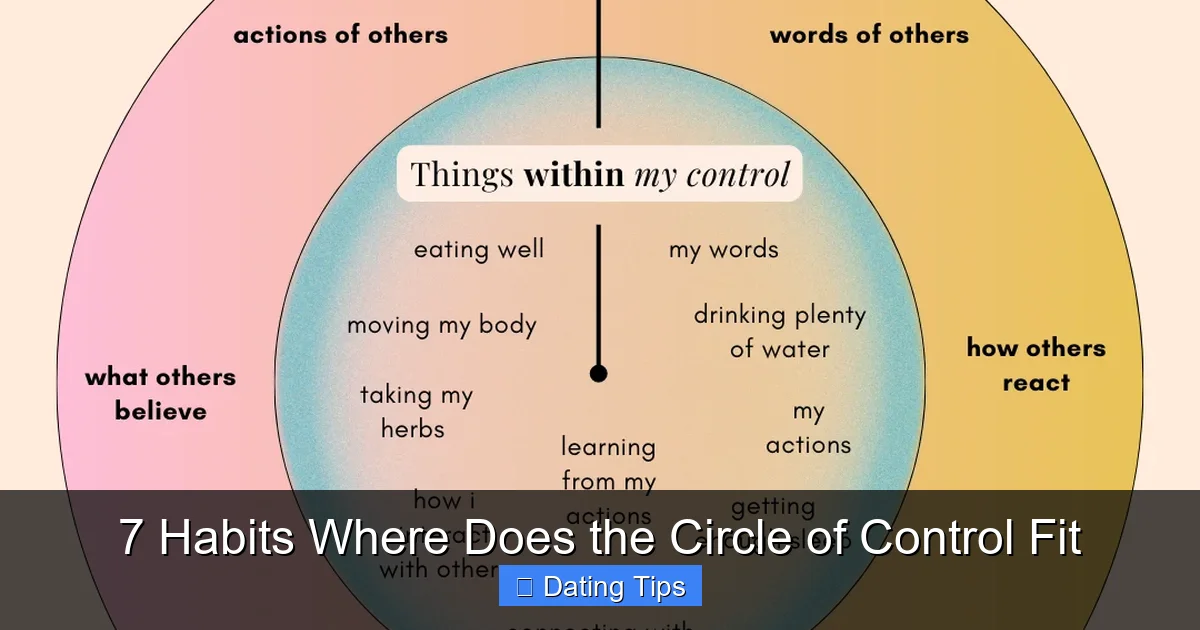
The Circle of Control is a powerful concept from Stephen R. Covey’s 7 Habits of Highly Effective People that helps you focus only on what you can actually influence. In dating and relationships, applying this principle means shifting your energy from things like others’ opinions or past mistakes to actions within your control—like communication, self-respect, and emotional honesty. By doing so, you become more confident, less reactive, and genuinely happier in love.
Imagine this: You’ve been single for months, swiping endlessly, going on dates, and hoping for a spark. But instead of feeling hopeful, you’re stuck in a cycle of anxiety—wondering if he’s texting you back, replaying awkward conversations, or worrying if you’re “too much” or “not enough.” Sound familiar? You’re not alone. So many people get caught up in chasing love while losing themselves in the process.
This is where the **Circle of Control** comes in—a game-changing idea from Stephen R. Covey’s bestselling book *The 7 Habits of Highly Effective People*. At its core, the Circle of Control isn’t just another productivity hack; it’s a mindset shift that applies beautifully to dating, self-worth, and emotional intelligence. When you understand where your circle ends and begins, you reclaim power over your life—especially in matters of the heart.
But here’s the catch: most people confuse their Circle of Concern (what they *want*) with their Circle of Control (what they *can actually do*). And when you spend all your time worrying about things outside your influence—like whether someone likes you or if they’ll propose—you lose sight of what truly matters: building a fulfilling life, one intentional choice at a time.
So let’s break down exactly **where the Circle of Control fits into the 7 Habits**, especially as it relates to modern dating. We’ll explore practical examples, real-life scenarios, and actionable steps so you can stop spinning your wheels and start living with clarity and confidence.
—
Key Takeaways
- The Circle of Control includes things you can directly influence: Your thoughts, actions, reactions, choices, and commitments.
- The Circle of Concern includes external factors: Others’ behaviors, societal expectations, past relationship patterns, or whether someone texts back.
- Focus on expanding your Circle of Influence: This overlaps with both circles—things you care about but can still affect through skill and effort.
- In dating, stop obsessing over outcomes: Instead, concentrate on being present, authentic, and emotionally available.
- Habit 2: Begin with the End in Mind aligns perfectly with the Circle of Control: Define what you want in a relationship and act accordingly.
- Practicing this habit reduces anxiety: You stop wasting mental energy on uncontrollable variables like attraction levels or timing.
- This mindset builds healthier boundaries: You protect your peace without becoming passive or manipulative.
📑 Table of Contents
Understanding the Circle of Control vs. Circle of Concern
Before we dive into the habits, let’s get clear on what these two circles really mean—and why it matters for your dating life.
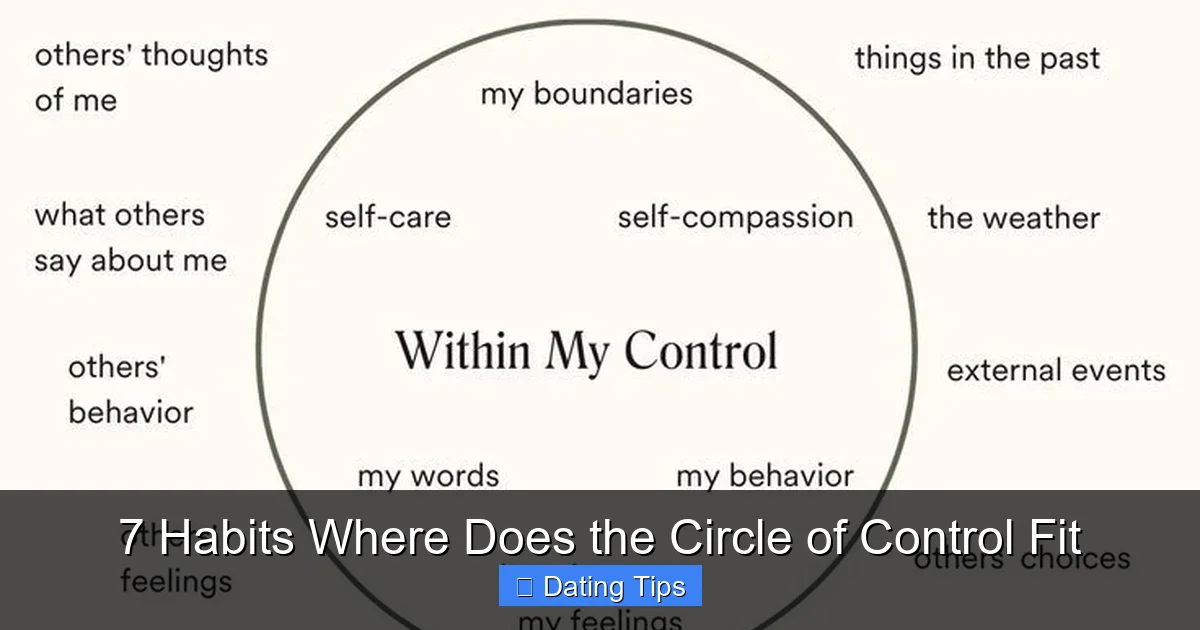
Think of your **Circle of Control** as everything inside your direct influence: your words, your decisions, your attitude, your effort, your willingness to grow. If you can say “yes” or “no” to it, or change it through action, it’s yours to manage.
Your **Circle of Concern**, on the other hand, is everything you care about but may not control. That includes other people’s feelings, their choices, societal norms, or even whether you’re getting enough matches on dating apps. These are important, sure—but they’re not yours to command.
Now, there’s also a third zone called your **Circle of Influence**, which sits between the two. It includes things you care about and *can* influence—like improving your conversation skills, showing kindness consistently, or working on emotional availability. This is where growth happens.
In dating, this framework looks something like this:
– **Inside your Circle of Control**: How you dress, what you say during a date, whether you respond kindly to rejection, your daily self-care routine.
– **Inside your Circle of Concern**: Whether he remembers your birthday, if she’s seeing someone else, how long it takes to find “the one.”
– **Inside your Circle of Influence**: Making yourself more interesting, being genuinely curious about others, setting healthy boundaries.
When you keep focusing only on your Circle of Concern—especially in romantic contexts—you create a fragile sense of happiness that depends entirely on external validation. That’s exhausting. And unsustainable.
That’s why integrating the Circle of Control into your daily life isn’t just helpful—it’s essential.
—
How the 7 Habits Connect to the Circle of Control
Visual guide about 7 Habits Where Does the Circle of Control Fit
Image source: 7habitspip.weebly.com
Stephen Covey didn’t design the 7 Habits in isolation. Each habit builds on the last, creating a foundation for personal effectiveness. And guess what? The Circle of Control threads through them all—but most notably in Habit 1 and Habit 2.
Let’s walk through each habit briefly to see where the Circle of Control fits naturally:
Habit 1: Be Proactive
This is the cornerstone of the Circle of Control. Being proactive means recognizing that you’re responsible for your responses—even to difficult situations. In dating, this could mean choosing to smile even after a bad first date, or deciding to prioritize yourself instead of waiting for someone to notice you.
It’s easy to fall into reactive patterns: “He didn’t text me back, so I must be boring.” But proactive thinking flips that: “I choose to invest in myself today—because my worth isn’t tied to his reply.”
Habit 2: Begin with the End in Mind
Here’s where intention meets action. If you’ve ever asked yourself, “What kind of partner do I want?” or “How should I treat myself in a relationship?”, you’re already practicing this habit. The Circle of Control supports this by helping you define values (like respect, honesty, growth) and then align your behavior with them—regardless of who shows up.
For example, if your goal is mutual respect, then checking your phone constantly during a date falls outside your circle of control—but choosing to engage fully is firmly inside it.
Habit 3: Put First Things First
Time management meets emotional discipline. Prioritizing your goals means scheduling time for self-improvement, friendships, hobbies—even if no one’s asking you out. When you honor your own needs first, you shrink your Circle of Concern and expand your Circle of Control.
Think of it like refueling your car before driving far. You don’t wait until you’re stranded to fill up. Same with self-respect.
Habit 4: Think Win-Win
Relationships thrive on collaboration—not competition. Applying win-win thinking means approaching dates and connections as opportunities to connect, not prove anything. Your Circle of Control includes how you show up: with curiosity, generosity, and zero need to “win.”
Habit 5: Seek First to Understand, Then to Be Understood
Active listening is a superpower. When you focus on understanding someone else (your Circle of Influence), you naturally reduce anxiety about being misunderstood or judged (your Circle of Concern). This builds deeper intimacy and reduces misunderstandings.
Habit 6: Synergize
Combining strengths creates something greater than the sum of its parts. In dating, synergy happens when two people complement each other’s growth. But again, your Circle of Control is about how you contribute to that synergy—through openness, adaptability, and shared values.
Habit 7: Sharpen the Saw
This habit is all about renewal—physical, mental, social, spiritual. Nurturing yourself strengthens your ability to engage authentically in relationships. When you’re physically tired or mentally drained, your Circle of Control shrinks. But when you prioritize rest, learning, and joy, you make space for meaningful connection.
—
Practical Ways to Apply the Circle of Control in Dating
Visual guide about 7 Habits Where Does the Circle of Control Fit
Image source: nutritiontofit.com
Ready to put theory into practice? Here are concrete strategies to help you live more intentionally in the realm of dating and relationships.
1. Stop Chasing Validation Outside Yourself
If your mood swings based on whether someone replies quickly or likes your photos, you’re operating mostly in your Circle of Concern. Shift focus to internal validation: Did I speak kindly today? Did I try something new? Did I honor my values?
Try this exercise: For one week, write down three small wins each day—no matter how minor. Not getting a text back doesn’t count unless you chose peace anyway.
2. Reframe Rejection as Feedback (Not Failure)
Rejection hurts—but it’s not a reflection of your worth. Your Circle of Control includes how you respond to it. Do you spiral into doubt, or do you use it to refine your approach?
Example: After a disappointing date, instead of thinking “No one will ever like me,” ask: “What did I learn about communication or compatibility?” Then act on that insight.
3. Set Clear Boundaries Without Guilt
Boundaries are part of your Circle of Control. Saying “no” to unwanted attention, limiting time on dating apps, or ending conversations that drain you—these are all within your power.
Remember: Healthy boundaries shrink your Circle of Concern and protect your energy.
4. Focus on Process, Not Outcome
You can’t force chemistry or predict when love will strike. But you *can* control how you prepare: Are you cultivating hobbies? Working on emotional availability? Showing up as your full self?
Process-focused dating leads to better experiences—even if romance doesn’t happen right away.
5. Practice Emotional Detachment from Results
It’s okay to hope for connection—but not okay to tie your happiness to it. Your Circle of Control includes your emotional response: “I hope we click, but I’m happy either way.”
This isn’t coldness—it’s freedom.
—
Real-Life Example: Sarah’s Journey
Visual guide about 7 Habits Where Does the Circle of Control Fit
Image source: i.pinimg.com
Sarah had been on countless dates but felt stuck. She obsessed over whether men found her attractive, worried about saying the wrong thing, and panicked when conversations ended awkwardly. She was deep in her Circle of Concern—and miserable because of it.
Then she read about the Circle of Control and decided to test it. She started journaling daily questions like:
– “What can I control today?”
– “Did I speak honestly?”
– “Did I show up as my best self?”
She stopped tracking how often men replied to her texts. Instead, she focused on hosting fun conversations and pursuing her passion for painting. Within weeks, she met Mark—someone who appreciated her authenticity, not her performance.
They dated for six months before realizing they wanted different things. But Sarah wasn’t crushed. Why? Because she’d built her identity outside the relationship. Her happiness wasn’t dependent on him anymore.
That’s the magic of the Circle of Control: it turns dating from a desperate search into a natural extension of your growth.
—
Common Mistakes People Make (And How to Avoid Them)
Even when people grasp the concept, they often misapply it. Here’s what to watch out for:
– **Confusing control with manipulation**: Just because you can influence something doesn’t mean you should. Manipulating someone’s emotions crosses ethical lines and erodes trust.
– **Using it to avoid vulnerability**: Saying “I can’t feel hurt” or “I won’t let myself care” shuts down genuine connection. Vulnerability is part of your Circle of Influence—not control.
– **Ignoring red flags**: If someone disrespects boundaries, that’s outside your control—but recognizing it is inside your influence. Don’t confuse awareness with helplessness.
The key is balance: take responsibility for your part, but accept others’ autonomy.
—
Final Thoughts: Love With Confidence, Not Fear
The Circle of Control isn’t about shutting down emotions or pretending you’re invincible. It’s about directing your energy wisely. When you stop fighting reality and start investing in what you *can* shape, life—including love—becomes lighter, clearer, and more joyful.
In dating, this means embracing uncertainty without losing yourself. It means showing up fully, even when outcomes aren’t guaranteed. And it means knowing that your value isn’t negotiable—no matter who walks in or out of your life.
As you move forward, remember: You don’t need to control everything. You just need to control how you respond. And that? That’s always within reach.
Want more tools to build confidence in love? Check out our article on habits of attractive women—or explore ways to cultivate daily happiness through simple routines.
Frequently Asked Questions
Where does the Circle of Control fit in the 7 Habits?
It’s foundational to Habit 1 (Be Proactive) and supports all habits by distinguishing between what you can and cannot control. Focusing on controllable actions increases effectiveness and peace.
Can I apply the Circle of Control to online dating?
Absolutely. Your Circle of Control includes how you profile yourself, message matches, and handle rejection—not whether someone swipes right or responds.
Does this mean I shouldn’t care about others’ opinions?
You can care without depending on approval. Care is in your Circle of Concern; how you respond to feedback is in your Circle of Control.
How do I stop obsessing over relationship outcomes?
Redirect energy toward actions: improve conversation skills, deepen friendships, work on self-esteem. Outcomes follow naturally when you’re grounded in purpose.
Is the Circle of Control selfish?
Not at all. Prioritizing what you can control fosters self-respect, which enables healthier, more balanced relationships with others.
What if someone keeps hurting me despite my efforts?
Your Circle of Control includes how you respond to pain—but also includes knowing when to walk away. Protecting your peace is an act of courage, not weakness.
