
Apologies may sound sincere, but they often fall short when it comes to truly healing emotional pain in relationships. Just because someone says “I’m sorry” doesn’t mean the hurt is gone—or that trust can be easily restored. Emotional wounds run deeper than words, and without real change, apologies can even feel hollow or manipulative. In dating and long-term relationships, trust is rebuilt through consistent actions, not one-time declarations. This article explores why apologies alone won’t make the hurt just go away and offers practical steps toward genuine emotional recovery.
Have you ever said “I’m sorry” after hurting someone—only to feel like nothing changed? Or maybe you’ve received an apology that felt empty, like the other person wasn’t really trying to understand your pain? If so, you’re not alone. In dating and relationships, apologies are often seen as the magic fix—the moment everything gets better. But here’s the truth: apologies don’t always make the hurt just go away, no matter how sincere they sound.
Emotional wounds run deeper than surface-level words. When someone hurts us—whether it’s through cheating, lying, ignoring our needs, or breaking promises—it affects our sense of safety, worth, and trust. And while saying “I’m sorry” is a start, it’s not enough on its own. Healing requires more than remorse. It demands accountability, action, and time. In this article, we’ll explore why apologies alone won’t fix deep hurt in relationships and what you can do instead to protect your heart and rebuild—on your terms.
—
Key Takeaways
- Emotional pain isn’t fixed by words alone: Apologies are important, but they don’t automatically heal deep hurt or restore trust in a relationship.
- Trust requires consistency over time: Rebuilding trust means repeated, reliable behavior that proves the apology was more than just words.
- Timing and context matter: A rushed or insincere apology can worsen hurt feelings, especially if it’s followed by the same behavior.
- Hurt stems from unmet needs: Understanding what caused the hurt—like disrespect, betrayal, or neglect—helps address the root issue.
- Healing takes space and boundaries: Sometimes, stepping back from the relationship gives both people room to process emotions and grow.
- Communication must be two-way: True reconciliation involves listening to your partner’s feelings and expressing your own honestly.
- Self-healing is essential: Focusing on your own well-being helps you move forward, whether the relationship continues or ends.
📑 Table of Contents
- The Myth of the Perfect Apology
- Why Words Aren’t Enough to Heal Emotional Wounds
- When Apologies Backfire: The Danger of Empty Words
- Rebuilding Trust: It’s Not About One Conversation
- The Role of Self-Healing in Moving Forward
- How to Communicate When Hurt Runs Deep
- What Happens When Both Sides Work on Healing?
- Final Thoughts: Healing Starts With You
The Myth of the Perfect Apology
We’ve all been taught that a good apology can fix almost anything. “Just say you’re sorry,” friends might say. “It’ll make things better.” But in real life, especially in romantic relationships, it’s not that simple. Think about it: have you ever apologized for something small—like forgetting an anniversary or snapping at your partner—and felt like it resolved everything? Probably not. The bigger the hurt, the less effective a simple apology tends to be.
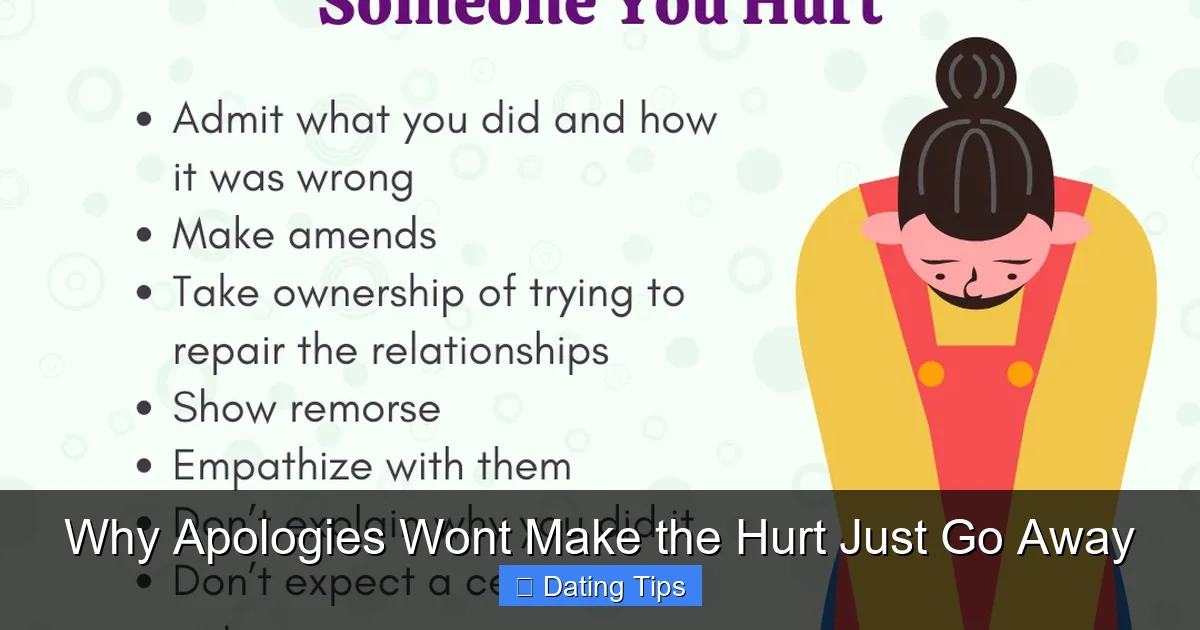
A perfect apology includes several parts: acknowledgment of the harm, empathy for how it affected the other person, acceptance of responsibility, and a plan to prevent it from happening again. But even with all those pieces, it’s possible to apologize without actually changing your behavior. That kind of apology is more about avoiding guilt than making amends.
For example, imagine your boyfriend says, “I’m sorry I didn’t text you back for three hours. I got busy at work.” On the surface, it sounds reasonable. But if he does it again—ignoring your messages while claiming he’s “just busy”—your hurt doesn’t disappear. Instead, it builds up. Why? Because your need for attention and connection wasn’t met. The apology addressed his actions, but not your feelings.
That’s why apologies won’t make the hurt just go away—especially when they’re not backed by real change. Trust isn’t rebuilt in one conversation; it’s built day by day through consistent actions.
—
Why Words Aren’t Enough to Heal Emotional Wounds
Visual guide about Why Apologies Wont Make the Hurt Just Go Away
Image source: substackcdn.com
When someone hurts us emotionally, it’s not just their fault—it’s also a reflection of our own vulnerability. We open ourselves up, share our hopes, dreams, and fears, and then get hurt. That pain lingers because it touches something deep inside. Apologies try to soothe that pain, but they often miss the mark.
Take betrayal, for instance. If your partner lied about seeing someone else, a simple “I’m sorry” might not cut it. You’re left questioning everything—was it real? Did they ever care? Was I just a distraction? Those questions don’t vanish with an apology. They need time, honesty, and proof that the behavior won’t happen again.
Similarly, if someone constantly dismisses your opinions or makes you feel small, an apology might come quickly—but unless they start valuing your voice, the hurt remains. Your self-worth isn’t restored by words alone. It’s rebuilt through repeated experiences of being respected and heard.
And let’s be honest: sometimes, people apologize just to stop the argument or avoid consequences. That kind of apology feels hollow. You can usually tell when someone isn’t being genuine—when their tone is defensive, when they blame you for “overreacting,” or when they promise to do better but don’t follow through.
So what makes an apology meaningful? It’s not the words themselves. It’s the intention behind them—and the actions that follow.
—
When Apologies Backfire: The Danger of Empty Words

Visual guide about Why Apologies Wont Make the Hurt Just Go Away
Image source: c8.alamy.com
Not every apology is helpful. In fact, some can make things worse. This happens when the apology is rushed, insincere, or used as a manipulation tactic. Let’s look at a few examples:
– The Over-Apologizing Partner: Someone who says “I’m sorry” for everything—even minor misunderstandings. This can make you feel like your feelings are invalid. If every little thing requires an apology, it erodes trust and creates tension.
– The Defensive Apology: “I’m sorry you felt that way.” This shifts blame onto you. Instead of taking responsibility, the person apologizes for your reaction, not their actions. That’s not real accountability.
– The Delayed Apology: Saying “I’m sorry” days or weeks after the incident. While timing isn’t always bad, a delayed apology can feel like an obligation rather than a heartfelt gesture. It misses the chance to show immediate empathy.
These kinds of apologies don’t heal hurt—they deepen it. They send the message: “My actions weren’t that big a deal,” or “You’re too sensitive.” When that happens, the hurt doesn’t just go away. It grows.
On the flip side, a meaningful apology acknowledges the full weight of what happened. It shows you understand how much damage was done. It doesn’t minimize your pain. And it commits to doing better.
If you’re on the receiving end of an apology that doesn’t sit right with you, it’s okay to pause. You don’t have to accept it immediately. Ask questions. Say, “Can you explain why you did that?” or “How do you plan to make sure this doesn’t happen again?”
Real apologies invite dialogue—not just silence.
—
Rebuilding Trust: It’s Not About One Conversation
Visual guide about Why Apologies Wont Make the Hurt Just Go Away
Image source: choosingtherapy.com
Trust is fragile. Once broken, it takes time—and effort—to rebuild. And here’s the hard truth: no single conversation will fix it. Trust is rebuilt through consistency. It’s shown in small moments: arriving on time, keeping promises, respecting boundaries, and choosing honesty over convenience.
Let’s say your partner cheated. An apology is necessary, but it’s just the beginning. You need to see changes: transparency in communication, willingness to attend counseling, and a commitment to rebuilding intimacy. Without those actions, the apology rings hollow.
In dating, trust is especially important because we’re still learning about each other. If someone breaks your trust early on—by lying about their intentions, hiding their past, or treating you poorly—it sets a pattern. Rebuilding that trust means paying close attention to how they behave moving forward.
Here are some signs that trust might be slowly returning:
– They follow through on small promises (e.g., texting when they said they would).
– They listen to your concerns without getting defensive.
– They ask how you’re feeling and actually care about the answer.
– They admit when they’re wrong—without blaming you.
But remember: you don’t have to rush this. Healing isn’t linear. Some days, you’ll feel hopeful. Others, you’ll feel raw and vulnerable. That’s normal. What matters is whether you’re choosing to stay in a relationship where your needs are respected—or if you’re staying out of fear, obligation, or hope for a “better” version of the person.
If trust isn’t being rebuilt—even after multiple efforts—it might be time to consider moving on. Staying in a relationship where your pain isn’t taken seriously only delays your healing.
—
The Role of Self-Healing in Moving Forward
One of the hardest parts of being hurt in a relationship is realizing that you have to heal yourself. That doesn’t mean you’re at fault—it means you’re human. You deserve peace, respect, and love. And sometimes, that means letting go.
Self-healing starts with acknowledging your pain. Don’t minimize it. Tell yourself, “This hurts because it mattered.” Then, give yourself permission to feel it. Cry, journal, talk to a friend, or seek therapy. Bottling up emotions only prolongs the hurt.
Next, focus on your needs. What do you require in a healthy relationship? Clear communication? Emotional availability? Mutual respect? Write it down. Use it as a guide—not just for your current partner, but for future ones.
Also, practice self-compassion. You’re not weak for being hurt. You’re strong for surviving it. Remind yourself daily: “I am worthy of love, even if this relationship didn’t work out.”
And finally, create distance if needed. Stepping back—physically, emotionally, or both—gives you space to breathe. You might read How To Pull Away To Make Him Want You to learn how to set boundaries without drama. Or explore Ways To Turn The Tables When He Pulls Away to regain control. These strategies aren’t about manipulation—they’re about self-respect.
Remember: healing isn’t selfish. It’s necessary. You can’t pour from an empty cup. Taking care of yourself isn’t the opposite of loving someone—it’s the foundation of any lasting relationship.
—
How to Communicate When Hurt Runs Deep
When emotional wounds run deep, talking can be scary. But avoiding the conversation only makes things worse. Here’s how to approach it with honesty and care:
1. **Choose the Right Time:** Don’t bring it up during an argument or when either of you is stressed. Find a calm moment when you can talk without distractions.
2. **Use “I” Statements:** Say, “I felt hurt when you canceled plans last minute,” instead of “You never care about me.” This reduces defensiveness and keeps the focus on your experience.
3. **Be Specific:** Vague complaints like “You always ignore me” make it hard for your partner to understand. Share a concrete example: “Last Tuesday, you canceled our dinner date without rescheduling, and I felt abandoned.”
4. **Listen Without Interrupting:** Give your partner space to respond. Even if they didn’t mean to hurt you, hearing your perspective matters.
5. **Ask Questions:** Instead of demanding answers, try, “Can you help me understand why that happened?” This invites empathy, not excuses.
6. **Set Boundaries:** If the behavior continues, be clear about what you need. For example, “If you cancel plans, I need you to reschedule within 24 hours.”
Talking about hurt isn’t easy. But it’s often the first step toward real change—or the decision to walk away.
—
What Happens When Both Sides Work on Healing?
Healing isn’t just about one person. It’s a shared journey—when both partners are willing to grow. That means:
– Acknowledging your role in the conflict (even if you weren’t the one who caused the main hurt).
– Asking for forgiveness—not expecting it immediately.
– Making amends through actions, not just words.
– Practicing patience. Healing takes months, not days.
Couples therapy can be incredibly helpful here. A neutral third party can guide difficult conversations and help you both express your needs safely.
But even without therapy, small steps matter. Try writing letters to each other (even if you don’t send them). Share your feelings honestly. Celebrate progress, no matter how small.
And remember: reconciliation doesn’t mean going back to the old dynamic. Healthy relationships evolve. They’re built on mutual growth, not repeating mistakes.
—
Final Thoughts: Healing Starts With You
Apologies are important—but they’re not the finish line. True healing begins when you take responsibility for your own emotional well-being. Whether the relationship continues or ends, your priority should be your peace.
Don’t rush to forgive just because someone said “I’m sorry.” Forgiveness is a process. And sometimes, the bravest choice is to protect your heart by walking away.
You deserve a relationship where your hurt is seen, your needs are honored, and your love is returned with consistency—not just words. Keep reading articles like Signs He Doesn’t Care About The Relationship to recognize red flags. Explore How To Make Your Man Respect You to build healthier dynamics. And if you’re curious about turning casual flings into something deeper, check out How To Go From Friend To Dating.
Your worth isn’t defined by how others treat you. It’s measured by how you treat yourself—especially when things get tough.
Frequently Asked Questions
Why don’t apologies make emotional hurt go away?
Emotional hurt runs deep and often involves broken trust, unmet needs, or repeated patterns of behavior. Apologies alone can’t erase these wounds because they don’t guarantee real change. Healing requires consistent actions, time, and mutual effort—not just words.
How do I know if an apology is genuine?
A genuine apology includes empathy, accountability, and a plan to change. It avoids blame, listens to your feelings, and shows through actions that the mistake won’t be repeated. If the same behavior continues, the apology likely wasn’t sincere.
Can trust be rebuilt after betrayal?
Yes, but it takes significant time, transparency, and consistent effort. Rebuilding trust means repeated proof of change—not just one conversation. Therapy can help both partners navigate the process safely and honestly.
Should I forgive someone even if they don’t fully understand my hurt?
Forgiveness is personal and doesn’t require your partner’s understanding—though it helps. You can choose to forgive without reconciling. Focus on releasing bitterness for your own peace, not theirs.
What if my partner keeps apologizing but repeats the same behavior?
This pattern suggests the apology isn’t leading to real change. Consider setting firm boundaries or reevaluating whether the relationship meets your needs. Consistency matters more than frequency of apologies.
Is it okay to take space after being hurt?
Absolutely. Taking space allows you to heal, gain clarity, and decide what’s best for your well-being. Use this time to reflect and protect your emotional health—regardless of whether you stay in the relationship.
