
Words have power—especially in marriage. While a loving phrase can heal and uplift, the wrong words can deeply wound. This article explores the worst things a husband can say to his wife, why they’re so damaging, and how to rebuild trust when communication breaks down.
Key Takeaways
- Hurtful words erode trust: Even one harsh statement can damage emotional safety and weaken the foundation of a marriage.
- Tone matters as much as content: How something is said—snapping, sarcasm, or coldness—can amplify the pain of the words themselves.
- Silence is not always golden: Withholding affection or shutting down emotionally can be as harmful as yelling.
- Apologies must be sincere: Saying “I’m sorry” without accountability or change doesn’t heal—it prolongs hurt.
- Patterns are more damaging than single incidents: Repeated negative communication creates long-term emotional distance.
- Healthy communication is a skill: Couples can learn to express needs without blame, criticism, or contempt.
- Seeking help is a sign of strength: Therapy or counseling can restore connection when words keep failing.
📑 Table of Contents
- Introduction: The Power of Words in Marriage
- Why Words Matter More Than We Think
- “You’re Overreacting” – Dismissing Her Feelings
- “I Told You So” – Weaponizing Past Mistakes
- “You’re Just Like Your Mother” – Bringing Family Into It
- “I Don’t Want to Talk About It” – Emotional Withdrawal
- “You Never Listen to Me” – Generalizing and Blaming
- “I’m Done” or “Maybe We Should Just Split” – Threatening the Relationship
- How to Heal After Saying the Wrong Thing
- Building a Kinder, Stronger Marriage
- Conclusion: Words Can Heal or Harm
Introduction: The Power of Words in Marriage
Marriage is built on love, trust, and communication. But let’s be real—no couple is perfect. We all have bad days. We get stressed, tired, or frustrated. And sometimes, in those moments, we say things we don’t mean. Or worse—we say things we *do* mean, but in the cruelest way possible.
Words are not just sounds. They carry weight. They can lift someone up or tear them down. In a marriage, where emotional intimacy is everything, the wrong words can cut deeper than any argument. A husband’s words shape how his wife feels seen, valued, and loved. When those words are dismissive, cruel, or belittling, the damage can last for years.
This isn’t about shaming men or painting husbands as villains. It’s about awareness. It’s about recognizing that even small, careless phrases can accumulate and erode the foundation of a relationship. The goal isn’t perfection—it’s progress. By understanding the worst things a husband can say to his wife, we can all become more mindful, compassionate partners.
Why Words Matter More Than We Think
Visual guide about Worst Things a Husband Can Say to His Wife
Image source: contenthub-static.grammarly.com
You might think, “It was just a joke,” or “She knows I didn’t mean it.” But here’s the truth: intent doesn’t erase impact. Just because you didn’t mean to hurt her doesn’t mean she wasn’t hurt.
Emotional safety is the bedrock of a strong marriage. When a wife feels safe, she’s more likely to be open, vulnerable, and connected. But when she’s constantly on edge, waiting for the next critical remark or cold silence, that safety vanishes. Over time, she may stop sharing her thoughts, hide her feelings, or even pull away emotionally.
Research shows that the way couples communicate predicts the success of their marriage more than any other factor—even money, sex, or parenting styles. The Gottman Institute, a leader in relationship research, found that contempt—expressed through sarcasm, mockery, or insults—is the number one predictor of divorce.
So yes, words matter. A lot. And while no one sets out to say the worst things a husband can say to his wife, it happens. Often in moments of stress, anger, or insecurity. The good news? Awareness is the first step toward change.
“You’re Overreacting” – Dismissing Her Feelings

Visual guide about Worst Things a Husband Can Say to His Wife
Image source: romancecompass.com
One of the most damaging things a husband can say is, “You’re overreacting.” It sounds innocent enough, but it’s a verbal slap in the face.
When a wife shares her feelings—whether she’s upset about something he said, stressed about work, or hurt by a comment—she’s inviting him into her emotional world. She’s trusting him with her vulnerability. And when he responds with “You’re overreacting,” he’s essentially saying, “Your feelings don’t matter. You’re wrong for feeling this way.”
This phrase invalidates her experience. It tells her that her emotions are irrational, exaggerated, or unwarranted. And over time, that message sinks in: “Maybe I *am* too sensitive. Maybe I shouldn’t feel this way.”
Why This Phrase Is So Harmful
When someone says “You’re overreacting,” they’re not just disagreeing—they’re dismissing. They’re placing themselves as the judge of what’s reasonable, and her feelings as the problem. This creates a power imbalance. It says, “My perspective is correct; yours is flawed.”
And here’s the kicker: feelings aren’t logical. You can’t reason someone out of sadness, anger, or fear. Telling someone they’re overreacting doesn’t calm them down—it shuts them down.
Real-Life Example
Imagine this: Sarah comes home from work, exhausted. Her boss criticized her in front of the team. She tells her husband, “I feel so humiliated. I don’t know if I can face them tomorrow.”
Instead of offering comfort, he says, “You’re overreacting. It was just one comment. Everyone gets criticized at work.”
Now Sarah doesn’t just feel hurt by her boss—she feels alone at home. She might think, “If even my husband doesn’t understand, who will?” She stops sharing. The emotional distance grows.
What to Say Instead
Instead of dismissing, try validating. Say something like:
– “That sounds really tough. I’m sorry you went through that.”
– “I can see why that would upset you. That’s not fair.”
– “How are you feeling about it now?”
Validation doesn’t mean you agree with her reaction—it means you respect her right to feel it. It says, “Your feelings are real, and I’m here for you.”
“I Told You So” – Weaponizing Past Mistakes
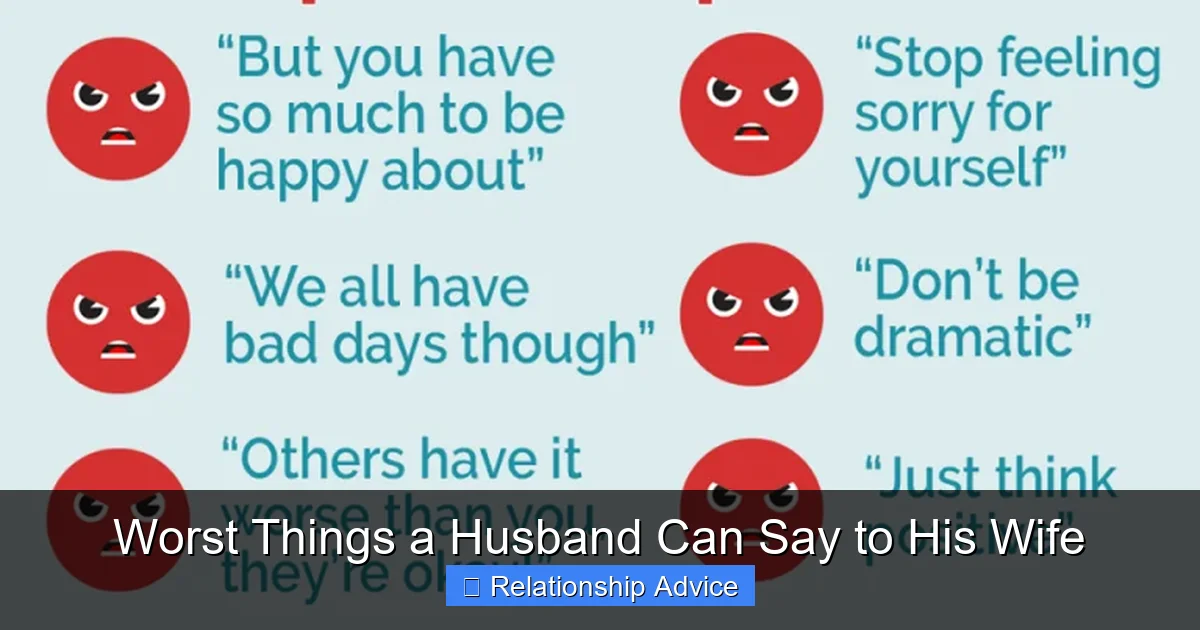
Visual guide about Worst Things a Husband Can Say to His Wife
Image source: calmsage.com
We’ve all heard it: “I told you so.” It’s often said with a smug tone, a raised eyebrow, or a sigh of superiority. And it’s one of the worst things a husband can say to his wife.
This phrase isn’t about sharing wisdom. It’s about winning. It’s about proving you were right and she was wrong. It turns a moment of vulnerability—when she’s admitting a mistake or facing a consequence—into a victory lap for him.
Why “I Told You So” Destroys Trust
When a wife admits she made a mistake, she’s showing courage. She’s opening up, hoping for support, understanding, or even just a hug. But “I told you so” turns that moment into punishment.
It says, “I knew you’d fail, and now I get to remind you of it.” It makes her regret being honest. Next time, she might hide her mistakes instead of sharing them.
And let’s be honest—everyone makes mistakes. Marriage isn’t about keeping score. It’s about walking through life together, even when things go wrong.
Real-Life Example
Mark and Lisa are planning a family vacation. Lisa suggests driving instead of flying to save money. Mark warns, “It’s a long drive. The kids will get restless. We should fly.”
Lisa insists, “We’ll be fine. It’ll be an adventure.”
Two hours into the trip, the kids are crying, the car smells like stale snacks, and Lisa is exhausted. Mark turns to her and says, “I told you so.”
Now Lisa feels shame, regret, and resentment. She might think, “Why did I even try? He always knows better.” The next time she has an idea, she’ll hesitate. She’ll second-guess herself. The partnership weakens.
What to Say Instead
Instead of rubbing it in, offer support:
– “This is tough. Want to pull over and take a break?”
– “I know you were trying to save money. That was really thoughtful.”
– “Next time, we can plan differently—but we’ll get through this.”
These responses acknowledge the mistake without shaming. They focus on solutions, not blame.
“You’re Just Like Your Mother” – Bringing Family Into It
Ah, the classic: “You’re just like your mother.” This phrase is a low blow. It’s not just criticism—it’s a personal attack wrapped in family baggage.
Most people have complicated relationships with their parents. Even if they love them, there are traits they don’t admire. When a husband says this, he’s not just criticizing his wife—he’s dragging her entire family into the argument.
Why This Phrase Is So Painful
This statement implies that her behavior is inherited, unchangeable, and deeply flawed. It suggests she’s doomed to repeat her mother’s mistakes. It also invalidates her individuality. She’s not “Sarah” anymore—she’s “just like her mom.”
And let’s be real: even if there’s truth in the comparison, it’s not helpful. It doesn’t solve the problem. It just adds insult to injury.
Real-Life Example
Tom and Rachel are arguing about money. Rachel wants to save for a new car. Tom wants to invest in a business idea. Rachel says, “We need to be practical. We can’t just spend money we don’t have.”
Tom snaps, “You’re just like your mother—always worried about every penny. No wonder your family never took any risks.”
Now Rachel doesn’t just feel criticized—she feels attacked on a personal, familial level. She might think, “He doesn’t just dislike my opinion—he dislikes my whole family.” The argument escalates, and the real issue gets lost.
What to Say Instead
Focus on the behavior, not the person:
– “I feel nervous about taking financial risks right now. Can we talk about a compromise?”
– “I understand you want to save, but I’m excited about this opportunity. How can we balance both?”
This keeps the conversation about the issue, not the insult.
“I Don’t Want to Talk About It” – Emotional Withdrawal
Sometimes, the worst thing a husband can say isn’t a harsh word—it’s silence. “I don’t want to talk about it” is a wall. It shuts down communication and leaves his wife feeling alone.
Marriage thrives on connection. When one partner withdraws, the other feels abandoned. Even if he’s not yelling or insulting, the emotional distance can be just as painful.
Why Emotional Withdrawal Hurts
When a wife shares something important—a worry, a dream, a conflict—she’s reaching out. She’s saying, “I need you.” And when he responds with, “I don’t want to talk about it,” he’s saying, “I’m not here for you.”
This creates a cycle. She tries to connect. He pulls away. She tries harder. He withdraws more. Eventually, she stops trying. The relationship becomes a series of surface-level exchanges—no depth, no intimacy.
Real-Life Example
Jenna tells her husband, “I’ve been feeling really lonely lately. I miss us spending time together.”
He sighs and says, “I don’t want to talk about it. I’m tired.”
Jenna feels rejected. She thinks, “He doesn’t care how I feel.” She stops sharing. They eat dinner in silence. They go to bed without talking. The loneliness grows.
What to Say Instead
Even if you’re not ready to talk, acknowledge her:
– “I hear that you’re feeling lonely. I’m not in the right headspace to talk now, but can we set a time later this week?”
– “I’m sorry you’re feeling that way. I want to be there for you—can we talk after I’ve had a moment to unwind?”
This shows you’re not dismissing her—you’re just asking for space.
“You Never Listen to Me” – Generalizing and Blaming
“You never listen to me” is a sweeping accusation. It’s not about one missed conversation—it’s about her entire character.
This phrase is problematic for two reasons. First, it’s almost always an exaggeration. No one *never* listens. Second, it puts all the blame on her, ignoring your own role in communication.
Why This Phrase Escalates Conflict
When someone says “You never…” or “You always…,” it triggers defensiveness. She’ll think, “That’s not true! I listened last week!” Instead of addressing the real issue, she’ll argue about the wording.
And because it’s so broad, it doesn’t offer a solution. It just labels her as a bad listener—without explaining what she should do differently.
Real-Life Example
David tells his wife, “I’ve been stressed about work. My boss is micromanaging me.”
She nods and says, “That sounds rough. Have you talked to HR?”
He snaps, “You never listen to me! I just wanted you to say you understand, not give me advice!”
Now she feels confused and criticized. She thought she was helping. Now she’s labeled as a bad listener.
What to Say Instead
Be specific and use “I” statements:
– “I felt like you were giving me advice instead of just listening. I really just needed you to hear me out.”
– “I appreciate that you want to help, but sometimes I just need to vent. Can you just listen for now?”
This focuses on your need, not her failure.
“I’m Done” or “Maybe We Should Just Split” – Threatening the Relationship
Nothing strikes fear into a marriage like the threat of divorce. Saying “I’m done” or “Maybe we should just split” during an argument is emotional blackmail.
It’s not a solution—it’s a weapon. It’s meant to scare her into compliance, silence, or submission. And it works. But the cost is high.
Why Threats Destroy Security
Marriage is supposed to be a safe harbor. A place where you know, no matter what, you’re in it together. When a husband threatens to leave, that safety vanishes.
She starts walking on eggshells. She avoids conflict. She agrees with him even when she disagrees—just to keep the peace. The relationship becomes about survival, not love.
And if he says it once, she’ll remember it forever. Even if he takes it back, the doubt remains: “Will he leave next time?”
Real-Life Example
Chris and Maria are arguing about chores. Maria says, “You never help around the house. I’m exhausted.”
Chris yells, “Fine! If you’re so unhappy, maybe we should just split!”
Maria freezes. She stops arguing. She cleans the house alone that night. But inside, she’s terrified. She starts wondering if he’s serious. The trust is broken.
What to Say Instead
Take a break instead of threatening:
– “I’m too angry to talk right now. Can we take 20 minutes and come back to this?”
– “I need a moment to calm down. I don’t want to say something I’ll regret.”
This shows you’re committed to resolving the issue—not ending the relationship.
How to Heal After Saying the Wrong Thing
Let’s be honest: most of us have said something we regret. The goal isn’t to be perfect—it’s to repair.
When you’ve said one of the worst things a husband can say to his wife, here’s how to make it right:
1. Apologize Sincerely
Don’t say, “I’m sorry you felt that way.” That puts the blame on her. Say, “I’m sorry I said that. It was hurtful, and I regret it.”
2. Take Responsibility
Don’t make excuses. Don’t say, “I was stressed.” Own your words: “I was frustrated, but that doesn’t make it okay.”
3. Ask How You Can Do Better
Say, “What can I do to make this right?” or “How can I support you better next time?” This shows you’re committed to change.
4. Follow Through
Words matter, but actions matter more. If you said you’d listen more, prove it. If you said you’d stop criticizing, show it.
5. Consider Counseling
If hurtful words are a pattern, therapy can help. A counselor can teach you healthier ways to communicate and rebuild trust.
Building a Kinder, Stronger Marriage
Marriage isn’t about avoiding conflict—it’s about navigating it with care. The worst things a husband can say to his wife aren’t just about the words themselves. They’re about the message behind them: “You don’t matter.” “I’m not here for you.” “You’re not enough.”
But the opposite is also true. When a husband chooses kindness, patience, and empathy, he sends a different message: “You’re safe with me.” “I see you.” “I’m in this with you.”
It starts with small choices. Choosing to listen instead of interrupt. Choosing to validate instead of dismiss. Choosing to apologize instead of defend.
And remember: change takes time. You won’t get it right every time. But every effort counts.
Conclusion: Words Can Heal or Harm
The worst things a husband can say to his wife aren’t just phrases—they’re patterns of disconnection. They chip away at trust, intimacy, and love. But the good news? Words can also heal.
Every conversation is a chance to build or break. To uplift or undermine. To connect or withdraw.
You don’t have to be perfect. You just have to be present. Listen. Apologize. Grow.
Because at the end of the day, marriage isn’t about never saying the wrong thing. It’s about choosing, again and again, to say the right one.
Frequently Asked Questions
Is it ever okay to say “You’re overreacting”?
Generally, no. Even if you think her reaction is strong, saying “You’re overreacting” dismisses her feelings. Instead, try validating her emotions and asking what she needs.
What if my wife says hurtful things too?
Both partners can say hurtful things. The key is mutual accountability. Focus on your own communication and encourage open, respectful dialogue—without keeping score.
How do I stop saying things I regret in the heat of the moment?
Practice pausing before speaking. Take a breath, count to five, or say, “I need a moment.” This small pause can prevent a lot of damage.
Can a marriage recover after repeated hurtful words?
Yes, but it takes effort. Both partners need to commit to change, often with the help of counseling. Rebuilding trust is possible, but it requires consistency and sincerity.
What if my wife doesn’t believe my apologies?
Apologies need to be followed by action. If she’s skeptical, show her through consistent behavior that you’re changing—not just saying you are.
Are there phrases that are worse than others?
Yes. Threats of divorce, contempt (like mockery), and personal attacks are among the most damaging. They erode emotional safety faster than criticism or defensiveness.