
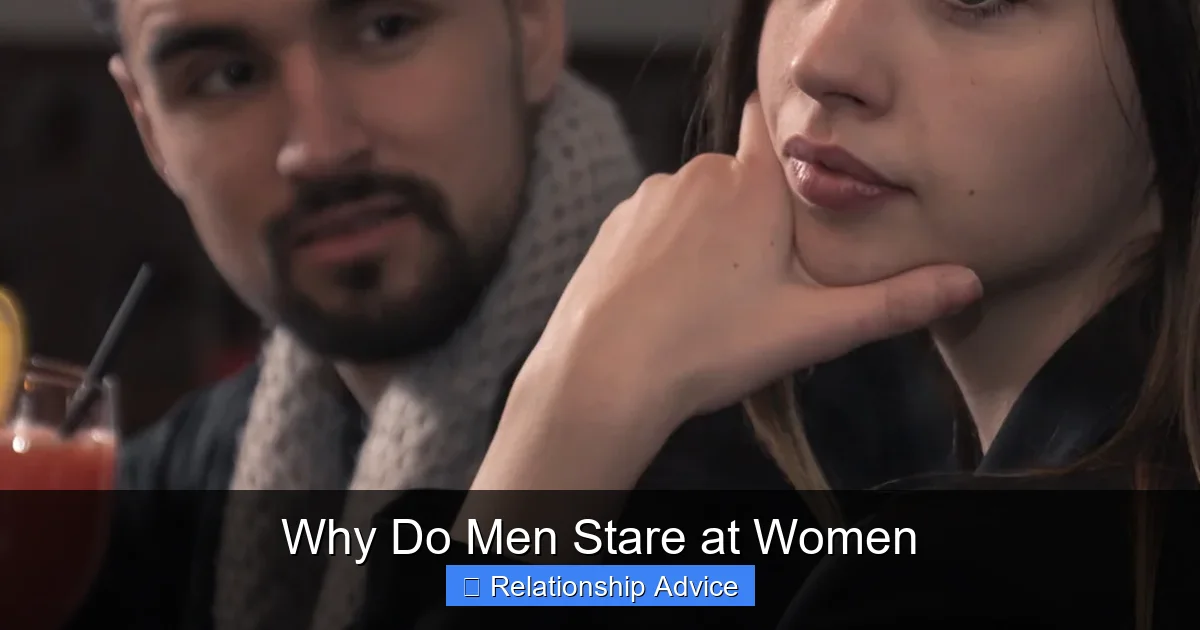
Men stare at women for a mix of biological, psychological, and social reasons—but not all staring is the same. Understanding the difference between admiration, curiosity, and objectification can help foster healthier interactions and mutual respect.
Have you ever been walking down the street, minding your own business, when suddenly you catch a man staring at you? Maybe it was a quick glance, or maybe it felt like he was frozen in place, eyes locked on you like you were a museum exhibit. It’s a moment that can shift your mood in seconds—some women feel flattered, others feel uneasy, and many just want it to stop. You’re not alone. This experience is incredibly common, and it raises a big question: Why do men stare at women?
It’s not just about attraction—though that’s part of it. The reasons behind male staring are layered, involving biology, psychology, culture, and personal habits. Some men don’t even realize they’re doing it. Others might think they’re being subtle, but to the woman on the receiving end, it can feel anything but subtle. Whether it’s on public transit, at a coffee shop, or during a work meeting, unwanted attention can be distracting, annoying, or even threatening.
But here’s the thing: not all attention is bad. A warm, respectful glance can be a form of human connection. The problem arises when staring crosses the line from appreciation to intrusion. Understanding why this happens—and how to respond—can help both men and women navigate these moments with more empathy and clarity. In this article, we’ll unpack the science, the social norms, and the real-life impact of male staring, so you can feel more informed, empowered, and in control.
Key Takeaways
- Biological instincts play a role: Evolutionary psychology suggests men may instinctively notice physical traits linked to health and fertility.
- Social conditioning influences behavior: Media and cultural norms often normalize male gaze, shaping how men perceive and react to women.
- Not all staring is sexual: Some looks stem from curiosity, admiration, or even distraction—context matters.
- Intent vs. impact is crucial: Even if a man doesn’t mean harm, prolonged or intense staring can make women feel uncomfortable or unsafe.
- Respectful attention is possible: Men can appreciate beauty without objectifying—eye contact should be brief, polite, and consensual.
- Women’s reactions vary widely: How a woman responds to being stared at depends on her personality, past experiences, and the situation.
- Open communication helps: Discussing boundaries and comfort levels can improve mutual understanding in relationships and public spaces.
📑 Table of Contents
- The Science Behind the Stare: Biology and Evolution
- Social and Cultural Influences
- Psychological Reasons: Curiosity, Insecurity, and Habit
- The Impact on Women: Comfort, Safety, and Emotional Well-Being
- How Men Can Be More Mindful
- How Women Can Respond (If They Choose To)
- Building a Culture of Respect
- Conclusion
The Science Behind the Stare: Biology and Evolution
Let’s start with the basics: why do men, more often than women, seem to stare? One explanation lies in our evolutionary past. According to evolutionary psychology, men may be biologically wired to notice physical cues associated with fertility and health—things like symmetrical features, clear skin, and certain body proportions. These traits, research suggests, can signal reproductive fitness, and men may subconsciously scan for them.
This doesn’t mean men are “programmed” to objectify women—it’s more about instinctual attention. Think of it like a built-in radar system that’s been shaped over thousands of years. In ancestral environments, quickly identifying healthy mates could have been a survival advantage. Today, that same instinct might manifest as a lingering glance at someone walking by.
But here’s the catch: evolution doesn’t excuse behavior. Just because something is “natural” doesn’t mean it’s respectful or appropriate. Humans have the ability to override instincts with empathy and social awareness. A man might notice a woman’s appearance—just as a woman might notice a man’s—but how he responds to that notice is what matters.
Hormones and Attraction
Hormones like testosterone also play a role. Higher levels of testosterone in men are linked to increased sexual motivation and attention to physical cues. This doesn’t mean all men with high testosterone are staring creepily—but it does help explain why men, on average, may be more visually oriented when it comes to attraction.
Studies using eye-tracking technology have shown that men tend to focus more on faces and bodies when looking at women, while women often scan more broadly—taking in clothing, context, and social cues. This difference in visual attention isn’t about superiority or intent; it’s about how our brains are wired.
Still, biology is only part of the story. Culture, upbringing, and personal values shape how these instincts are expressed. A man raised in an environment that teaches respect and consent will likely manage his attention differently than one who hasn’t been taught those lessons.
Social and Cultural Influences
Visual guide about Why Do Men Stare at Women
Image source: usercontent.one
If biology gives us the raw material, culture builds the house. The way men are socialized plays a huge role in why they stare—and how women are expected to react. From a young age, boys are often taught to be assertive, dominant, and visually confident. Meanwhile, girls are frequently taught to be modest, polite, and accommodating—even when uncomfortable.
Media plays a massive part in this. Movies, TV shows, advertisements, and music videos often portray men as active observers and women as passive objects of desire. Think about it: how many times have you seen a scene where a man checks out a woman walking by, followed by a slow-motion shot of her body? These images normalize the idea that it’s okay—even expected—for men to stare.
This is what feminist theorists call the “male gaze”—a cultural framework where women are viewed through a heterosexual male perspective, often reducing them to their physical appearance. When this becomes the default way of seeing, it’s easy for men to fall into patterns of staring without realizing the impact.
The Role of Social Media
Social media has amplified this dynamic. Platforms like Instagram and TikTok are flooded with images of idealized bodies, often curated to attract attention. Men are constantly exposed to highly stylized, sexualized portrayals of women, which can skew their perception of what’s normal or acceptable in real life.
When a man sees a woman in person, he might unconsciously compare her to the images he’s consumed online. This doesn’t mean he’s trying to be disrespectful—but it can lead to unrealistic expectations and heightened attention.
Moreover, the anonymity of the internet can embolden some men to act in ways they wouldn’t in person. A stare might feel less risky when it’s not accompanied by conversation or accountability. But in real life, that same stare can feel invasive.
Psychological Reasons: Curiosity, Insecurity, and Habit
Visual guide about Why Do Men Stare at Women
Image source: usercontent.one
Not all staring is about attraction. Sometimes, it’s about something deeper—or simpler. Men might stare out of curiosity, boredom, or even insecurity. Let’s break it down.
Curiosity and Novelty
Humans are naturally curious creatures. When we see something new or different—like a unique hairstyle, an unusual outfit, or someone who stands out in a crowd—we tend to look. Men are no exception. A man might stare at a woman not because he finds her attractive, but because she’s wearing a bright red coat in a sea of gray coats, or because she’s laughing loudly in a quiet café.
This kind of staring is usually brief and unintentional. The problem arises when it lingers or feels intense. Even if the intent is innocent, the impact can be unsettling.
Insecurity and Validation
Believe it or not, some men stare because they’re insecure. They might be seeking validation—wondering if they’re attractive, if they’re being noticed, or if they’re measuring up. A man might glance at a woman to see if she’s looking back, or to compare himself to other men in the room.
This behavior is often rooted in low self-esteem or social anxiety. Instead of engaging in conversation, he might rely on silent observation as a way to feel connected—or to reassure himself that he’s still “in the game.”
Habit and Lack of Awareness
Sometimes, staring is just a bad habit. Men who grew up in environments where this behavior was normalized—or never corrected—might not realize how it comes across. They might think, “I’m just looking,” without considering how it feels to be on the other end.
This is where education and self-awareness come in. Many men aren’t taught to think about the impact of their gaze. But with a little reflection, they can learn to be more mindful.
The Impact on Women: Comfort, Safety, and Emotional Well-Being
Visual guide about Why Do Men Stare at Women
Image source: townsquare.media
Now let’s shift focus to the other side of the stare: how it affects women. For many, being stared at is more than just annoying—it’s emotionally taxing. It can trigger feelings of vulnerability, anxiety, and even fear.
Feeling Objectified
When a man stares at a woman’s body—especially in a way that ignores her face or personality—it can feel dehumanizing. She’s no longer a person; she’s a collection of parts to be evaluated. This is what psychologists call objectification, and it’s linked to lower self-esteem, body shame, and even depression in women.
Imagine being at work, trying to focus on a presentation, when you notice a colleague staring at your chest. No matter how professional you are, that moment can shatter your confidence. You might start wondering, “Did I do something wrong? Should I cover up? Am I being too noticeable?”
Safety Concerns
In some cases, staring can feel threatening. Women are often taught from a young age to be aware of their surroundings and to trust their instincts. If a man’s stare feels intense, prolonged, or accompanied by other behaviors (like following or leering), it can trigger a fight-or-flight response.
This is especially true in isolated or poorly lit areas. A woman might change her route, speed up her walk, or pull out her phone to call someone—not because she’s paranoid, but because she’s protecting herself.
Emotional Drain
Even when the stare isn’t overtly threatening, it can be emotionally draining. Women often report feeling “on display” in public spaces. They might adjust their clothing, avoid eye contact, or choose different routes to minimize attention. This constant vigilance takes a toll.
Over time, this can lead to what some researchers call “gender-based stress”—a chronic state of anxiety related to being a woman in a male-dominated world. It’s not just about one stare; it’s about the accumulation of small, everyday experiences that chip away at a woman’s sense of safety and autonomy.
How Men Can Be More Mindful
So what can men do? The good news is that awareness is the first step. Many men want to be respectful but don’t know how. Here are some practical tips:
Practice Respectful Eye Contact
Eye contact is important for connection, but it should be brief and consensual. A good rule of thumb: if the other person looks away, you should too. Avoid staring at someone’s body—focus on their face, and only for a few seconds at a time.
Check Your Intent
Ask yourself: Why am I looking? Is it admiration? Curiosity? Or am I trying to assert dominance or seek validation? Being honest with yourself can help you adjust your behavior.
Listen to Feedback
If a woman tells you that your staring made her uncomfortable, believe her. Don’t argue or minimize her experience. Say, “I’m sorry. I didn’t mean to make you feel that way,” and move on.
Educate Yourself
Read about consent, gender dynamics, and the impact of the male gaze. Understanding the broader context can help you be more empathetic.
Model Better Behavior
If you’re a father, brother, or friend, talk to the men in your life about respectful behavior. Change starts with conversation.
How Women Can Respond (If They Choose To)
Women aren’t responsible for managing men’s behavior—but many want to know how to respond when it happens. Here are some options:
Use Nonverbal Cues
A firm look, a raised eyebrow, or turning your body away can signal that you’re not interested in attention. Sometimes, this is enough to stop the stare.
Speak Up (If Safe)
If you feel safe, you can say something like, “I notice you’re staring. That makes me uncomfortable.” You don’t owe anyone an explanation, but a direct response can be empowering.
Seek Support
If the staring feels threatening, don’t hesitate to ask for help. Tell a friend, alert security, or call someone you trust.
Practice Self-Compassion
Remember: you didn’t do anything wrong. You have the right to exist in public without being stared at. Don’t blame yourself or change your behavior to accommodate others.
Building a Culture of Respect
Ultimately, changing the culture around staring requires collective effort. It’s not just about individual men learning to look away—it’s about creating spaces where everyone feels seen, valued, and safe.
This starts with education. Schools, workplaces, and media outlets can promote messages of consent, empathy, and mutual respect. Men can be allies by calling out inappropriate behavior and supporting women’s autonomy.
It also means redefining masculinity. Men don’t have to be dominant or aggressive to be strong. They can be kind, attentive, and respectful—and still be confident.
When we shift the narrative from “men stare because they can” to “men can choose to see women as whole people,” we create a world where staring isn’t a power move—it’s just a moment of human connection, handled with care.
Conclusion
So, why do men stare at women? The answer isn’t simple. It’s a mix of biology, culture, psychology, and personal habits. But understanding the reasons doesn’t mean accepting the behavior—especially when it crosses the line into discomfort or harm.
The key is empathy. Men can learn to be more mindful of how their gaze affects others. Women can feel empowered to set boundaries and speak up when needed. And together, we can build a culture where attention is given—not taken.
Remember: a glance can be a gift or a burden, depending on how it’s given. Let’s aim for the gift.
Frequently Asked Questions
Is it always wrong for men to stare at women?
No, not always. Brief, respectful eye contact can be a normal part of human interaction. The issue arises when staring is prolonged, intense, or focused on body parts in a way that feels objectifying.
Why do some women feel flattered by being stared at?
Some women may interpret a stare as a sign of attraction or admiration, especially if it feels respectful. However, this doesn’t mean all women want to be stared at—reactions vary based on personality, context, and past experiences.
Can women stare at men too?
Yes, women can and do stare at men. However, societal norms and power dynamics often make male staring feel more intrusive or threatening, especially in public spaces.
What should I do if a man won’t stop staring at me?
You can use nonverbal cues like looking away or crossing your arms. If you feel safe, you can speak up directly. If the behavior feels threatening, seek help from others or remove yourself from the situation.
How can men avoid making women uncomfortable?
Men can practice brief, polite eye contact, avoid staring at bodies, and be mindful of context. Listening to feedback and educating themselves about respectful behavior also helps.
Does staring always mean a man is attracted?
Not necessarily. Staring can stem from curiosity, habit, insecurity, or even distraction. Attraction is just one possible reason—intent and context matter more than the act itself.