
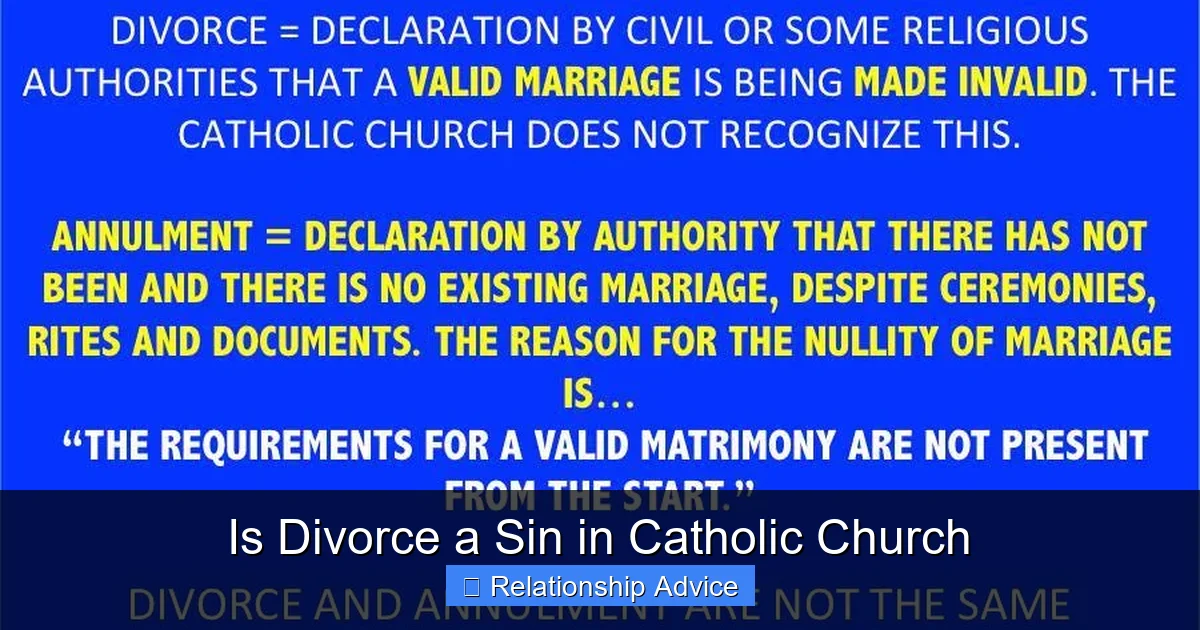
The Catholic Church teaches that marriage is a sacred, lifelong covenant, and divorce is not recognized as valid. However, the Church does not consider divorce itself a sin in the same way as breaking a sacrament—instead, it views divorce as a civil reality that doesn’t dissolve the marital bond. Catholics who divorce may still receive sacraments unless they remarry civilly without an annulment.
This is a comprehensive guide about Is Divorce A Sin In Catholic Church.
Key Takeaways
- Marriage is a sacrament: In the Catholic Church, marriage is a sacred bond between a man and a woman, intended to be lifelong and indissoluble.
- Divorce is not a sacramental dissolution: The Church does not recognize divorce as ending a valid marriage; only death or an annulment can do that.
- Annulment vs. divorce: An annulment declares that a marriage was never valid from the start, while divorce is a legal separation recognized by the state.
- Remarriage after divorce: Catholics who remarry civilly without an annulment are not in full communion with the Church and generally cannot receive Holy Communion.
- Mercy and pastoral care: The Church emphasizes compassion, support, and guidance for divorced individuals, encouraging healing and reconciliation.
- Civil divorce is not a sin: While the Church discourages divorce, it acknowledges the reality of civil separation and does not treat it as a mortal sin in all cases.
- Path to healing: The Church offers resources like counseling, support groups, and the annulment process to help divorced Catholics navigate their faith journey.
[FEATURED_IMAGE_PLACEHOLDER]
Is Divorce a Sin in Catholic Church?
When it comes to relationships, few topics stir as much emotion, confusion, and spiritual questioning as divorce—especially within the Catholic faith. If you’re a Catholic who’s facing marital struggles, or you know someone who is, you might be wondering: *Is divorce a sin in the Catholic Church?* It’s a deeply personal and often painful question, and the answer isn’t as simple as a yes or no.
The Catholic Church holds marriage in the highest regard. It’s not just a legal contract or a social agreement—it’s a sacrament, a sacred covenant between a man, a woman, and God. This belief shapes how the Church views divorce, remarriage, and the spiritual well-being of those who go through separation. But that doesn’t mean the Church turns its back on people who divorce. On the contrary, it offers guidance, compassion, and a path toward healing—even when the marriage ends.
In this article, we’ll explore what the Catholic Church really teaches about divorce, why it’s treated differently than in many other Christian denominations, and how individuals can navigate their faith after a marriage ends. Whether you’re seeking clarity for yourself or trying to support a loved one, understanding these teachings can bring peace, perspective, and hope.
Understanding the Catholic View of Marriage
To understand the Church’s stance on divorce, we first need to understand how it views marriage. In Catholicism, marriage isn’t just about love, commitment, or even legal rights—it’s a sacrament. That means it’s one of seven sacred rituals through which Catholics believe God imparts grace.
The Sacrament of Matrimony
The Sacrament of Matrimony is celebrated when a baptized man and woman freely exchange vows in the presence of a priest or deacon and two witnesses. During the ceremony, the couple becomes one flesh, not just emotionally or physically, but spiritually. The Church teaches that this union is modeled after the relationship between Christ and the Church—a bond of love, sacrifice, and permanence.
Because of this sacred dimension, the Church believes that a valid Catholic marriage cannot be broken by human action. Only death ends the marital bond. This is based on Jesus’ words in the Gospels: “What God has joined together, let no one separate” (Matthew 19:6). This teaching is central to Catholic theology and shapes the Church’s approach to divorce.
Indissolubility: The Lifelong Promise
One of the core principles of Catholic marriage is *indissolubility*—the idea that a valid marriage lasts forever. This doesn’t mean that marriages are perfect or that couples never struggle. It means that the Church believes the commitment made at the altar is meant to endure through all of life’s challenges.
This belief is rooted in both Scripture and centuries of Church tradition. The Catechism of the Catholic Church states: “The marriage covenant, by which a man and a woman form with each other an intimate communion of life and love, has been founded and endowed with its own special laws by the Creator” (CCC 1603). In other words, marriage isn’t just a human institution—it’s a divine one.
Because of this, the Church does not allow divorced Catholics to remarry in the Church unless the previous marriage is declared null through an annulment. This can be confusing for people outside the faith, who may see divorce and remarriage as a fresh start. But for Catholics, the sacramental bond remains unless proven otherwise.
The Role of Free Will and Consent
It’s important to note that the Church also emphasizes the importance of free will in marriage. For a marriage to be valid, both parties must enter into it freely, without coercion or fear. They must also have the intention to be faithful, to be open to children, and to stay together for life.
If one or both parties lacked this full intention—perhaps due to immaturity, fear, or misunderstanding—the marriage may not be valid in the eyes of the Church. This is where the annulment process comes in, which we’ll explore later.
What the Catholic Church Says About Divorce
Now that we understand the Church’s view of marriage, let’s address the big question: Is divorce a sin?
Divorce Is Not Recognized as a Sacramental Act
The Catholic Church does not recognize divorce as a way to end a marriage. A civil divorce—where a court legally dissolves a marriage—does not break the sacramental bond. In the eyes of the Church, the couple is still married, even if they live apart or have a legal separation.
This can be hard to grasp, especially in a culture where divorce is common and often seen as a solution to unhappiness. But the Church’s position is not about punishment—it’s about protecting the sanctity of marriage and the dignity of the sacrament.
Is Divorce a Sin?
Here’s where things get nuanced. The Church does not teach that divorce is a *mortal sin* in the same way as, say, murder or adultery. Instead, it views divorce as a *civil reality* that doesn’t change the spiritual status of the marriage.
In other words, getting a divorce doesn’t automatically cut you off from God or the Church. But it does raise serious moral and spiritual questions, especially if the divorce leads to remarriage without an annulment.
The Catechism states: “The Church, after careful discernment, teaches that divorced persons who have not remarried are not separated from the Church and can receive the sacraments” (CCC 1650). This means that divorced Catholics can still attend Mass, pray, and participate in the life of the Church.
However, if a divorced person remarries civilly without an annulment, the Church considers them to be in a state of ongoing adultery, because the original marriage bond is still seen as valid. In such cases, they are generally not permitted to receive Holy Communion, unless they are living as “brother and sister” (i.e., abstaining from sexual relations).
The Church’s Compassionate Response
Despite its strict teachings, the Church emphasizes mercy and pastoral care. Pope Francis, in particular, has spoken often about the need to accompany divorced and remarried Catholics with compassion. In his apostolic exhortation *Amoris Laetitia* (“The Joy of Love”), he wrote:
> “We have been called to form consciences, not to replace them… The Church’s pastors, in recognizing the particular situation of a divorced person who has not remarried, should not feel that their hands are tied.”
This means that priests and bishops are encouraged to walk with divorced individuals, helping them discern their situation in light of Church teaching, rather than simply applying rules without compassion.
Annulment: The Catholic Alternative to Divorce
If the Church doesn’t recognize divorce, what options do Catholics have when a marriage ends? The answer lies in the annulment process.
What Is an Annulment?
An annulment—technically called a *declaration of nullity*—is a Church ruling that a marriage was never valid from the beginning. It’s not the same as a divorce. A divorce says, “This marriage existed, but it’s over.” An annulment says, “This marriage never truly existed in the eyes of the Church.”
For example, if one spouse was forced into the marriage, or if they didn’t truly understand what marriage meant, or if they had a hidden intention not to be faithful, the marriage may be declared null.
How Does the Annulment Process Work?
The annulment process involves submitting a petition to a diocesan tribunal (a Church court). The person seeking the annulment—called the petitioner—must provide evidence that the marriage lacked one or more of the essential elements for validity.
These elements include:
– Full and free consent
– The intention to be faithful
– The intention to be open to children
– The intention to stay together for life
The other spouse—called the respondent—is notified and has the right to participate in the process. Witnesses, such as family members or friends, may be interviewed. The tribunal reviews all evidence and makes a decision.
The process can take several months to over a year, depending on the complexity of the case. It’s not about proving who was “at fault” in the divorce, but about determining whether the marriage was valid from the start.
Is an Annulment Easy to Get?
No, an annulment is not automatic. Many people assume that because a marriage ended in divorce, it must have been invalid. But the Church requires clear evidence of a defect in consent or understanding.
That said, the process has become more accessible in recent years. Many dioceses offer free or low-cost annulment services, and Pope Francis has streamlined the process to make it faster and more merciful.
Life After Divorce: Faith, Healing, and the Church
Divorce is one of the most painful experiences a person can go through. For Catholics, the added layer of spiritual concern can make it even harder. But the Church is not a place of judgment—it’s a place of healing.
You Are Not Alone
If you’re a divorced Catholic, know this: you are not cut off from God’s love. The Church welcomes you. You can still pray, attend Mass, and receive the sacraments (with some limitations, depending on your situation).
Many parishes offer support groups for divorced and separated Catholics. These groups provide a safe space to share your story, find encouragement, and grow in faith. Organizations like *Divine Mercy for Divorced Catholics* and *Retrouvaille* (a program for troubled marriages) also offer help.
Reconciliation and Second Marriages
If you’ve divorced and remarried civilly, you may feel distant from the Church. But there is hope. The first step is often to explore the annulment process for your previous marriage. If granted, you may be able to marry in the Church and fully participate in sacramental life.
Even if an annulment isn’t possible, the Church encourages you to live a life of faith. You can still grow spiritually, raise your children in the Church, and serve your community. Some priests may also offer spiritual guidance to help you discern your path.
Practical Tips for Moving Forward
– Talk to a priest or spiritual director: They can help you understand Church teaching and guide you with compassion.
– Seek counseling: Emotional healing is essential. A Catholic therapist can help you process grief and rebuild your life.
– Stay connected to your faith: Prayer, Scripture, and the sacraments can bring peace during difficult times.
– Be patient with yourself: Healing takes time. Don’t rush the process.
Common Misconceptions About Divorce in the Catholic Church
There are many myths and misunderstandings about what the Church teaches on divorce. Let’s clear up a few.
“The Church Hates Divorced People”
False. The Church loves all people, including those who are divorced. Its teachings are meant to protect the dignity of marriage and the souls of those involved—not to punish.
“You Can’t Receive Communion If You’re Divorced”
Not necessarily. If you’re divorced but not remarried, you can usually receive Communion. If you’ve remarried civilly without an annulment, the situation is more complex, but dialogue with a priest can help.
“Annulments Are Just Catholic Divorces”
No. An annulment is a declaration that the marriage was never valid. It’s a theological and legal process, not a rubber stamp.
“The Church Never Grants Annulments”
Not true. While the process is thorough, many annulments are granted each year. The Church takes its responsibility seriously, but it also seeks justice and mercy.
Conclusion: Faith, Mercy, and the Path Forward
So, is divorce a sin in the Catholic Church? The short answer is: it’s complicated. The Church does not recognize divorce as ending a sacramental marriage, and it teaches that marriage is meant to be lifelong. But it also recognizes the pain, complexity, and human frailty that lead to divorce.
What the Church offers is not condemnation, but compassion. It invites divorced Catholics to come home—to seek healing, to grow in faith, and to live with dignity. Whether through the annulment process, spiritual guidance, or support from the community, there is a path forward.
If you’re walking this journey, remember: God’s love is greater than any mistake, any failure, or any broken relationship. The Church is not a fortress of rules—it’s a family of sinners and saints, all striving to follow Christ. And in that family, there is always room for you.
Frequently Asked Questions
Can a divorced Catholic receive Holy Communion?
Yes, if you are divorced but not remarried, you can generally receive Holy Communion. If you have remarried civilly without an annulment, the situation is more complex and may require spiritual guidance from a priest.
What is the difference between a divorce and an annulment in the Catholic Church?
A divorce is a legal dissolution of marriage by the state, but the Church does not recognize it as ending a sacramental bond. An annulment is a Church declaration that the marriage was never valid from the start due to a defect in consent or understanding.
How long does the annulment process take?
The annulment process typically takes 12 to 18 months, depending on the diocese and the complexity of the case. Some dioceses have streamlined the process to make it faster.
Can I get an annulment if my ex-spouse doesn’t cooperate?
Yes. The annulment process can proceed even if the other spouse does not participate, though their input can be helpful. The tribunal will make a decision based on available evidence.
Is divorce a mortal sin in the Catholic Church?
The Church does not classify divorce itself as a mortal sin. However, remarrying civilly without an annulment may place a person in a state that conflicts with Church teaching, affecting their ability to receive certain sacraments.
Are there support groups for divorced Catholics?
Yes. Many parishes and Catholic organizations offer support groups, counseling, and retreats for divorced and separated individuals. Programs like Retrouvaille and Divine Mercy for Divorced Catholics provide spiritual and emotional support.