
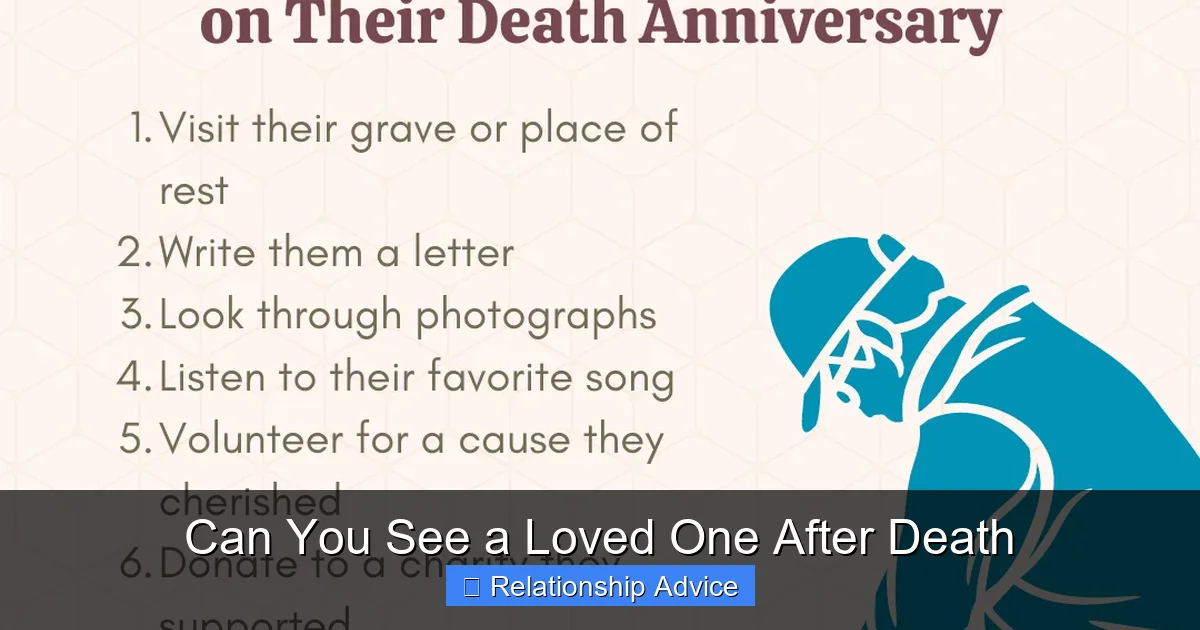
Many people wonder if they can see a loved one after death, and while science doesn’t provide definitive answers, spiritual traditions, personal experiences, and emotional connections offer profound comfort. This article explores diverse perspectives—from religious beliefs to near-death accounts—to help you find peace and meaning in grief.
Losing someone you love is one of the most painful experiences life can bring. In those quiet moments after a loss—when the house feels too still, or you catch yourself reaching for the phone to call them—you might wonder: *Can I see my loved one again? Will I ever feel their presence?* These questions aren’t just about curiosity. They’re about love, connection, and the deep human need to believe that something beautiful continues beyond the final breath.
The idea of seeing a loved one after death has been part of human culture for millennia. From ancient burial rituals to modern spiritual practices, people across time and geography have sought reassurance that death isn’t the end—just a transition. Whether you’re grieving a parent, a partner, a child, or a close friend, the longing to reconnect is universal. And while science can’t prove or disprove an afterlife, countless personal stories, religious teachings, and emotional experiences suggest that love may transcend even death itself.
This article explores the many ways people have sought—and found—answers to the question: *Can you see a loved one after death?* We’ll look at spiritual beliefs, scientific insights, personal experiences, and practical ways to honor and feel connected to those who’ve passed. Whether you’re seeking comfort, clarity, or simply a way to keep their memory alive, this guide offers compassionate, thoughtful perspectives to help you navigate your grief with hope and heart.
Key Takeaways
- Spiritual beliefs widely support the idea of reuniting with loved ones after death: Many religions, including Christianity, Islam, Hinduism, and Buddhism, teach that the soul continues beyond physical life and may reunite with family and friends in an afterlife.
- Near-death experiences often include encounters with deceased loved ones: People who’ve had NDEs frequently report seeing family members who’ve passed away, offering comfort and reassurance during their experience.
- Grief can manifest as sensory experiences of a loved one’s presence: Hearing a voice, feeling a touch, or catching a familiar scent are common and natural responses to loss, often providing emotional solace.
- Dreams and meditation can create meaningful connections with the departed: Many people report vivid dreams or meditative visions of loved ones, which can help process grief and maintain a sense of bond.
- Science remains open but inconclusive about life after death: While neuroscience explains consciousness as brain-based, some researchers study consciousness beyond the brain, leaving room for ongoing exploration.
- Honoring a loved one’s memory strengthens emotional continuity: Rituals, storytelling, and legacy projects help keep their spirit alive in your heart and daily life.
- Finding personal meaning is key to healing: Whether through faith, philosophy, or personal reflection, creating your own understanding of what comes after death can bring peace.
📑 Table of Contents
- What Do Major Religions Say About Reuniting After Death?
- Near-Death Experiences: Stories of Reunion
- Signs and Sensations: Feeling a Loved One’s Presence
- Dreams, Meditation, and the Power of the Mind
- Science and the Mystery of Consciousness
- How to Honor and Stay Connected to a Loved One
- Conclusion: Love Beyond Death
What Do Major Religions Say About Reuniting After Death?
Religious traditions around the world offer some of the most detailed and comforting answers to the question of life after death. For billions of people, faith provides a framework not just for understanding death, but for believing in reunion with loved ones. Let’s explore what some of the world’s major religions teach about seeing a loved one after death.
Christianity: Eternal Life and Reunion in Heaven
In Christianity, the belief in an afterlife is central. Most denominations teach that after death, the soul goes to be with God—either immediately or after a period of purification (as in Catholicism). The New Testament speaks of heaven as a place of joy, peace, and eternal fellowship. In Revelation 21:4, it says, “He will wipe every tear from their eyes. There will be no more death or mourning or crying or pain.” Many Christians believe that in heaven, they will be reunited with family and friends who have also accepted Christ.
This belief brings profound comfort to grieving families. Imagine a mother who lost her young daughter to illness. Though her heart aches, she clings to the hope that one day, they’ll walk together in a garden of light, free from pain. That hope isn’t just wishful thinking—it’s a cornerstone of her faith and a source of strength.
Islam: Paradise and the Reunion of Believers
In Islam, death is seen as a transition to the afterlife, where individuals are judged based on their deeds. Those who lived righteously are promised Jannah (Paradise), described in the Quran as a place of gardens, rivers, and eternal peace. Importantly, the Quran suggests that believers will be reunited with their loved ones in Paradise. Surah Al-Waqi’ah (56:15–26) describes the righteous being attended by their families in bliss.
For Muslims, this promise offers deep solace. A father who lost his wife may find peace in the belief that their love wasn’t cut short—it was merely paused. In the afterlife, they’ll be together again, free from sorrow. This belief encourages compassion, forgiveness, and living a life aligned with faith, knowing that relationships matter beyond this world.
Hinduism and Buddhism: Rebirth and Karmic Connection
Hinduism and Buddhism offer a different perspective—one centered on reincarnation and karma. In these traditions, the soul (or consciousness) is reborn into a new life after death, based on past actions. While this means you may not see the exact same person again in the same form, the idea is that souls are part of a vast, interconnected cycle.
In Hinduism, the ultimate goal is moksha—liberation from the cycle of rebirth. Once achieved, the soul merges with the divine (Brahman), where all separation ends. In that state, the boundaries between individuals dissolve, and love becomes universal. Similarly, in Buddhism, the goal is Nirvana—a state of peace beyond desire and suffering. While personal identity fades, the compassion and love you shared with others continue to ripple through existence.
For someone grieving, this might mean that their loved one’s essence lives on, perhaps in a new form or as part of a greater whole. It’s a reminder that love isn’t lost—it transforms.
Other Spiritual Traditions: Ancestors and the Spirit World
Many Indigenous and animistic traditions believe in a spirit world where ancestors continue to live and guide the living. In cultures like those of Native American, African, and Polynesian peoples, it’s common to honor ancestors through rituals, offerings, and storytelling. These practices reflect a deep belief that the dead are never truly gone—they’re just in another realm, watching over their families.
For example, during Día de los Muertos in Mexico, families build altars with photos, food, and candles to welcome the spirits of their loved ones. They believe their ancestors return for a visit, and the celebration is both joyful and sacred. This tradition shows how cultural practices can make the idea of seeing a loved one after death feel tangible and real.
Near-Death Experiences: Stories of Reunion
Visual guide about Can You See a Loved One After Death
Image source: static01.nyt.com
While religious beliefs offer comfort through doctrine, near-death experiences (NDEs) provide personal, firsthand accounts of what it might be like beyond death. Thousands of people who’ve been clinically dead—only to be revived—report similar experiences: floating above their bodies, moving through a tunnel, encountering a bright light, and meeting deceased loved ones.
Common Themes in NDEs
One of the most consistent elements in NDEs is the presence of familiar people. Many report seeing parents, siblings, or friends who had passed away long before. These encounters are often described as warm, loving, and deeply reassuring. The loved ones may speak words of comfort, or simply smile and embrace the experiencer.
For instance, a man who survived a heart attack recalled seeing his mother, who had died when he was a child. She held out her hand and said, “It’s not your time yet.” He felt such peace that he didn’t want to return—but he did, to share his story.
These experiences aren’t limited to any one culture or religion. They’ve been reported by people of all ages, backgrounds, and beliefs. This universality suggests that the phenomenon may tap into something fundamental about human consciousness.
Why Do NDEs Feel So Real?
Scientists have studied NDEs for decades, trying to understand whether they’re hallucinations, brain chemistry, or glimpses of another reality. Some theories suggest that oxygen deprivation or neurotransmitter surges could cause these visions. But many experiencers insist that their NDEs felt more real than everyday life—more vivid, more meaningful, more *true*.
Dr. Raymond Moody, who coined the term “near-death experience,” interviewed hundreds of people and found that NDEs often lead to lasting changes: reduced fear of death, increased compassion, and a stronger sense of purpose. For those who’ve lost someone, hearing these stories can be deeply validating. It’s as if the universe is whispering: *You’re not alone. Love doesn’t end.*
Can NDEs Prove an Afterlife?
While NDEs don’t offer scientific proof, they do offer something equally valuable: hope. For someone grieving, the idea that their loved one might be waiting in a place of peace can be a lifeline. Even if you’re skeptical, these stories invite us to consider that consciousness might be more than just brain activity—that love might be eternal.
Signs and Sensations: Feeling a Loved One’s Presence
Visual guide about Can You See a Loved One After Death
Image source: everydaypower.com
Even without a near-death experience, many people report feeling the presence of a loved one after they’ve died. These experiences—often called “after-death communications” or ADCs—can be subtle or profound, and they’re more common than you might think.
Common Types of After-Death Communications
– **Hearing a voice or name:** A woman might hear her father call her name, even though he’s been gone for years.
– **Feeling a touch or hug:** Someone might feel a hand on their shoulder or a gentle embrace when they’re alone.
– **Smelling a familiar scent:** The smell of a loved one’s perfume, cologne, or cooking can appear out of nowhere.
– **Seeing a figure or light:** A brief glimpse of someone standing in a doorway, or a flash of light in the corner of a room.
– **Finding meaningful objects:** Discovering a lost item, like a ring or photo, in an unexpected place.
These experiences often happen during times of stress, grief, or quiet reflection. They’re not hallucinations in the clinical sense—they feel real, personal, and deeply meaningful.
Are These Signs Real or Imagined?
From a scientific standpoint, the brain is wired to seek patterns and meaning, especially during emotional times. Grief can heighten sensitivity, making us more aware of subtle sensations. But that doesn’t mean these experiences are “just in our heads.” For the person experiencing them, they feel like messages—like their loved one is saying, *I’m still with you.*
Psychologist Dr. Allan Botkin, who studied ADCs, found that people who experienced them often healed faster from grief. The sense of connection helped them feel less alone and more at peace.
How to Respond to a Sign
If you experience something like this, don’t dismiss it. Instead, acknowledge it. Say a quiet thank you. Light a candle. Talk to them, as if they’re listening. These moments aren’t about proving anything—they’re about connection. And in grief, connection is everything.
Dreams, Meditation, and the Power of the Mind
Visual guide about Can You See a Loved One After Death
Image source: realestlove.com
Dreams have long been seen as a bridge between the living and the dead. In many cultures, dreams are considered messages from the spirit world. And for good reason—many people report vivid, comforting dreams of loved ones who’ve passed.
Dream Visits: Messages from Beyond?
A mother might dream that her son, who died in a car accident, visits her. He looks healthy and happy, and he tells her, “I’m okay. Don’t worry about me.” She wakes up with tears of relief. These dreams often feel more real than regular dreams—they’re clear, emotional, and leave a lasting impression.
While science explains dreams as the brain processing memories and emotions, their emotional power is undeniable. For someone grieving, a dream visit can feel like a gift—a moment of reunion, even if only in sleep.
Meditation and Visualization
Meditation can also open a door to connection. By quieting the mind and focusing on love, you may feel a sense of presence. Some people use guided meditations designed to help them “meet” a loved one in a peaceful setting—like a garden or beach. These practices don’t claim to summon spirits, but they can create a safe space for emotional release and healing.
Try this simple exercise: Sit quietly, close your eyes, and picture your loved one in a place that feels peaceful. Imagine them smiling, healthy, and at peace. Talk to them. Listen. You might not hear words, but you might feel a sense of calm or warmth. That’s the power of love—even across dimensions.
Science and the Mystery of Consciousness
Science has made incredible progress in understanding the brain, but consciousness remains one of its greatest mysteries. While most scientists agree that consciousness arises from brain activity, some researchers are exploring whether it might exist beyond the physical body.
The Hard Problem of Consciousness
Philosopher David Chalmers called it the “hard problem”: How do physical processes in the brain create subjective experience? Why do we have feelings, thoughts, and awareness? If consciousness is purely biological, it should end when the brain dies. But if it’s more than that—if it’s a fundamental part of the universe—then maybe it doesn’t.
Some theories, like quantum consciousness or panpsychism, suggest that consciousness might be woven into the fabric of reality. While these ideas are speculative, they open the door to possibilities beyond current science.
Research on Life After Death
A few scientists have studied phenomena like NDEs, ADCs, and children who remember past lives. Dr. Ian Stevenson, a psychiatrist, documented hundreds of cases where children claimed to remember previous lives, often with verifiable details. While controversial, his work suggests that consciousness might not be entirely dependent on the brain.
Other researchers are studying the effects of psychedelics on spiritual experiences. Substances like psilocybin (in magic mushrooms) have been shown to induce feelings of unity, transcendence, and connection to loved ones—similar to NDEs.
What Science Can’t (Yet) Answer
Science is based on observation and evidence. Until we can measure or replicate an afterlife, it remains outside the realm of empirical proof. But that doesn’t mean it’s not real. Science evolves. What seems impossible today might be understood tomorrow.
For now, science offers no definitive answer to whether you can see a loved one after death. But it also doesn’t rule it out. And in that space of uncertainty, hope can grow.
How to Honor and Stay Connected to a Loved One
Whether or not you believe in an afterlife, one thing is certain: love doesn’t end with death. The bond you shared continues in your memories, your values, and your heart. Here are practical ways to honor that connection.
Create a Memorial Ritual
Light a candle on their birthday. Visit their favorite place. Cook their favorite meal. These small acts keep their spirit alive in your daily life.
Share Stories
Talk about them with family and friends. Share funny memories, lessons they taught you, or moments that made you proud. Storytelling keeps their legacy alive.
Write a Letter
Write to them as if they’re reading it. Tell them about your life, your feelings, your dreams. You don’t need to send it—just the act of writing can be healing.
Support a Cause They Cared About
Volunteer, donate, or advocate for something they believed in. It’s a powerful way to carry their values forward.
Keep a Memory Box
Fill a box with photos, letters, and mementos. On hard days, open it and remember the love you shared.
Trust Your Heart
Ultimately, whether you believe in heaven, reincarnation, or simply the enduring power of love, trust what brings you peace. Grief is personal. Healing is personal. And so is your connection to your loved one.
Conclusion: Love Beyond Death
The question “Can you see a loved one after death?” doesn’t have a single answer. But it has many beautiful, meaningful responses. From the promises of faith to the comfort of personal experiences, from the mystery of consciousness to the power of memory, there are countless ways to feel connected to those we’ve lost.
You may never see them with your eyes again. But you can feel them in your heart. You can hear them in your memories. You can carry them in your choices, your kindness, your love.
And perhaps, in the quiet moments—when the wind whispers, or a dream feels real, or a scent brings them back—you’ll know they’re still with you. Not because science says so, but because love says so.
And love, after all, is the one thing that truly never dies.
Frequently Asked Questions
Can you really see a loved one after they die?
While there’s no scientific proof of an afterlife, many people report seeing or sensing deceased loved ones through dreams, near-death experiences, or moments of deep emotion. These experiences are deeply personal and often provide comfort and healing.
Is it normal to feel a loved one’s presence after they pass?
Yes, it’s very common. Many people hear voices, feel touches, or smell familiar scents after a loss. These sensations are natural parts of grief and can help you feel connected during a difficult time.
Do all religions believe in reuniting with loved ones after death?
Most major religions teach some form of afterlife where reunion is possible, though the details vary. Christianity and Islam speak of heaven, while Hinduism and Buddhism focus on rebirth and spiritual liberation.
Can science prove that we see loved ones after death?
Science cannot currently prove or disprove an afterlife. While brain activity explains many experiences, the nature of consciousness remains a mystery, leaving room for ongoing exploration and personal belief.
How can I feel closer to a loved one who has died?
Try rituals like lighting a candle, writing letters, sharing memories, or meditating. These practices honor their memory and can bring a sense of peace and connection.
Are near-death experiences real?
NDEs are real experiences reported by thousands of people, often including encounters with loved ones. While their cause is debated, they frequently lead to positive changes in outlook and reduced fear of death.