
Staying in an unhealthy relationship is never worth your peace. If you’re constantly unhappy, disrespected, or emotionally drained, it might be time to consider ending things. Recognizing these warning signs early can save you years of heartache.
Key Takeaways
- Constant unhappiness: If your partner consistently makes you feel sad, anxious, or unworthy, that’s a major red flag that shouldn’t be ignored.
- Lack of respect: Disrespect isn’t just name-calling—it includes dismissing your feelings, making you feel small, or ignoring your boundaries.
- Emotional distance: When intimacy fades completely and you feel like roommates instead of partners, it’s often too late to fix the connection.
- Repeated broken promises: Trust erodes when your partner keeps saying they’ll change but never follows through on their commitments.
- No effort to improve: Healthy relationships grow together; if both people refuse to work on issues, staying together only maintains the problem.
- You feel worse than before: A good partner lifts you up, not down. If dating has made you more insecure, anxious, or depressed, it’s time to reevaluate.
- Your gut is screaming: Your intuition knows your relationship better than logic sometimes. If every fiber of your being says “this isn’t right,” listen to that voice.
📑 Table of Contents
- The Quiet Crisis: When Love Turns Toxic
- 1. Constant Unhappiness and Emotional Drain
- 2. Persistent Lack of Respect
- 3. Complete Emotional Distance
- 4. Repeated Broken Promises and Betrayal
- 5. No Mutual Effort to Resolve Issues
- 6. You Feel Worse About Yourself Than Before
- 7. Your Intuition Is Consistently Warning You
- When to Seek Professional Help
- Moving Forward With Hope
The Quiet Crisis: When Love Turns Toxic
Have you ever felt like something was wrong in your relationship, but you couldn’t quite put your finger on it? Maybe you’re constantly tired after spending time with your partner, or perhaps you find yourself making excuses for their behavior. You might even catch yourself thinking, “This isn’t how I imagined my life would go.” These subtle signals often point to deeper issues that need attention—or possibly, resolution.
Every relationship goes through ups and downs. That’s normal. But when certain patterns become consistent, persistent, and deeply damaging, it may be time to seriously consider whether this partnership is serving your best interests. Recognizing the signs you should break up isn’t about giving up—it’s about honoring your worth and choosing yourself first.
1. Constant Unhappiness and Emotional Drain
When someone consistently brings you down rather than lifting you up, that’s a significant warning sign. Healthy relationships are supposed to make you feel supported, cherished, and happier overall. If you find yourself:
– Feeling anxious or worried before seeing your partner
– Constantly apologizing for things that aren’t your fault
– Neglecting your own needs and desires
– Losing interest in hobbies and activities you once loved
– Feeling drained after conversations or time together
These are all indicators that your relationship may be emotionally toxic. As one counselor explains, “When someone consistently makes you feel bad about yourself, it’s not love—it’s control.”
Consider this example: Sarah had been with Mark for three years. At first, he seemed perfect—funny, attentive, supportive. But over time, he began criticizing her appearance daily, telling her she was “too fat” or “not attractive enough.” He’d mock her career choices and belittle her friends. Sarah started canceling plans with her family because Mark said they “weren’t his type.” Eventually, she realized she hadn’t laughed in months. The constant negativity had eroded her confidence entirely.
If you’re experiencing similar patterns where your partner regularly diminishes your self-worth, it’s crucial to address this immediately. You deserve to be celebrated, not criticized.
Red Flags of Emotional Drainage
- Feeling guilty for wanting alone time
- Making excuses for your partner’s negative behavior
- Comparing yourself to others and feeling inadequate
- Having fewer friends because your partner disapproves
- Neglecting personal goals and aspirations
Remember, it’s not selfish to want to be happy. In fact, it’s essential. As psychologist Dr. Brené Brown notes, “Vulnerability is not winning or losing; it’s having the courage to show up and be seen when we have no control over the outcome.” Choosing yourself requires that same courage.
2. Persistent Lack of Respect
Respect forms the foundation of any healthy relationship. Without it, there’s no trust, no safety, and certainly no love. When you’re dating someone who consistently disrespects you, it sends a clear message: your boundaries don’t matter.
Respect isn’t just about grand gestures—it’s in the small, everyday actions. Consider these examples:
– Dismissing your opinions or feelings as “stupid”
– Checking your phone without permission
– Making plans without considering your schedule
– Mocking your beliefs or values
– Taking credit for your accomplishments
– Ignoring important dates or milestones
As relationship coach Esther Perel puts it, “The greatest predictor of relationship success isn’t chemistry—it’s respect.” When someone repeatedly violates your boundaries, it creates a power imbalance that’s impossible to sustain healthily.
For instance, take James and Maria’s situation. Maria worked hard to save for a vacation, but when James found out, he booked his own trip without consulting her. When she expressed disappointment, he said, “You’re being dramatic. I earned this.” This wasn’t just about vacation plans—it was about Maria’s efforts being invalidated.
Another concerning pattern involves financial disrespect. If your partner spends money recklessly while you worry about bills, or hides purchases from you, this erodes trust significantly. Financial transparency builds security in a relationship, while secrecy breeds suspicion.
Signs Your Partner Isn’t Respecting Boundaries
- Entering your personal space without knocking
- Using sarcasm to belittle your concerns
- Expecting immediate responses to messages
- Making decisions that affect both of you without discussion
- Touching things that aren’t theirs without asking
If you find yourself constantly explaining why certain behaviors are inappropriate, that’s a major red flag. Healthy partners understand and honor each other’s boundaries naturally—they don’t require constant reminders.
3. Complete Emotional Distance
Intimacy isn’t just about physical connection—it’s emotional vulnerability, shared experiences, and deep understanding. When this intimacy evaporates completely, you’re left with two strangers sharing the same space.
Emotional distance manifests in several ways:
– Avoiding deep conversations about the future
– Shutting down during disagreements instead of communicating
– Not supporting each other through difficult times
– Feeling lonely even when physically together
– Having nothing meaningful to say to each other
– Dreading family gatherings because everyone notices the distance
Think about it this way: if you were to meet your partner today, would you introduce them to your closest friends? Would they know anything about your dreams, fears, or deepest struggles? If not, that’s a serious indicator of emotional disconnection.
Take Rachel and David, for example. They’d been married for eight years. For months, they’d barely spoken except to discuss rent or childcare. When Rachel tried to talk about her career ambitions, David would change the subject. When she mentioned feeling overwhelmed, he’d say, “Everyone feels that way.” Their home felt less like a sanctuary and more like a hotel room.
Sometimes emotional distance develops gradually. You might start noticing:
– Less eye contact during conversations
– Fewer “I love you” moments
– Physical touch becoming rare
– Different sleep schedules preventing connection
– Shared activities losing meaning
As author Harville Hendrix explains, “Love is an improvisational dance—you have to be willing to move together.” When one person stops dancing, the connection breaks.
How to Address Emotional Distance
If you notice this pattern, try having an honest conversation using “I” statements: “I’ve been feeling disconnected lately, and I miss our closeness.” Pay attention to their response. Do they acknowledge your feelings? Are they willing to work on reconnection?
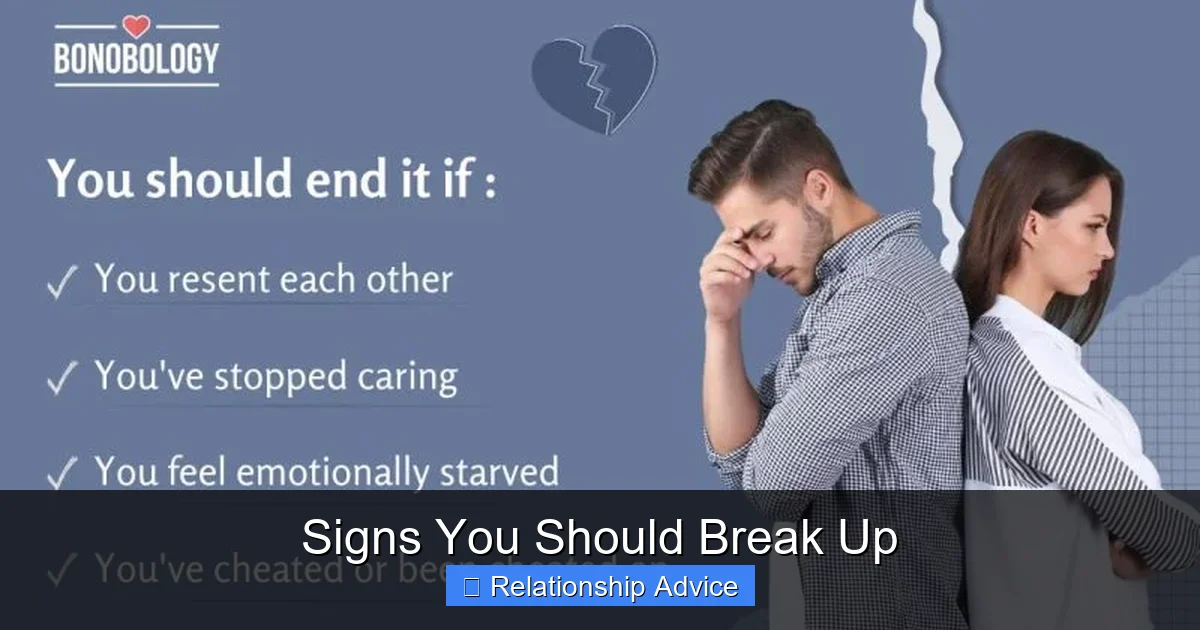
Visual guide about Signs You Should Break Up
Image source: bonobology.com
But if they respond with defensiveness, dismissal, or indifference, that tells you everything you need to know. You can’t force intimacy—it must be mutually desired.
4. Repeated Broken Promises and Betrayal
Trust is the glue that holds relationships together. When that trust gets repeatedly broken, the structure becomes unstable. Some common types of betrayal include:
– Breaking confidentiality (sharing private information)
– Failing to follow through on important commitments
– Being dishonest about basic facts or whereabouts
– Prioritizing others over you consistently
– Making empty promises about changing behavior
Consider this scenario: Alex promised to help Taylor move apartments. On moving day, Alex called last minute claiming they were sick. Later, Taylor discovered they’d actually gone golfing with friends. When confronted, Alex said, “You’re overreacting. It’s just one time.” This kind of pattern erodes trust completely.
Financial dishonesty is another major betrayal. If your partner lies about debts, hides purchases, or refuses to create a joint budget, this creates serious problems. As financial therapist Vicki Robin notes, “Money reveals character—what people do with their finances shows who they really are.”
Even seemingly minor betrayals can accumulate. For example:
– Saying “I’m busy” when you’re actually avoiding quality time
– Promising to call but forgetting repeatedly
– Agreeing to therapy but refusing to participate
– Planning future events without including you
Each broken promise chips away at the foundation of your relationship. Over time, you stop believing their words altogether. As author John Gray writes, “The secret to happiness is low expectations.” Setting those expectations too high in an untrustworthy relationship guarantees disappointment.
Rebuilding Trust Takes Time—And Effort
If your partner recognizes their pattern of broken promises, ask what concrete steps they’ll take to rebuild trust. Specific actions matter more than vague apologies. Consistent, reliable behavior over weeks and months is the only way trust returns.
But if they dismiss your concerns or blame you for their unreliability, that’s a clear sign they’re not committed to change. You deserve honesty, not excuses.
5. No Mutual Effort to Resolve Issues
Healthy relationships involve working through challenges together. When both partners refuse to engage in problem-solving, stagnation sets in. Warning signs include:
– Always blaming each other without taking responsibility
– Refusing to apologize even for legitimate mistakes
– Avoiding difficult conversations altogether
– Expecting one person to always compromise
– Believing the relationship is “perfect” while ignoring obvious problems
Consider this dynamic: Emma and Liam argued constantly about household responsibilities. Emma cleaned while Liam did nothing. When Emma complained, Liam would say, “You’re controlling.” When Liam finally agreed to help, he’d only do it when reminded multiple times. Neither was willing to change their fundamental approach to fairness.
In some cases, one partner actively sabotages attempts at resolution. They might:
– Change the subject during discussions
– Bring up unrelated past grievances
– Use guilt trips instead of listening
– Threaten to leave when confronted about issues
This creates a cycle of conflict without resolution. As couples therapist Sue Johnson explains, “Secure attachment means feeling safe to express needs without fear of abandonment.” When that safety disappears, communication dies.
How to Assess Mutual Commitment
Ask yourself: When we have problems, do we both want to fix them? Or does one person always avoid the conversation? If the answer isn’t clearly yes, you may be in a one-sided relationship.
Remember, it’s okay to accept differences—but not when those differences prevent basic functioning. As author Stephen Covey says, “Seek first to understand, then to be understood.” If your partner refuses to listen, the relationship lacks this fundamental ingredient.
6. You Feel Worse About Yourself Than Before
One of the most powerful indicators of an unhealthy relationship is how it affects your self-perception. If dating someone has made you feel:
– More insecure about your appearance
– Less confident in your decisions
– More anxious about social situations
– Less worthy of love and respect
– More dependent on their approval
Then something is seriously wrong. As psychologist Carl Rogers noted, “The curious paradox is that when I accept myself just exactly as I am, suddenly I can change.” When someone constantly criticizes you, you lose touch with your authentic self.
Take Maya’s story: She’d always been confident about her body, but after meeting Ben, she started comparing herself to models. He’d comment on her weight, tell her she looked “old” for her age, and suggest she needed plastic surgery. Within six months, Maya had gained 30 pounds despite eating normally—stress-induced. Her friends noticed the change in her personality too. She used to laugh easily; now she seemed perpetually worried.
Signs your relationship is damaging your self-esteem:
– You catch yourself believing their criticisms
– You avoid mirrors or photos
– You second-guess every decision
– You feel relieved when they’re not around
– You’ve changed your appearance to please them
As author Brené Brown emphasizes, “Owning our story can be hard but not nearly as difficult as living a story imposed by someone else.” If your relationship feels like someone else’s story, it’s time to reclaim your narrative.
Reclaiming Your Self-Worth
Start by reconnecting with activities that make you feel good about yourself. Seek support from trusted friends or a therapist. Remember: your worth isn’t determined by anyone else’s opinions. As Maya discovered, true self-acceptance comes from within—not from external validation.
If your partner responds positively to your renewed confidence, great! If not, that reveals their true priorities. You deserve to be with someone who celebrates your growth, not one who fears it.
7. Your Intuition Is Consistently Warning You
We often underestimate our gut feelings because society teaches us to “think rationally.” But your intuition knows your relationship better than logic sometimes. When your inner voice consistently whispers:
– “Something feels off”
– “This isn’t right for me”
– “I’m not happy anymore”
– “Why am I still here?”
…those are important messages. As author Malcolm Gladwell explains, “Listening to your intuition is not about ignoring reason; it’s about balancing reason with instinct.” Your subconscious picks up on patterns your conscious mind misses.
Consider this: Jessica had a great job, wonderful friends, and a supportive family. But her boyfriend kept criticizing her career choice, telling her she was “wasting her potential.” Every time she tried to discuss this, he’d get defensive. Yet, she stayed because “we’ve come so far.” One day, after he mocked her dream of traveling the world, she realized she’d stopped imagining her future. Her intuition screamed it was time to leave, even though logically, nothing was objectively wrong.
Pay attention to physical sensations too:
– Stomach knots when thinking about your partner
– Headaches after arguments
– Trouble sleeping when they’re coming over
– Loss of appetite around them
These bodily reactions are your nervous system responding to stress. As researcher Paul Ekman notes, “The body doesn’t lie—it reveals what the mind tries to hide.” If your body consistently reacts negatively to being with your partner, that’s a powerful signal.
Honoring Your Gut Instinct
Give yourself permission to trust your feelings without rationalizing them away. Write down what you’re feeling and why. Sometimes putting thoughts on paper clarifies them. Talk to trusted friends about your concerns—they might see patterns you’re missing.
Remember: intuition isn’t magic—it’s your brain processing experiences you’re not consciously aware of. As Maya Angelou said, “Do the best you can until you know better. Then when you know better, do better.” If you know your relationship isn’t right, doing better means leaving.
When to Seek Professional Help
Sometimes recognizing the signs you should break up is the easy part—taking action is harder. If you’re struggling with this decision, consider seeking professional guidance. Relationship counselors can provide objective perspectives and tools to navigate complex emotions.
Therapy isn’t just for couples—individual therapy can help you clarify your needs and build confidence. As psychologist Irvin Yalom writes, “The creation of strong bonds is the most important achievement of therapy.” Strengthening your own foundation makes leaving easier and rebuilding afterward more successful.
If you suspect your partner might be manipulative, a therapist can help you recognize patterns and set healthy boundaries. Remember, seeking help isn’t weakness—it’s wisdom. As Brené Brown reminds us, “Vulnerability is the birthplace of innovation, creativity, and change.” Choosing yourself requires courage, but it’s worth it.
Moving Forward With Hope
Leaving an unhealthy relationship is one of life’s hardest decisions, but it’s also one of the most empowering. You’re not giving up—you’re choosing growth over stagnation, self-respect over tolerance, and happiness over mediocrity.
After leaving, focus on healing and rediscovering yourself. Reconnect with friends and hobbies you love. Practice self-care daily. And remember: the end of one chapter often opens doors to better ones. As author Anne Lamott says, “Almost everything will work again if you unplug it for a few minutes, including you.”
If you’re unsure whether these signs apply to your situation, consider this exercise: Make a list of your relationship’s positive aspects and negative aspects. Be honest. Then ask yourself: Which list makes me feel stronger? Which makes me feel weaker? Your answer will reveal your truth.
Ultimately, relationships should enhance your life, not diminish it. You deserve someone who sees your worth, respects your boundaries, and makes you genuinely happy. If you’re wondering “Is this the right person for me?”—the answer is likely no when these warning signs are present.
Your journey doesn’t end when you leave—it evolves. And sometimes, the bravest thing you can do is let go of what’s holding you back so you can embrace what’s truly meant for you.
Frequently Asked Questions
How do I know if I should break up with someone?
If you’re constantly unhappy, feel disrespected, experience emotional distance, or notice repeated betrayals without genuine effort to change, it may be time to reconsider the relationship. Listen to your intuition—if something feels fundamentally wrong, it probably is.
What are red flags that indicate it’s time to break up?
Key red flags include persistent criticism, lack of respect for boundaries, complete emotional disconnection, chronic broken promises, one-sided effort in resolving conflicts, and consistently feeling worse about yourself than before dating.
How can I tell if my relationship is unhealthy?
Unhealthy relationships make you feel anxious, drained, or diminished rather than supported and elevated. If you frequently apologize for things that aren’t your fault or neglect your own needs to please your partner, that’s a major warning sign.
What should I do if I’m unsure whether to stay or leave?
Try journaling about your feelings and concerns. Talk to trusted friends or a therapist for objective perspective. Ask yourself: Do I feel stronger or weaker after being with this person? Your gut reaction often reveals the truth.
Can unhealthy relationships ever become healthy?
Sometimes yes, with mutual effort and willingness to change. But if one partner refuses to address problematic patterns or blames the other for all issues, staying may only maintain the damage. Growth requires both parties’ commitment.
How long should I stay in a relationship that feels wrong?
There’s no universal timeline—it depends on your unique situation. What matters most is whether the relationship serves your well-being. If you’re constantly questioning why you’re staying rather than looking forward to time together, that’s a clear signal.
