

Can you pray for someone to love you? Yes—prayer is a powerful way to invite divine influence into your relationship journey. While you cannot control another person’s feelings, prayer can help you release attachment, open your heart, and align with love. This article explores how to pray effectively, when it’s appropriate, and what real love truly looks like.
Can You Pray for Someone to Love You? A Heartfelt Guide to Faith, Healing, and Real Love
When someone captures your heart but doesn’t return your feelings, it’s natural to wonder: Can I ask God—or the universe, or fate—to make them love me back?
This question touches something deep inside us. It speaks to our desire for connection, validation, and the hope that love might still be possible. But before we dive into the mechanics of prayer, let’s talk honestly about what prayer really does—and what it doesn’t do.
Prayer isn’t a magic button. You can’t press it and suddenly have someone change their mind, drop everything, and declare undying love. That kind of outcome feels satisfying in the moment, but it rarely leads to lasting peace. Instead, true prayer is about transformation—your transformation.
So yes, you can pray for someone to love you. But the most powerful version of that prayer focuses less on changing another person and more on freeing your own soul.
Let’s explore what this means, how to pray with honesty and integrity, and why focusing on your own growth often opens doors to real love—even if that’s not with the person you initially had your heart set on.
Key Takeaways
- Prayer doesn’t force love: You can’t demand that someone fall in love with you through prayer. True love must be freely given by both parties.
- Focus on your heart: Praying for someone to love you should center on healing your own emotions, not manipulating theirs.
- Timing matters: Some relationships are meant to teach lessons, not last forever. Pray with wisdom about when to let go.
- Love yourself first: When you feel worthy of love, you attract healthier connections and reduce desperate longing.
- Use prayer as reflection: Prayer can help clarify whether you’re seeking love or avoiding loneliness.
- Seek guidance beyond prayer: Talk to trusted friends, mentors, or counselors when navigating emotional pain.
- Real love grows naturally: Healthy relationships develop from mutual respect, shared values, and emotional safety—not divine intervention.
📑 Table of Contents
Understanding the Nature of Prayer in Relationships
What Prayer Really Is
At its core, prayer is communication. Whether you believe in God, the universe, or simply the power of intention, prayer is a way to express your deepest hopes, fears, and desires. In relationships, people often use prayer to seek clarity, comfort, or even control over another person’s feelings.
But here’s the truth: no amount of prayer changes someone else’s free will. Just like you can’t force a flower to bloom before its time, you can’t rush another person’s heart. What prayer *can* do is shift your perspective, calm your anxiety, and help you move forward with grace.
Think of prayer like lighting a candle in a dark room. You don’t know where the light will lead, but it changes the atmosphere around you. Similarly, praying for someone to love you can bring inner peace—even if the outcome isn’t what you hoped for.
The Difference Between Hope and Control
One of the biggest traps in praying for love is confusing hope with control. Hope says, “I wish things could be different, and I trust the process.” Control says, “Make this happen exactly how I want it to.”
When you pray with hope, you’re inviting possibilities without demanding results. When you pray with control, you’re trying to manipulate reality—which rarely ends well.
For example, imagine you’re praying daily for your crush to fall in love with you. If they suddenly do, will they know it’s because of your prayers? Or will they sense something off—like pressure or guilt? That kind of dynamic isn’t healthy for either person.
Instead, try this: pray for courage to accept whatever comes next. Pray for strength to keep living your life fully, regardless of who loves you. Pray for wisdom to recognize when someone is meant to walk into your future—and when they’re only meant to pass through.
When Prayer Feels Like Desperation
There’s a fine line between sincere longing and desperate pleading. Ask yourself: Am I praying because I genuinely believe love is possible, or because I’m afraid of being alone?
If your prayers are filled with phrases like “Please make him love me,” or “I need her to choose me,” you might be crossing into territory where prayer becomes an act of self-sabotage. That’s not peace—that’s pain dressed up as devotion.
Healthy prayer honors your worth. It acknowledges your feelings while refusing to beg for scraps of affection. As one spiritual teacher once said, “You don’t deserve someone’s love just because you want it. You deserve it because you are enough—right now, as you are.”
How to Pray Honestly About Love
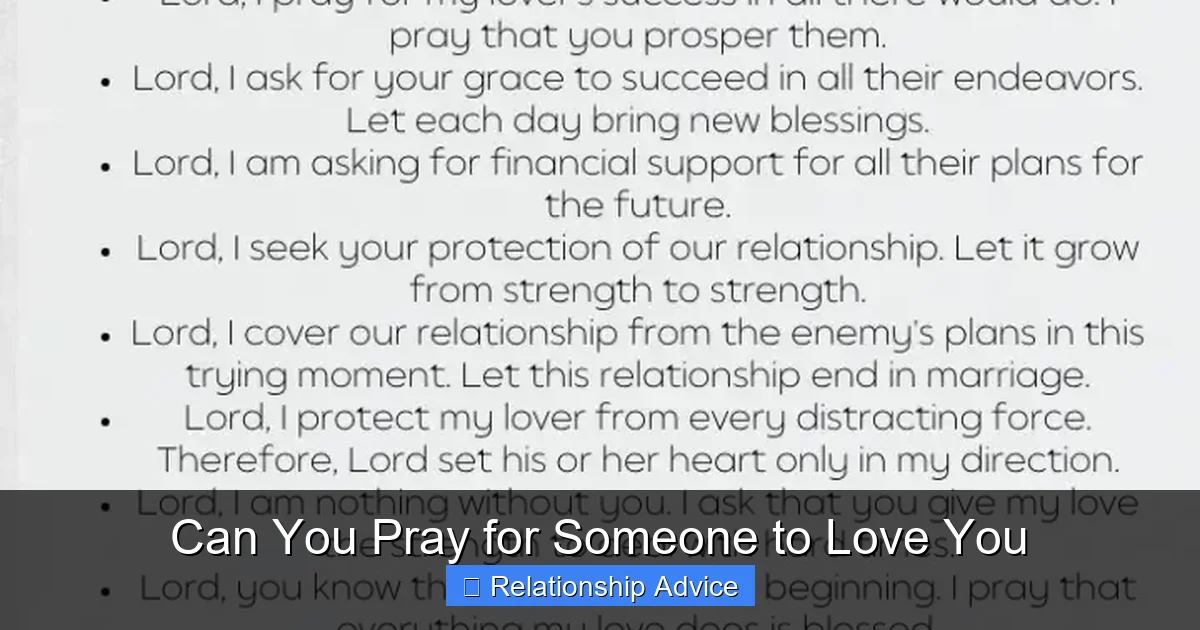
Visual guide about Can You Pray for Someone to Love You
Image source: faithfulchristian.net
Start with Gratitude
Before you ask for anything, begin by thanking your higher power (or the universe, or life itself) for what’s already good. Maybe you’ve met someone kind. Maybe you’ve experienced joy today. Maybe you’re safe, fed, and loved by someone.
Gratitude shifts your energy from lack to abundance. And abundance creates space for real love—not the kind that depends on another person’s approval, but the kind that flows freely because you’re whole on your own.
Try this simple prayer:
“Thank you for the love I already have. Thank you for guiding me toward people who honor me. Help me open my heart without closing it off to myself.”
Notice how this isn’t about fixing someone else—it’s about honoring your own journey.
Acknowledge Your Feelings Without Clinging
It’s okay to admit: “I’m hurting. I miss them. I wish they loved me.” But don’t stop there. After naming your pain, add: “Help me release this attachment so I can heal.”
Clinging keeps you stuck. Letting go—even slightly—creates room for new chapters. You don’t have to forget the person; you just stop making their happiness your sole purpose.
For instance, Sarah prayed every night for months that her ex would come back. She wrote letters she never sent, replayed memories obsessively, and canceled plans whenever he posted on social media. One day, she realized she was praying less for his return and more for her own survival.
She started writing gratitude lists instead. She joined a hiking group. She volunteered at an animal shelter. Slowly, the ache faded—not because he changed his mind, but because she stopped depending on him to fix herself.
Ask for Guidance, Not Outcomes
Instead of praying, “Make him love me,” try: “Show me what I need to learn. Reveal who I’m meant to be with. Give me the courage to walk away if this isn’t right.”
This reframes prayer from a command to a conversation. It invites wisdom rather than interference. And often, the answer isn’t “yes, he’ll love you,” but “no, he won’t—but here’s someone better waiting for you.”
Internal Link Example: Signs God Doesn’t Want You To Give Up On Someone can help you discern whether persistence is love or stubbornness.
The Role of Free Will in Love
Why You Can’t Force Another Person’s Heart
Every human being has free will—the sacred right to choose their own path, including whom they love. Even if two people are spiritually aligned, drawn together by destiny, or share a profound bond, neither can force the other to act against their conscience.
Trying to bypass free will through prayer (or manipulation) usually backfires. People sense coercion. They pull away. Or worse, they stay out of pity or obligation—and that’s not real love.
Think of it like planting seeds. You can prepare the soil, water the plants, and pray for rain. But you can’t make the sun shine at midnight or stop the frost from coming. Nature follows its course.
Similarly, love follows its own rhythm. You can nurture it, but you can’t manufacture it.
What Happens When Free Will Meets Divine Timing?
Sometimes, prayer works—not because it changes someone’s mind, but because it changes *you*. You become calmer, clearer, more attractive. The universe then brings new opportunities into your orbit.
For example, Mark spent years praying for his high school sweetheart to realize she loved him. He sent poems, showed up at her door, even got her best friend to vouch for his loyalty. Nothing worked. Years later, after therapy and self-work, he met someone who adored him effortlessly. Turns out, he wasn’t wrong for loving her—he was just too young to receive what he needed.
His prayer hadn’t failed. It had redirected him.
Internal Link Example: Can A Man Learn To Love A Woman explores how personal growth impacts romantic compatibility.
Recognizing Unhealthy Patterns
If you find yourself praying constantly about the same person—or feeling crushed every time they’re near—you might be caught in a pattern of obsession. This isn’t healthy love; it’s codependency wrapped in spirituality.
Ask yourself:
– Do I feel anxious when I’m not thinking about this person?
– Have I stopped pursuing my dreams because I’m waiting for them?
– Would I still care if I knew they were happy with someone else?
If answers lean negative, consider talking to a therapist. Spiritual practices like prayer work best alongside professional support when dealing with deep emotional wounds.
Internal Link Example: How To Stop Begging Someone To Love You offers practical steps to break free from emotional dependency.
When Not to Pray for Someone to Love You
They’re Already Committed
If someone is in a relationship—married, dating, engaged—praying for them to leave or betray their partner crosses ethical lines. Real love respects boundaries. It honors others’ choices.
Instead, pray for their happiness. Pray that they find joy, peace, and fulfillment—even if it’s not with you. This kind of selfless prayer actually brings blessings, because it reflects maturity and grace.
You’re Using Prayer to Avoid Responsibility
Some people pray so intensely because they’re avoiding hard work. They’d rather wait for divine intervention than build confidence, improve communication skills, or face rejection with dignity.
But growth happens in action, not in silence. Praying is great—but it pairs best with doing. Attend workshops. Read books. Work on your goals. Show up as your best self. Then, when love arrives, it’ll be because you’re ready—not because you begged.
Your Pain Is Too Fresh
Grief takes time. If you’ve recently been rejected, lost a relationship, or experienced heartbreak, give yourself permission to mourn. Praying for someone to love you too soon might mean you’re still tangled in old emotions.
Wait until you feel grounded. Until you’ve processed the loss. Until you can look back without flinching. Only then will your prayers carry wisdom, not sorrow.
Internal Link Example: How To Unlove Someone You Love The Most walks you through the stages of releasing attachment.
Building Self-Love as a Foundation for Real Connection
Why Self-Worth Matters More Than Approval
People who feel unworthy often pray desperately for love because they believe they don’t deserve it unless someone proves otherwise. But real love isn’t conditional. It’s not earned through performance or desperation.
When you love yourself fully—flaws and all—you stop chasing validation. You become magnetic. Others notice your stability, your humor, your kindness. And when they do, they’re drawn to *you*, not to your neediness.
Self-love isn’t selfish. It’s essential. Without it, every relationship becomes a battle for attention, a test of your worthiness. With it, relationships thrive because both people show up as their authentic selves.
Practical Ways to Cultivate Self-Love
– **Set boundaries**: Say no when you’re tired. Protect your time and energy.
– **Practice affirmations**: Repeat daily: “I am worthy of love. I am enough.”
– **Do things you enjoy**: Paint, dance, cook, hike—whatever lights you up.
– **Surround yourself with supporters**: Spend time with people who lift you up.
– **Forgive yourself**: Everyone makes mistakes. Don’t punish yourself for past choices.
Internal Link Example: Don’t Marry Someone Until You Can Honestly Answer These Questions includes exercises to assess your readiness for committed love.
Love Attracts Love
When you radiate confidence, joy, and peace, you create a frequency that attracts similar energy. You might not meet “the one” tomorrow—but you’ll cross paths with someone who appreciates your glow. And that’s how real connections form.
Remember: You don’t need permission to be loved. You don’t need proof that you matter. You matter simply because you exist.
Finding Peace Regardless of the Outcome
Acceptance as Freedom
True peace comes not from getting what you want, but from accepting what is. When you stop fighting reality, you reclaim your power. You’re no longer a prisoner of hope or fear. You’re free to live.
Acceptance doesn’t mean giving up. It means acknowledging the truth: some doors close so others can open. Some people leave so you can grow into your full potential.
Internal Link Example: Can You Find Love After 50 shows that love isn’t limited by age, timing, or past hurts.
Loving Yourself Enough to Let Go
The hardest part of letting go is realizing you were strong enough to hold on—and now you’re strong enough to release. It’s not weakness. It’s wisdom.
Imagine holding onto a balloon filled with helium. At first, it lifts you. But eventually, it pulls you down, cuts off your breath, and drags you into traffic. Letting go isn’t surrender—it’s survival.
When you love yourself enough, you choose freedom over fear. You choose health over habit. You choose joy over obligation.
Creating New Beginnings
After heartbreak, many people assume their story is over. But endings are just setups for new chapters. Maybe this person wasn’t the right match. Maybe they were a teacher, not a partner. Maybe they helped you understand what you truly want.
Use this time to rediscover yourself. Travel. Learn a language. Start a business. Adopt a pet. Fall in love with your own company.
And when you do pray again—for love, for clarity, for healing—do it from a place of wholeness. Not emptiness. Not desperation. Wholeness.
Final Thoughts: Prayer as a Path, Not a Prize
Can you pray for someone to love you? Absolutely. But remember: the goal isn’t to win them back. The goal is to transform your heart so you can recognize real love when it walks in.
Prayer won’t force love. But it can soften your spirit. It can quiet your fears. It can guide you toward people who see your value—and treat you kindly because of it.
And if that person isn’t the one you pictured? That’s okay too. Because sometimes, the greatest gift of all is learning to love yourself so completely that you no longer need anyone else to complete you.
Love isn’t found in another person’s arms. It’s built—day by day—in the quiet moments of self-respect, self-care, and self-belief.
So pray. But also act. Pray. But also heal. Pray. But also grow.
That’s how you attract love that lasts.
Frequently Asked Questions
Can prayer change someone’s feelings about me?
Prayer cannot force another person to love you. Human hearts operate through free will, not divine commands. However, prayer can shift your mindset, helping you heal and grow—making you more open to genuine connections.
Is it wrong to pray for someone who is already in a relationship?
Yes, praying for someone to abandon their current partner crosses ethical boundaries. Instead, pray for their happiness and for wisdom to respect their choices. Selfless intentions yield inner peace.
How long should I pray for someone to love me?
If you’ve prayed sincerely for weeks or months and see no change, consider whether the relationship serves your highest good. Persistent prayer without action may indicate unresolved attachment.
Should I stop praying if they don’t love me back?
No—but reframe your prayers. Shift from “Make them love me” to “Help me release this attachment” or “Reveal who I’m meant to be with.” Focus on your healing, not their response.
Does God answer prayers about love?
Answers come in many forms: inner peace, clarity, new opportunities, or simply the courage to move on. Sometimes “no” means “not yet,” “not this person,” or “not now.” Trust the process.
Can I pray for myself to become lovable?
Absolutely. Pray for self-awareness, confidence, and kindness. But remember: you’re already lovable just as you are. True worth isn’t earned—it’s inherent.
