
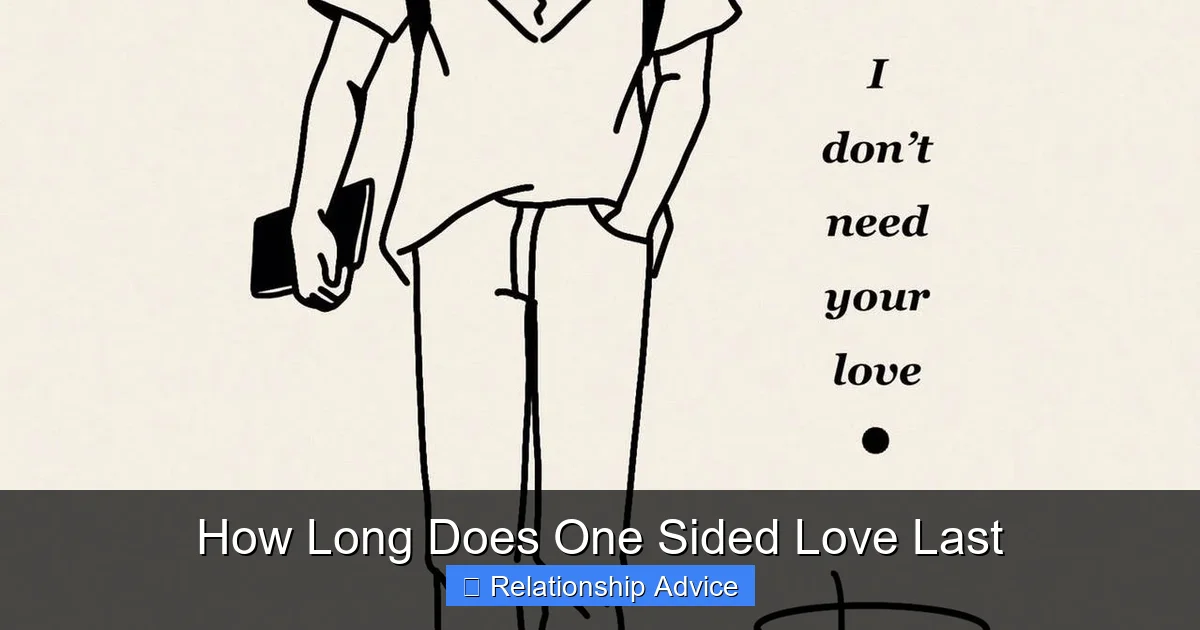
One sided love rarely lasts forever—but how long it lingers depends on emotional investment, hope, and self-awareness. While some move on in months, others carry unrequited feelings for years without realizing it’s time to let go.
Have you ever found yourself replaying a text message over and over, wondering if that tiny “:)” meant something more? Or maybe you’ve caught yourself smiling at a memory of them laughing at your joke—only to remember they’ve never once said “I love you” back? That’s the quiet ache of one sided love: a feeling so real to you, yet completely unseen by the other person.
It’s not about grand gestures or dramatic declarations. Sometimes, it’s the little things—the way they remember your coffee order, how they light up when you walk into a room (or so you think), or how they confide in you about their day. You build entire futures in your mind based on fragments of attention, mistaking kindness for affection and proximity for promise. And when reality doesn’t match the fantasy? The disappointment cuts deep.
But here’s the truth most people avoid saying out loud: **one sided love doesn’t last forever—but it can feel like it does**. The emotional toll, the sleepless nights, the constant overanalysis—it all adds up. So how long does one sided love actually last? The answer isn’t simple, because it depends on you, them, and the invisible threads of hope that keep you tethered. In this article, we’ll explore the timeline of unrequited love, why it lingers, and most importantly, how to finally let go.
Key Takeaways
- One sided love often fades within 6–18 months: Most people begin to heal and detach after this period, especially when there’s no reciprocation or hope of change.
- Emotional attachment prolongs the pain: The deeper your emotional investment, the longer it may take to release feelings—even if logically you know it’s not working.
- Hope is the biggest barrier to moving on: Believing “they might change” or “things could get better” keeps you stuck far longer than necessary.
- Self-worth plays a critical role: People with strong self-esteem recognize unreciprocated love faster and are more likely to walk away sooner.
- External validation fuels the cycle: Occasional kindness or mixed signals from the other person can reignite hope and extend the emotional limbo.
- Healing requires action, not just time: Passive waiting rarely works—active steps like setting boundaries, therapy, or new experiences speed up recovery.
- It’s okay to grieve—but don’t romanticize: Acknowledge the loss, but avoid idealizing the person or relationship that never truly existed.
📑 Table of Contents
Understanding One Sided Love: What It Really Means
Before we dive into timelines, let’s get clear on what one sided love actually is. It’s not just liking someone who doesn’t like you back. It’s investing emotionally in a relationship that isn’t mutual. You care deeply, maybe even love them, but they don’t return that depth of feeling—or worse, they’re unaware of it entirely.
One sided love often starts subtly. Maybe you’re friends, coworkers, or acquaintances who share a spark of connection. You laugh together, text often, and feel a sense of closeness. But over time, you notice the imbalance: you’re always the one initiating plans, you’re the one remembering birthdays, you’re the one hoping for more. Meanwhile, they remain emotionally distant, inconsistent, or openly involved with someone else.
The Emotional Hallmarks of Unrequited Love
So how do you know if you’re in one sided love? Look for these common signs:
- You’re always waiting: You check your phone constantly, hoping for a message. You rearrange your schedule to be near them. You’re always the one reaching out first.
- You overanalyze everything: A delayed reply feels like rejection. A casual compliment feels like a confession. You read between the lines of every interaction.
- You idealize them: You focus on their best qualities and ignore red flags. You tell yourself, “If only they knew how I felt, they’d feel the same.”
- You feel emotionally drained: The constant hope and disappointment leave you exhausted. You feel anxious, sad, or even angry—but you can’t stop caring.
- You avoid talking about it: You don’t tell friends how you really feel because you’re afraid of sounding “too much” or “clingy.”
These aren’t signs of weakness—they’re signs of deep emotional investment. But they’re also warning lights. One sided love thrives in ambiguity, and the longer it goes on, the harder it becomes to see clearly.
The Timeline: How Long Does One Sided Love Last?
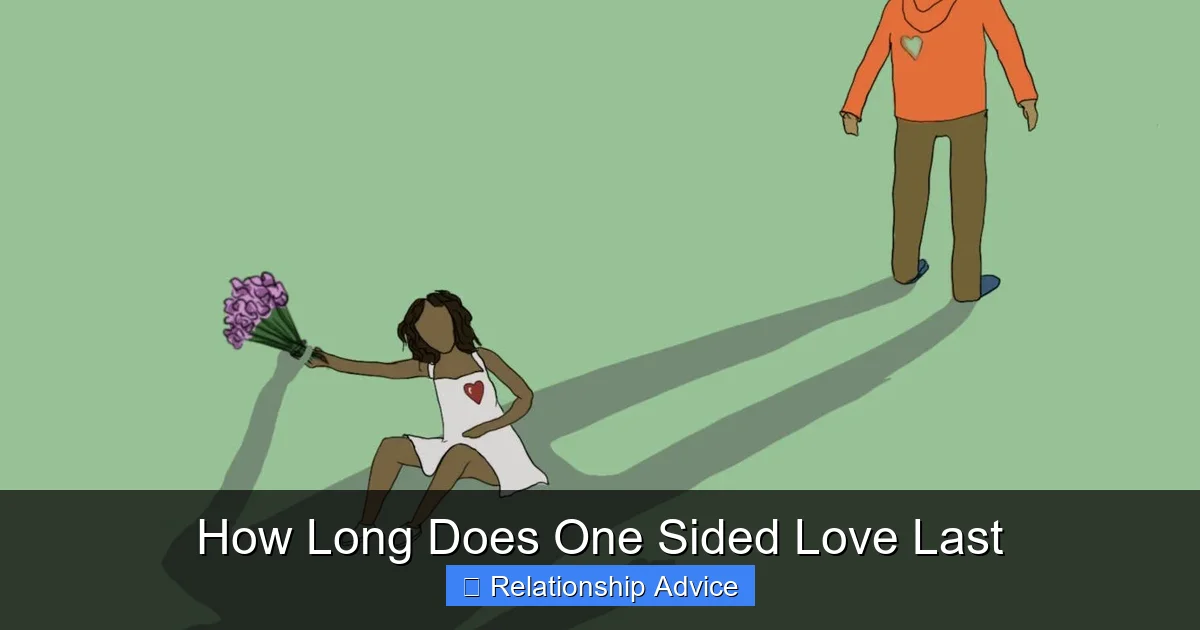
Visual guide about How Long Does One Sided Love Last
Image source: wallpapers.com
Now for the big question: how long does one sided love last? The answer varies, but research and psychology offer some general patterns.
On average, **most people begin to move on from unrequited love within 6 to 18 months**. This timeline isn’t set in stone—it depends on factors like how long you’ve known the person, how intense your feelings are, and whether there’s any chance of reciprocation.
Short-Term One Sided Love (Under 6 Months)
If your feelings developed quickly—say, after a few weeks of intense connection—then one sided love might fade relatively fast. In these cases, the emotional bond hasn’t had time to deepen, and the absence of reciprocation is clearer.
For example, imagine you met someone at a conference. You talked for hours, exchanged numbers, and texted nonstop for two weeks. But then they stopped replying. You might feel hurt, but after a month or two, the intensity fades. You realize it was more about the excitement of connection than real love.
In these situations, the timeline is shorter because the foundation was shallow. Without shared history or deep emotional intimacy, it’s easier to let go.
Medium-Term One Sided Love (6–18 Months)
This is the most common timeframe for one sided love. You’ve known the person for a while—maybe you’re coworkers, classmates, or long-time friends. You’ve shared personal stories, supported each other through tough times, and built a real connection. But somewhere along the way, you realized your feelings weren’t returned.
This phase is tricky because the emotional bond is strong. You care about them deeply, and you might still hope they’ll “come around.” You tell yourself, “Maybe they’re just not ready,” or “They’ll see how great we are together.”
But hope is a powerful trap. It keeps you checking your phone, replaying conversations, and imagining future scenarios. And because the person may still be kind or friendly, you misinterpret their actions as signs of interest.
In this stage, one sided love can last anywhere from several months to over a year. The longer you wait, the more you invest—and the harder it becomes to walk away.
Long-Term One Sided Love (Over 18 Months)
When one sided love lasts more than a year and a half, it often becomes a pattern—not just a phase. This usually happens when:
- The person gives occasional mixed signals (e.g., flirting one day, pulling away the next)
- You’re afraid of losing the friendship or connection entirely
- You have low self-worth and believe you don’t deserve better
- You’re isolated or lack other meaningful relationships
In these cases, one sided love can drag on for years. I’ve spoken to people who carried feelings for someone for 3, 5, even 10 years—without ever being honest about it. They’d attend their weddings, comfort them through breakups, and still hope for a miracle.
But here’s the hard truth: **if someone hasn’t reciprocated your feelings after 18 months, they probably never will**. Love doesn’t hide that long. If they cared the way you do, they’d show it—not just in moments of convenience, but consistently.
Why One Sided Love Lingers: The Psychology Behind the Pain
Visual guide about How Long Does One Sided Love Last
Image source: wallpapers.com
So why does one sided love last so long, even when it’s clearly not working? It’s not just about the other person—it’s about how your brain and emotions are wired.
The Role of Dopamine and Attachment
When you’re in love—even unrequited love—your brain releases dopamine, the “feel-good” chemical. Every text, every smile, every moment of attention triggers a small reward. Over time, your brain starts to crave that dopamine hit, making you seek out more contact, even if it’s inconsistent.
This is similar to how addiction works. You don’t need constant validation—you just need enough to keep you hooked. A delayed reply followed by a sudden “Hey, miss you!” can be more addictive than steady affection.
Additionally, if you have an anxious attachment style, you’re more likely to cling to one sided love. You fear abandonment, so you tolerate imbalance because any connection feels better than none.
The Fantasy Factor
One sided love often lives in your imagination more than in reality. You create a version of the person—and the relationship—that doesn’t actually exist. You imagine how they’d be as a partner, how they’d treat you, how happy you’d be together.
This fantasy becomes a comfort. It gives you something to hold onto when real-life interactions fall short. But it also prevents you from seeing the truth: the person you love may not even know you exist in that way.
Fear of Loss and the Sunk Cost Fallacy
Another reason one sided love lasts so long? Fear. You’re afraid that if you stop hoping, you’ll lose them completely. You’ve invested so much time, energy, and emotion—walking away feels like admitting it was all for nothing.
This is the sunk cost fallacy: the idea that because you’ve already invested, you should keep going. But in love, that logic doesn’t apply. Staying in a one sided relationship doesn’t recover your past investment—it just costs you more.
Signs It’s Time to Let Go
Visual guide about How Long Does One Sided Love Last
Image source: wallpapers.com
Knowing how long one sided love lasts is one thing. Knowing when to let go is another. Here are clear signs it’s time to move on:
- You’re always the one initiating: If you’re the only one texting, calling, or making plans, it’s not mutual.
- They don’t remember important things about you: Birthdays, allergies, your dog’s name—small details show care.
- They’re dating someone else: If they’re in a relationship and haven’t acknowledged your feelings, it’s over.
- You feel worse after talking to them: Instead of feeling uplifted, you leave conversations feeling drained or rejected.
- You’ve asked for clarity and got none: If you’ve expressed your feelings and they’ve avoided answering, that’s your answer.
- You’re changing who you are to impress them: You’re not being authentic—you’re performing.
Letting go doesn’t mean you didn’t care. It means you care enough about yourself to stop waiting for someone who isn’t coming.
How to Heal and Move Forward
Healing from one sided love takes time, but it’s possible. Here’s how to start:
1. Acknowledge Your Feelings
Don’t suppress your emotions. It’s okay to feel sad, angry, or confused. Journal about it. Talk to a trusted friend. Say it out loud: “I loved them, and they didn’t love me back.” Naming it helps you process it.
2. Create Distance
This is crucial. Unfollow them on social media. Mute their notifications. Avoid places you know they’ll be. Distance reduces temptation and gives your brain space to heal.
3. Focus on Yourself
Reinvest in your own life. Take up a hobby, start exercising, learn something new. When you focus on your growth, you stop waiting for external validation.
4. Challenge Your Thoughts
When you catch yourself thinking, “Maybe they’ll change,” ask: “What evidence do I have?” Replace fantasy with facts. Remind yourself: “They haven’t shown interest in two years. That’s not going to change.”
5. Seek Support
Talk to a therapist or join a support group. You’re not alone—many people have been through this. Professional guidance can help you break the cycle and rebuild your self-worth.
6. Allow Yourself to Grieve
One sided love is a real loss. You’re mourning a relationship that never was. Give yourself permission to grieve—but don’t romanticize it. This wasn’t love. It was longing.
Final Thoughts: Love Should Never Be a One-Way Street
So, how long does one sided love last? For some, it’s a few months. For others, it’s years. But no matter the timeline, the truth remains: **love should never be a one-way street**.
You deserve someone who sees you, values you, and chooses you—not someone you have to convince, chase, or hope for. One sided love teaches us about longing, patience, and the strength it takes to walk away. But it shouldn’t define your story.
Let this experience be a lesson, not a life sentence. Use it to grow, to understand yourself better, and to recognize what real, mutual love looks like. And when you’re ready, open your heart again—not to someone who makes you wait, but to someone who meets you halfway.
Because you’re not too much. You’re not unlovable. You’re just waiting for the right person to finally see you.
Frequently Asked Questions
Can one sided love ever turn into mutual love?
It’s rare, but not impossible. If the other person develops feelings over time and communicates them clearly, a relationship can grow. However, if there’s no sign of change after months or years, it’s unlikely—and waiting indefinitely isn’t healthy.
How do I stop thinking about someone who doesn’t love me back?
Focus on creating distance, redirecting your energy to hobbies or goals, and challenging obsessive thoughts. Replace “What if?” with “What’s next for me?” Over time, the mental loop will weaken.
Is it wrong to stay friends with someone I have feelings for?
It can be, especially if you’re not over them. Friendship requires emotional balance, and one sided love disrupts that. It’s often healthier to take a break until you’ve healed.
Why do I keep hoping they’ll change their mind?
Hope is a survival mechanism—it keeps you connected to the possibility of love. But real change requires action, not just time. If they haven’t shown interest, hope becomes a trap.
How long does it take to fully recover from unrequited love?
Most people feel significantly better within 3–6 months of taking active steps to heal. Full emotional recovery can take up to a year, depending on the depth of attachment and support systems.
Should I tell them how I feel?
If it brings closure, yes—but only if you’re prepared for any response. Be honest, but don’t expect them to reciprocate. The goal is clarity, not conversion.
