
Begging for love erodes self-respect and rarely leads to genuine connection. This guide helps you break the cycle, rebuild confidence, and attract love that’s freely given—not demanded.
Key Takeaways
- Recognize the signs of emotional dependency: Constantly seeking validation, ignoring red flags, or sacrificing your needs are clear indicators you’re begging for love.
- Understand why you’re doing it: Fear of abandonment, low self-worth, or past trauma often drive the need to beg for affection.
- Rebuild your self-worth: Shift focus from external validation to internal confidence through self-care, boundaries, and personal growth.
- Set and enforce healthy boundaries: Saying “no” and walking away from one-sided relationships protects your emotional well-being.
- Practice emotional detachment: Detaching doesn’t mean you stop caring—it means you stop letting someone else’s actions control your peace.
- Focus on self-love first: When you love yourself fully, you stop needing others to fill the void and start attracting balanced, reciprocal love.
- Seek support when needed: Therapy, coaching, or trusted friends can help you heal and break unhealthy patterns.
📑 Table of Contents
- Why Begging for Love Never Works—And Why It Hurts You
- Understanding the Root: Why Do We Beg for Love?
- Signs You’re Begging for Love (And Why It’s Time to Stop)
- How to Stop Begging for Love: A Step-by-Step Guide
- What to Do When You’re Tempted to Beg
- Attracting Love That Doesn’t Require Begging
- Conclusion: You Are Worthy of Love—Without Conditions
Why Begging for Love Never Works—And Why It Hurts You
Let’s be honest: there’s something deeply painful about feeling like you have to convince someone to love you. Maybe you’ve sent one too many texts after being ghosted. Maybe you’ve apologized for things you didn’t do just to keep the peace. Or maybe you’ve stayed in a relationship long after it stopped feeling good, hoping they’d finally “see” you.
You’re not alone. So many of us—especially those who’ve grown up in emotionally unpredictable environments—have learned to equate love with effort. We believe that if we just try harder, show up more, or prove our worth, someone will finally choose us. But here’s the hard truth: love that has to be begged for is not real love.
Real love is freely given. It’s not earned through desperation or performance. When you’re begging for love, you’re not just asking for affection—you’re asking someone to validate your existence. And that’s a burden no one should have to carry, least of all someone who isn’t willing to meet you halfway.
The good news? You can stop. You can break this cycle, heal the wounds that drive it, and start attracting relationships where love flows naturally—without begging, bargaining, or bargaining.
Understanding the Root: Why Do We Beg for Love?
Visual guide about How to Stop Begging Someone to Love You
Image source: quotefancy.com
Before we can stop begging for love, we need to understand why we started in the first place. This isn’t about blaming yourself. It’s about getting curious. What past experiences taught you that love is conditional? What messages did you absorb about your worth?
Childhood Wounds and Attachment Styles
Many of us carry emotional baggage from childhood that shapes how we relate to love as adults. If your parents were inconsistent—sometimes loving, sometimes distant—you may have learned that love has to be “won.” You might have developed an anxious attachment style, where you constantly seek reassurance and fear abandonment.
For example, imagine a child whose parent only showed affection after they got good grades or behaved perfectly. That child grows up believing love is earned through performance. As an adult, they might over-apologize, over-explain, or over-give in relationships, hoping to “earn” the love they crave.
On the flip side, if you grew up in a home where love was withheld or conditional, you might have developed a deep fear of rejection. This fear can make you cling to relationships that aren’t serving you, just to avoid being alone.
Low Self-Worth and the Need for External Validation
Another major driver of begging for love is low self-worth. When you don’t believe you’re inherently lovable, you look outside yourself for proof. You might think, “If this person loves me, then I must be worthy.” But that’s putting your sense of self in someone else’s hands—and that’s a dangerous game.
Think about it: if your worth depends on someone else’s approval, you’re always at their mercy. One cold text, one canceled date, one dismissive comment, and your entire sense of value crumbles. That’s not freedom. That’s emotional slavery.
Trauma Bonds and the Cycle of Hope
Sometimes, begging for love happens in the context of a trauma bond—a powerful, addictive connection formed through cycles of highs and lows. One day, your partner is loving and attentive. The next, they’re distant or hurtful. This unpredictability creates a dopamine-driven cycle, much like addiction.
You start clinging to the “good” moments, believing that if you just try harder, you can get back to that place of connection. But the truth is, the person who loves you doesn’t make you work for it. They show up consistently, not just when it’s convenient.
Signs You’re Begging for Love (And Why It’s Time to Stop)
Visual guide about How to Stop Begging Someone to Love You
Image source: media1.tenor.com
You might not realize you’re begging for love—especially if it’s become your normal. But there are clear signs. Ask yourself:
- Do I constantly check my phone, hoping for a text from them?
- Do I make excuses for their behavior (“They’re just busy,” “They’re stressed”)?
- Do I feel anxious or panicked when they don’t respond right away?
- Have I stopped doing things I enjoy just to be available for them?
- Do I feel like I’m walking on eggshells to avoid conflict?
- Do I feel more lonely when I’m with them than when I’m alone?
If you answered yes to any of these, you’re likely in a pattern of emotional dependency. And while it’s understandable, it’s also unsustainable.
The Emotional Cost of Begging
Begging for love doesn’t just affect your relationship—it affects your entire life. It drains your energy, lowers your self-esteem, and makes you feel powerless. Over time, you start to believe you’re not enough. You might even feel ashamed of how much you’re giving, which leads to resentment.
And here’s the kicker: the more you beg, the less likely you are to receive real love. Why? Because people are drawn to confidence, not desperation. When you’re constantly seeking validation, you signal that you don’t believe in your own worth—and that’s not attractive.
How to Stop Begging for Love: A Step-by-Step Guide
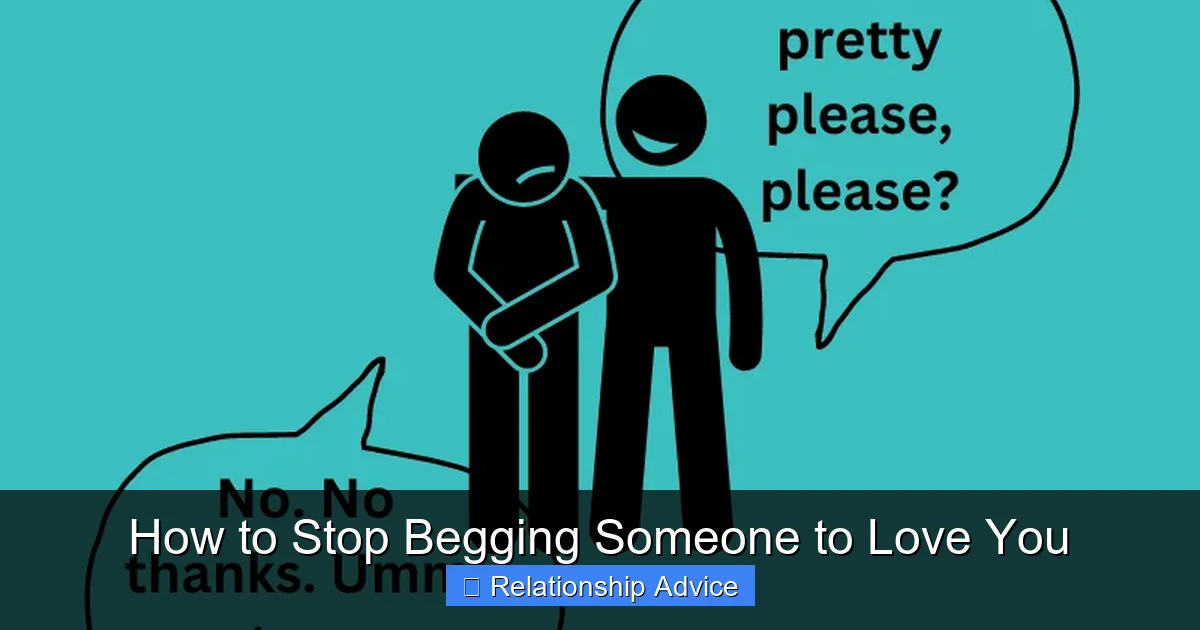
Visual guide about How to Stop Begging Someone to Love You
Image source: violenceprevention.utah.edu
Breaking the cycle of begging for love isn’t easy, but it’s absolutely possible. It starts with a shift in mindset: from “I need them to love me” to “I am worthy of love, with or without them.” Here’s how to make that shift.
Step 1: Acknowledge the Pattern
The first step is awareness. You can’t change what you don’t see. Take a honest look at your recent relationships. Have you been the one doing all the reaching out? The one apologizing first? The one compromising your values to keep the peace?
Write it down. Journal about how it feels. Acknowledge the pain, the hope, the fear. This isn’t about self-blame—it’s about clarity.
Step 2: Reconnect with Your Self-Worth
You are not your relationship status. You are not defined by whether someone chooses you. Your worth is inherent. It doesn’t depend on anyone else’s opinion.
Start small. Every day, do one thing that makes you feel good about yourself. It could be as simple as taking a walk, cooking a meal you enjoy, or saying a kind thing to yourself in the mirror.
Practice affirmations like:
- “I am enough, just as I am.”
- “I deserve love that is freely given.”
- “My worth does not depend on someone else’s approval.”
Over time, these words will sink in. They’ll replace the old, harmful beliefs that told you you had to earn love.
Step 3: Set and Enforce Boundaries
Boundaries are not walls—they’re guidelines for how you allow others to treat you. If someone isn’t showing up for you, it’s okay to say, “I can’t keep doing this.”
For example, if your partner consistently cancels plans last minute, you might say: “I value my time, and I need consistency. If you can’t commit, I’ll need to take a step back.”
And then—this is crucial—follow through. If they don’t change, give yourself permission to walk away. It’s not punishment. It’s self-respect.
Step 4: Practice Emotional Detachment
Detachment doesn’t mean you stop caring. It means you stop letting someone else’s actions control your emotional state.
When you feel the urge to text them “just to check in,” pause. Ask yourself: “Is this coming from love, or from fear?” If it’s fear, let it go.
Instead, redirect that energy. Call a friend. Go for a run. Write in your journal. The more you fill your life with things that bring you joy and peace, the less power this person has over you.
Step 5: Focus on Self-Love and Personal Growth
Love starts with you. When you’re full, you don’t need to beg for scraps. So invest in yourself.
Take a class. Start a hobby. Travel. Therapy. Read books on self-worth. The more you grow, the more confident you become—and the less you’ll tolerate one-sided love.
Remember: you’re not waiting for someone to complete you. You’re already whole.
What to Do When You’re Tempted to Beg
Even after you’ve done the work, there will be moments of weakness. Maybe they send a vague text. Maybe you see them with someone new. Your old patterns might resurface.
When that happens, have a plan.
Create a “Stop” Ritual
When you feel the urge to beg—to send that text, make that call, show up uninvited—pause. Do something that interrupts the impulse.
Try this:
- Put your phone in another room.
- Take 10 deep breaths.
- Say out loud: “I am not begging for love.”
- Write down what you’re feeling instead of acting on it.
This gives your brain a chance to switch from panic mode to rational mode.
Lean on Your Support System
You don’t have to do this alone. Call a trusted friend. Text your sister. Join a support group. Sometimes, just saying the words out loud—“I really want to text them right now”—can take the power out of the urge.
And if you’re struggling deeply, consider therapy. A professional can help you unpack the root causes and build healthier patterns.
Attracting Love That Doesn’t Require Begging
When you stop begging for love, something beautiful happens: you start attracting people who love you freely.
Why? Because confidence is magnetic. People are drawn to those who know their worth. They want to be around someone who is secure, kind, and self-assured.
And when you’re not desperate, you can actually see red flags. You can recognize when someone isn’t right for you—and walk away without guilt.
What Real Love Looks Like
Real love is:
- Consistent—not just when it’s convenient.
- Respectful—they honor your boundaries.
- Reciprocal—both people give and receive.
- Peaceful—you feel calm, not anxious.
- Free—no begging, no bargaining, no performance.
If your relationship doesn’t feel like this, it’s okay to leave. You’re not giving up. You’re choosing yourself.
Conclusion: You Are Worthy of Love—Without Conditions
Stopping the cycle of begging for love is one of the most empowering things you can do. It’s not about being cold or detached. It’s about reclaiming your power.
You are not broken. You are not unlovable. You are a whole, worthy human being—exactly as you are.
The love you’re seeking isn’t out there waiting for you to earn it. It’s already within you. And when you finally believe that, you’ll stop begging—and start attracting the kind of love that lifts you up, not tears you down.
So take a deep breath. Let go of the need to be chosen. Choose yourself. Love yourself. And watch as the right people—those who love you freely and fully—naturally find their way to you.
Frequently Asked Questions
Is it wrong to want someone to love you?
No, it’s completely human to want love and connection. The issue isn’t the desire—it’s when that desire turns into begging, sacrificing your worth, or staying in unhealthy dynamics just to feel chosen.
How do I know if I’m begging for love or just being caring?
If you’re constantly giving without receiving, ignoring your own needs, or feeling anxious when they don’t respond, you’re likely begging. Caring is mutual—begging is one-sided.
What if I’m afraid of being alone if I stop begging?
It’s normal to fear loneliness, but staying in a relationship out of fear isn’t love—it’s survival. True connection comes from choice, not desperation. Being alone can be healing and empowering.
Can someone change and start loving me without me begging?
People can change, but not because you beg them to. Real change comes from within them. If they’re not showing consistent effort, it’s unlikely to happen—no matter how much you try.
How long does it take to stop begging for love?
It depends on your history and commitment to healing. Some people notice shifts in weeks; others take months or years. Be patient. Progress, not perfection, is the goal.
Should I cut off all contact if I’m begging for love?
Not necessarily, but creating space—like taking a break or reducing contact—can help you gain clarity and rebuild your confidence. Sometimes distance is needed to heal.
