

Feeling unheard in your relationship? Instead of saying “you never listen,” try these compassionate, constructive alternatives that promote understanding and connection. This guide offers practical phrases and communication strategies to help you express your needs without blame, defensiveness, or resentment.
Key Takeaways
- Replace blame with “I” statements: Saying “I feel unheard” focuses on your emotions, not their behavior, reducing defensiveness.
- Be specific about what you need: Instead of general complaints, clearly state what listening looks like to you in the moment.
- Use time-sensitive language: Phrases like “right now” or “in this conversation” keep feedback current and actionable.
- Acknowledge their effort: Recognizing when your partner does listen builds goodwill and encourages repeat behavior.
- Ask for a pause when emotions run high: Suggesting a break prevents escalation and allows space for calm, productive dialogue.
- Focus on solutions, not faults: Shift the conversation toward how you can both improve communication together.
- Practice active listening yourself: Modeling good listening encourages reciprocity and mutual respect.
📑 Table of Contents
- Why “You Never Listen” Hurts More Than It Helps
- The Power of “I” Statements Over “You” Accusations
- Be Specific: What Does “Listening” Actually Look Like?
- Use Time-Sensitive Language to Keep Feedback Current
- Acknowledge the Good: Reinforce Positive Listening
- Ask for a Pause When Emotions Run High
- Focus on Solutions, Not Faults
- Model the Behavior You Want to See
- Conclusion: Communication Is a Practice, Not a Perfection
Why “You Never Listen” Hurts More Than It Helps
Let’s be honest—there’s a moment in almost every relationship when you feel like your words are bouncing off a wall. Maybe you’ve shared something important, and your partner zones out, changes the subject, or responds with a distracted “uh-huh.” In that instant, frustration builds. And before you know it, the words slip out: “You never listen to me!”
It’s a natural reaction. When we feel unseen or unheard, our instinct is to call out the other person’s behavior. But here’s the problem: “You never listen” is a sweeping, absolute statement. It’s not just about one conversation—it paints your partner as someone who *always* fails at listening. And that kind of language? It triggers defensiveness, shuts down dialogue, and often leads to arguments instead of understanding.
Think about it: when someone says, “You never listen,” how do you feel? Probably attacked. Maybe even unfairly judged. Even if there’s truth to the sentiment, the delivery makes it hard to hear. Your partner might respond with, “That’s not true! I listened last week when you told me about your day!” And just like that, the conversation shifts from your feelings to their rebuttal.
But what if there was a better way? What if you could express your hurt without making your partner feel like a failure? That’s where learning to say things instead of “you never listen” becomes a game-changer. It’s not about sugarcoating your emotions—it’s about communicating them in a way that invites connection, not conflict.
The Power of “I” Statements Over “You” Accusations

Visual guide about Things to Say Instead of You Never Listen
Image source: realestlove.com
One of the most effective communication tools in any relationship is the “I” statement. Instead of pointing a finger with “you never listen,” you shift the focus to your own experience. This small change in language can make a huge difference in how your message is received.
For example, instead of saying, “You never listen to me,” try:
“I feel unheard when I’m talking and you’re looking at your phone.”
Notice the difference? The first sentence blames. The second expresses a feeling and ties it to a specific behavior. It’s not an attack—it’s an invitation to understand your inner world.
“I” statements work because they reduce defensiveness. When you say “you,” your partner’s brain goes into protection mode. But when you say “I feel,” it’s harder to argue with someone’s emotions. After all, feelings aren’t right or wrong—they just *are*. And when your partner hears that you’re hurting, they’re more likely to respond with empathy than with anger.
Let’s look at a few more examples:
– Instead of: “You never listen when I talk about work.”
Try: “I feel frustrated when I share something about my job and don’t get a response.”
– Instead of: “You never pay attention to what I say.”
Try: “I feel like my thoughts aren’t being heard when I talk and you change the subject.”
– Instead of: “You never care about my feelings.”
Try: “I feel lonely when I share something personal and don’t feel acknowledged.”
These rephrased statements don’t minimize your feelings—they actually make them clearer. And because they’re framed around your experience, your partner is more likely to listen without feeling attacked.
How to Craft Effective “I” Statements
Creating strong “I” statements takes a little practice, but it’s worth it. Here’s a simple formula to follow:
“I feel [emotion] when [specific behavior] because [reason].”
Let’s break that down:
– Emotion: Name how you’re feeling—frustrated, sad, overlooked, anxious.
– Specific behavior: Describe what your partner did (or didn’t do) in concrete terms. Avoid generalizations like “you never” or “you always.”
– Reason: Explain why that behavior affects you. This helps your partner understand the impact.
For example:
“I feel hurt when you interrupt me during conversations because it makes me feel like my thoughts aren’t important.”
This statement is clear, specific, and focused on your experience—not your partner’s character. It opens the door for a conversation instead of shutting it down.
Be Specific: What Does “Listening” Actually Look Like?

Visual guide about Things to Say Instead of You Never Listen
Image source: cdn.boldomatic.com
One reason “you never listen” falls flat is that it’s vague. What does “listening” mean, anyway? Is it making eye contact? Nodding? Repeating back what you said? Offering advice? Just being quiet?
Everyone has a slightly different idea of what good listening looks like. And if you don’t clarify your expectations, your partner might think they’re listening—even when you feel otherwise.
So instead of assuming they should know, try being specific about what you need in the moment.
For example:
“I’d really appreciate it if you could put your phone down and look at me while I talk about this.”
Or: “Can you just listen without giving advice right now? I just need to vent.”
These requests are clear, actionable, and kind. They don’t accuse—they invite cooperation.
Examples of Specific Requests
Here are more ways to express your needs without blame:
– “I feel more connected when you ask follow-up questions about my day.”
– “It helps me feel heard when you summarize what I said before responding.”
– “I’d love it if we could have a 10-minute chat each evening where we both put our devices away.”
– “When I’m upset, I need a few minutes to talk it out before we problem-solve.”
Notice how each of these focuses on a concrete behavior and explains why it matters to you. This clarity reduces confusion and increases the chances your partner will respond positively.
Timing Matters: When to Bring It Up
Another key to effective communication is timing. If you wait until you’re already frustrated to bring up a listening issue, your partner might feel ambushed. Instead, try addressing it calmly and early.
For example, if you notice your partner often checks their phone during conversations, you might say:
“Hey, I’ve noticed that sometimes when we talk, you’re on your phone. I really value our conversations, and I feel more connected when we’re both fully present. Could we try putting our phones away during dinner?”
This approach is proactive, not reactive. It shows you’re thinking about the relationship, not just reacting to a moment of frustration.
Use Time-Sensitive Language to Keep Feedback Current
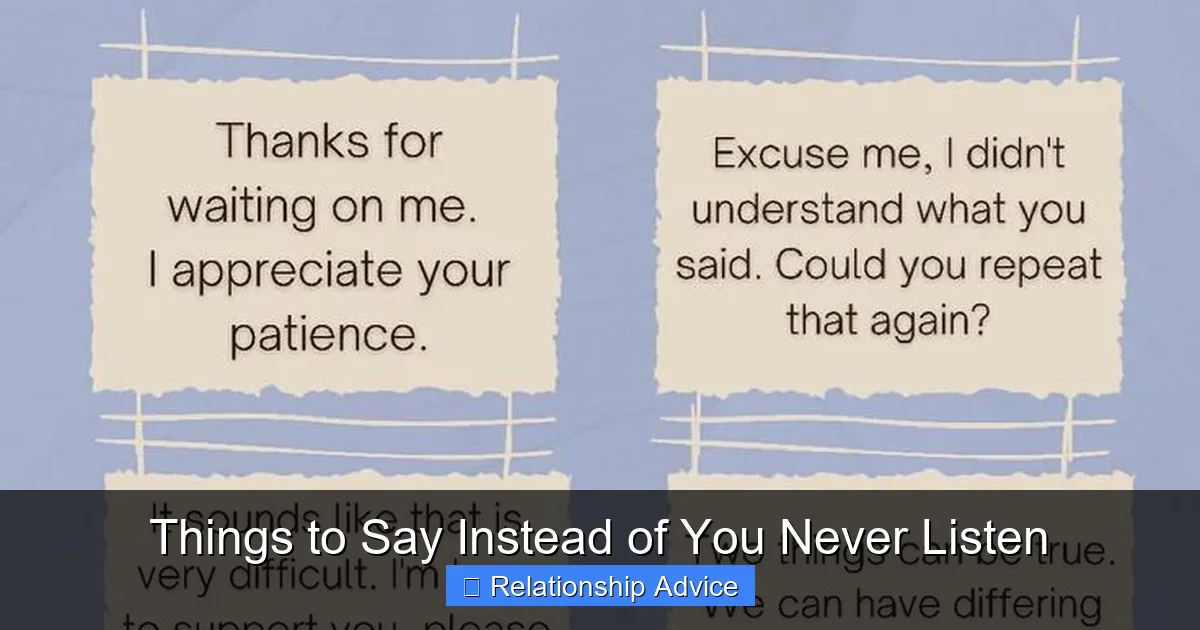
Visual guide about Things to Say Instead of You Never Listen
Image source: i.pinimg.com
One of the biggest problems with “you never listen” is that it’s absolute. Words like “never” and “always” make statements feel exaggerated—even when there’s truth behind them. And when people feel unfairly generalized, they’re more likely to shut down.
Instead, use time-sensitive language that keeps the focus on the present moment.
For example:
– Instead of: “You never listen to me.”
Try: “I’m having a hard time feeling heard in this conversation.”
– Instead of: “You always zone out when I talk.”
Try: “I noticed you looked away when I was sharing that story. Did you catch what I said?”
– Instead of: “You never care about my opinions.”
Try: “I felt a little dismissed when my idea wasn’t acknowledged earlier.”
These phrases are softer, more accurate, and less likely to provoke defensiveness. They also leave room for your partner to clarify or correct the situation.
Why “Right Now” Is More Powerful Than “Never”
Saying “I feel unheard right now” acknowledges that feelings can change. It doesn’t label your partner as a bad listener forever—it just names how you’re feeling in this moment. That makes it easier for your partner to respond with curiosity instead of guilt.
For example:
“I feel like I’m not being heard right now. Can we pause and talk about this?”
This opens the door for a reset. Your partner might say, “I’m sorry—I was distracted. What were you saying?” And just like that, the conversation can continue.
Acknowledge the Good: Reinforce Positive Listening
Let’s not forget: your partner probably *does* listen sometimes. Maybe they remembered your favorite coffee order, asked about your meeting, or listened patiently while you vented about a tough day.
When we only focus on the times they don’t listen, we create a skewed perception. And that can make your partner feel like nothing they do is ever good enough.
So instead of only pointing out the misses, make a point to acknowledge the hits.
Try saying:
“I really appreciated how you listened to me last night when I was stressed about work. It meant a lot.”
Or: “Thanks for asking about my day—it makes me feel cared for.”
These affirmations do two things: they reinforce positive behavior, and they build emotional safety. When your partner knows their efforts are seen and appreciated, they’re more likely to keep trying.
How Gratitude Improves Communication
Gratitude isn’t just polite—it’s powerful. Studies show that expressing appreciation in relationships increases satisfaction and connection. When you thank your partner for listening, you’re not just being nice—you’re teaching them what good listening looks like in your eyes.
And when they know what you value, they’re more likely to repeat it.
So the next time your partner gives you their full attention, don’t let it go unnoticed. A simple “thank you for listening” or “I really felt heard just now” can go a long way.
Ask for a Pause When Emotions Run High
Even with the best intentions, sometimes emotions flare. Maybe you’re tired, stressed, or already upset about something else. In those moments, trying to have a deep conversation about listening can backfire.
Instead of pushing through, try asking for a pause.
You might say:
“I’m feeling really overwhelmed right now, and I don’t want to say something I’ll regret. Can we take a break and come back to this in an hour?”
Or:
“I’m upset, and I need a few minutes to calm down before we talk. Is that okay?”
This shows emotional maturity. You’re not avoiding the issue—you’re protecting the conversation. And when you return, you’re more likely to speak calmly and clearly.
How to Re-Enter the Conversation
After a pause, it’s important to circle back. Don’t let the issue fester. When you’re ready, say something like:
“Hey, I wanted to come back to what we were talking about earlier. I felt unheard when you interrupted me, and I’d like to share why that matters to me.”
This keeps the focus on your feelings and invites your partner into the conversation—without blame.
Focus on Solutions, Not Faults
At the heart of every communication struggle is a desire to be understood. But too often, we get stuck in the cycle of blame: “You never listen,” “Well, you never ask questions,” “You’re always on your phone!”
Instead of pointing fingers, try shifting the conversation toward solutions.
Ask:
“How can we both do better at listening to each other?”
Or: “What would help you feel more present when we talk?”
This turns the issue into a team effort. You’re not accusing—you’re collaborating.
Collaborative Communication Examples
Here are some ways to invite your partner into the solution:
– “I’ve noticed we both get distracted during conversations. What if we tried a ‘no phones’ rule during dinner?”
– “Sometimes I feel like I’m talking to a wall. Can we agree to check in with each other—like, ‘Did you hear what I just said?’”
– “I want to feel more connected. What’s one thing I can do to help you listen better? And what’s one thing you can do for me?”
These questions open the door for mutual growth. They show that you’re not just criticizing—you’re committed to improving the relationship together.
Model the Behavior You Want to See
Here’s a truth that’s easy to forget: communication is a two-way street. If you want your partner to listen better, consider how well *you* listen.
Are you giving them your full attention? Are you interrupting? Are you multitasking while they talk?
Sometimes, we hold our partners to standards we don’t meet ourselves. And that can create resentment on both sides.
So before you ask for better listening, take a moment to reflect:
– Do I put my phone down when my partner speaks?
– Do I ask follow-up questions?
– Do I wait for them to finish before responding?
Modeling good listening doesn’t mean you’re perfect—it means you’re willing to grow. And when your partner sees you making an effort, they’re more likely to do the same.
Practical Tips for Active Listening
Here are a few simple ways to become a better listener:
– Make eye contact: It shows you’re engaged.
– Nod or use small verbal cues: “Mhm,” “I see,” “Go on.”
– Paraphrase what they said: “So what you’re saying is…”
– Ask open-ended questions: “How did that make you feel?” or “What happened next?”
– Avoid interrupting: Let them finish their thought before you respond.
When you practice these habits, you’re not just improving your listening—you’re showing your partner what it looks like.
Conclusion: Communication Is a Practice, Not a Perfection
Let’s face it—no one listens perfectly all the time. We’re human. We get distracted, tired, and overwhelmed. And sometimes, despite our best efforts, we still miss the mark.
But that doesn’t mean we should give up. It means we should keep practicing.
Instead of saying “you never listen,” try these kinder, more constructive alternatives. Use “I” statements. Be specific. Acknowledge the good. Ask for pauses. Focus on solutions. And model the behavior you want to see.
These small shifts won’t fix everything overnight. But over time, they build trust, deepen connection, and create a relationship where both people feel heard.
Remember: communication isn’t about winning an argument. It’s about understanding each other. And sometimes, the most powerful thing you can say isn’t a criticism—it’s a request for connection.
So the next time you feel unheard, take a breath. Choose your words with care. And speak from the heart—not from frustration.
Because when you do, you’re not just saying something different.
You’re building something better.
Frequently Asked Questions
Why is “you never listen” so harmful in a relationship?
“You never listen” is harmful because it’s an absolute, blaming statement that attacks your partner’s character rather than addressing a specific behavior. It triggers defensiveness and shuts down meaningful conversation, making it harder to resolve the real issue.
How can I express that I feel unheard without sounding accusatory?
Use “I” statements that focus on your feelings and experiences, such as “I feel unheard when I’m talking and you’re on your phone.” This approach reduces blame and invites empathy, making it easier for your partner to respond constructively.
What if my partner says they are listening, but I still don’t feel heard?
Be specific about what “listening” means to you. For example, say, “I feel more connected when you ask follow-up questions” or “I need you to put your phone down while we talk.” Clear expectations help bridge the gap between intention and perception.
Is it okay to take a break during a difficult conversation?
Yes—taking a pause when emotions are high is a healthy communication strategy. Say something like, “I need a few minutes to calm down so we can talk about this respectfully.” Just be sure to return to the conversation later.
How can I encourage my partner to listen better without nagging?
Focus on positive reinforcement. Thank them when they do listen well, and invite collaboration by asking, “How can we both improve our communication?” This builds teamwork instead of criticism.
What if my partner still doesn’t change their listening habits?
If efforts to communicate kindly and clearly don’t lead to change, consider having a calm discussion about the impact of poor listening on your relationship. If needed, seek support from a couples counselor to improve communication skills together.
